IV glutathione delivers the body's primary intracellular antioxidant directly into the bloodstream, which can measurably raise circulating glutathione levels. What it does with that boost is where the story gets complicated: mental clarity and short-term skin brightening are commonly reported, while claims about durable skin lightening or infection prevention rest on thin clinical evidence. The FDA's 2026 advisory on contaminated compounded glutathione makes sourcing and clinician oversight the deciding factor in whether this therapy is worth the risk.
TL;DR:
- IV glutathione effectively raises blood levels and addresses absorption issues but lacks strong evidence for durable skin lightening, immunity, or detoxification benefits.
- Clinical data supports its use in liver enzyme reduction and chemotherapy support but remains limited for general wellness or cosmetic claims.
- Dosing protocols typically range from 600 mg to 2,400 mg per session, with higher doses reserved for specific clinical indications and monitored closely.
- Serious risks associated with improperly compounded or contaminated glutathione injections include severe skin reactions, infection, organ toxicity, and anaphylaxis, making sourcing critical.
- Suitable candidates are healthy adults seeking monitored antioxidant support, while pregnant individuals, those on chemotherapy, or with organ disease should avoid or consult a doctor before use.
Table of Contents
- What Is Glutathione IV Therapy and Why Choose IV Over Oral?
- Does the Evidence Support Skin, Immunity, and Detox Claims?
- What Are Typical Glutathione IV Dosing Protocols?
- What Are the Documented Risks of Glutathione IV Therapy?
- Who Is a Reasonable Candidate for Glutathione IV Therapy?
- What Should You Ask Before Booking a Glutathione IV Session?
- How a Reputable Clinic Should Run Glutathione IV Therapy
- A Balanced Take on Glutathione IV Therapy
- Ready to Try a Monitored Glutathione IV Session?
- Sources
- FAQ
What Is Glutathione IV Therapy and Why Choose IV Over Oral?
Glutathione is a small molecule built from three amino acids, cysteine, glutamate, and glycine, and it's the closest thing the human body has to a built-in antioxidant reserve. The liver makes it continuously, and nearly every cell relies on it to neutralize free radicals and reset oxidative damage before it accumulates. Clinical resources describe it as the body's principal intracellular antioxidant, with a secondary role supporting the liver's phase II detoxification pathways, the chemical step that helps convert fat-soluble toxins into forms the kidneys can flush out, according to WebMD's clinical summary.
Glutathione also plays a supporting role in immune cell function, since white blood cells rely on adequate intracellular antioxidant capacity to manage the oxidative burst they generate while fighting pathogens.
The problem with taking glutathione by mouth is straightforward biochemistry: stomach acid and digestive enzymes break the peptide bonds apart before much of it reaches the bloodstream intact. That's why oral and topical glutathione products, however well formulated, tend to raise blood levels only modestly compared to infusion. IV administration skips digestion entirely, delivering the compound straight into circulation, which is why clinics reach for glutathione IV drip or slow push protocols when the goal is a rapid, complete rise in circulating levels rather than a slow trickle.
A few points are worth holding onto before you go further:
- Glutathione's antioxidant activity is well documented at the cellular level, but that doesn't automatically translate into a specific, provable clinical outcome for every marketed use.
- IV delivery solves a real bioavailability problem; it does not, by itself, prove that raising blood glutathione fixes skin tone, boosts immunity, or reverses fatigue.
- Clinics typically position IV glutathione as a finishing addition to a broader infusion, administered as a slow push after a vitamin drip, according to Empire Medical Training's clinical guide.
The mechanism is credible. The leap from mechanism to guaranteed outcome is where most marketing claims overreach.
Does the Evidence Support Skin, Immunity, and Detox Claims?
Evidence strength varies wildly depending on which benefit you're chasing, and lumping them together is exactly how marketing pages mislead people. Breaking it down by outcome gives a much clearer picture of what's plausible versus what's aspirational.
Skin brightening. This is the most commercially hyped use of glutathione IV therapy, and also the one with the shakiest data. A narrative review found that some studies report transient skin-lightening effects, but the overall evidence base is weak, with small sample sizes, short follow-up periods, and inconsistent dosing across trials, according to a narrative review on glutathione and skin lightening. The mechanism, glutathione's proposed interference with melanin synthesis, is biologically plausible, but regulators and dermatology reviewers caution against treating glutathione iv for skin brightening as a proven cosmetic procedure. Consumer health resources echo that caution directly, discouraging cosmetic IV use given the combination of thin evidence and documented safety risk, per InCare's consumer safety review.
Immunity. The mechanistic case is solid, glutathione does support immune cell antioxidant capacity, but that's a long way from clinical proof that infusions prevent colds, flu, or other infections in otherwise healthy adults. No large, high-quality randomized trial has demonstrated that IV glutathione reduces infection rates in a general wellness population. If someone tells you an infusion will "boost your immune system" against a specific illness, that claim is running well ahead of the data.
Detox and liver support. This is where the evidence gets more interesting, and more specific. Randomized trials in patients with non-alcoholic fatty liver disease have shown reductions in liver enzyme markers with glutathione supplementation, and separate research has looked at whether it lowers the incidence of nerve damage (neuropathy) in patients receiving cisplatin chemotherapy, according to clinical trial data reviewed in Cureus. These are condition-specific findings in monitored medical settings, not blanket proof that a wellness-clinic drip will "detox" a healthy liver that's already functioning normally.
Energy, mental clarity, and athletic recovery. Much of this is anecdotal or observational. Clinical practice reports do note that patients frequently describe feeling sharper or more alert within the first few sessions, an effect that shows up early and consistently enough that clinicians treat it as a reasonable expectation, even though it hasn't been isolated in rigorous placebo-controlled trials.
Where the evidence actually stands: the strongest clinical data clusters around narrow, monitored uses, oncology supportive care and NAFLD liver enzyme reduction, while general wellness, skin, and immunity claims rely mostly on mechanistic reasoning and small or short-term studies.
Here's the pattern across nearly every outcome:
- Strong lab-level mechanism, weak-to-moderate clinical trial support for elective wellness uses.
- Condition-specific trials (liver disease, chemotherapy side effects) show more promise than general "detox" or "immunity boost" framing.
- Regulators and reviewers consistently flag the gap between plausible biology and proven results, especially for cosmetic use.
None of this means IV glutathione is worthless. It means the honest answer to "does it work?" depends entirely on which specific claim you're asking about.
What Are Typical Glutathione IV Dosing Protocols?
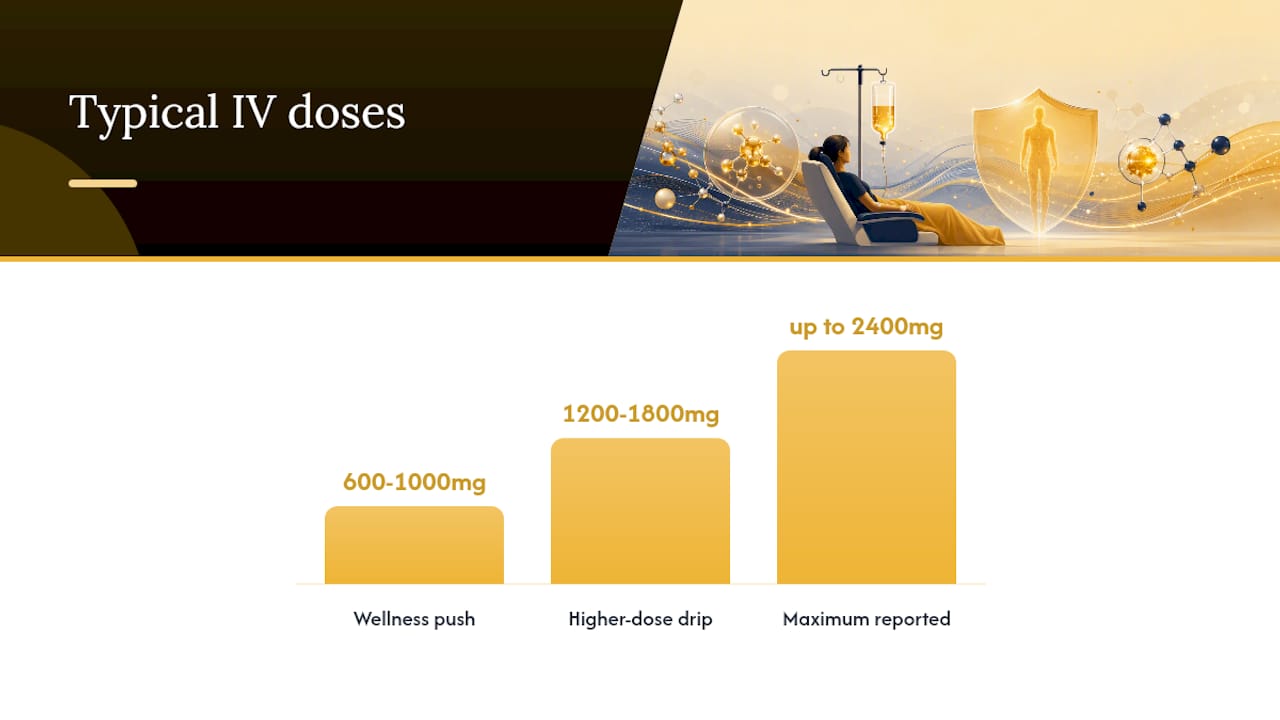
Clinical protocols generally fall into a predictable range, though the exact dose depends on whether the goal is general wellness support or a targeted clinical indication. Protocol sources describe dosing that typically runs from roughly 600 mg to 2,400 mg per session, according to clinical dosing protocols.
- Wellness-oriented IV push: Lower doses, generally in the 600 to 1,000 mg range, delivered as a slow push, often as the final step after a broader vitamin infusion.
- Higher-dose drip protocols: Doses from roughly 1,200 mg up to 1,800 mg or more, reserved for specific clinical indications and typically administered with closer monitoring.
- Induction phase: A short series of sessions, often weekly, to establish a baseline response before spacing treatments out.
- Maintenance phase: Less frequent sessions, sometimes monthly, once a patient's initial response has been assessed.
- Chemotherapy-adjacent timing: When glutathione is used near platinum-based chemotherapy agents like cisplatin, timing relative to the chemo infusion needs individualized clinical coordination, not a fixed formula.
Session length is usually short, a straight IV push can take just a few minutes, while a drip that includes glutathione alongside a Myers-type cocktail may run 30 to 45 minutes total.
On timeline, patients frequently report a subjective sense of mental clarity within the first one to three sessions, according to clinical practice observations from Empire Medical Training. Reported skin changes, when they occur at all, tend to show up later, often after four to eight sessions at higher doses, and even then the underlying evidence for lasting cosmetic change remains limited. Anyone promising instant, permanent skin lightening after one infusion isn't describing anything close to standard clinical experience.
What Are the Documented Risks of Glutathione IV Therapy?
The safety conversation changed meaningfully in 2026. The FDA issued an advisory reminding compounding pharmacies not to use dietary-supplement-grade glutathione in injectable products, after receiving reports tied to at least 30 adverse events, including fever, chills, sepsis-like symptoms, and hospitalizations, according to the FDA's compounding advisory. That's not a warning about the molecule itself so much as a warning about what happens when injectable-grade sterility standards get skipped.
That distinction matters for how you evaluate risk. The biggest real-world danger driver tends to be nonclinical: improper compounding, contaminated active pharmaceutical ingredient, and administration outside a properly regulated clinical setting, rather than glutathione itself causing harm when it's correctly sourced and administered.
Beyond the FDA's specific advisory, case reports and reviews in the literature document a broader spectrum of IV-specific harms:
- Severe skin reactions including Stevens-Johnson syndrome and toxic epidermal necrolysis (SJS/TEN).
- Hepatotoxicity (liver injury) and renal dysfunction in isolated case reports.
- Anaphylaxis and other acute infusion reactions.
- Infection or sepsis risk from contaminated product or poor IV technique.
- Rare but serious complications like air embolism when infusion technique is mishandled.
Reviews consistently note that injectable glutathione carries meaningfully more documented risk than oral or topical forms, precisely because it bypasses the body's normal absorption safeguards, according to a 2026 review of glutathione IV risks.
Pro Tip: Before your first session, ask the clinic directly where their glutathione is sourced and whether they can show a certificate of analysis (COA) from the compounding pharmacy. A clinic that hesitates to answer that question is telling you something.

If you experience fever, chills, difficulty breathing, chest pain, or a spreading rash after an infusion, treat it as an urgent medical situation, not something to wait out at home.
Who Is a Reasonable Candidate for Glutathione IV Therapy?
Reasonable candidates are generally healthy adults seeking monitored, occasional antioxidant support, or patients being treated within a specific evidence-backed indication under a physician's direction. This is not a universal fit, and certain situations call for real caution rather than a routine booking.
Contraindications and red flags worth taking seriously:
- Pregnancy or breastfeeding, where infusion therapies of this kind haven't been established as safe.
- Recent or planned platinum-based chemotherapy (like cisplatin) without explicit sign-off from the treating oncologist, since timing interactions matter.
- A history of severe allergic reactions to infusion therapies or their components.
- Uncontrolled hepatic or renal disease, since both organs are directly involved in processing and clearing the compound.
If any of those apply to you, or you're simply not ready to commit to injectable therapy, safer starting points exist. Oral glutathione and liposomal glutathione vs IV comparisons show liposomal formulations achieve somewhat better absorption than plain oral capsules, though still nowhere near IV bioavailability. N-acetylcysteine (NAC), a glutathione precursor, and dietary strategies that support the body's own production, like adequate protein and sulfur-rich vegetables, are lower-risk ways to support the same biochemical pathway without an infusion.
What Should You Ask Before Booking a Glutathione IV Session?
A short pre-appointment checklist protects you far more than any marketing claim on a clinic's website. Walk in prepared, and you'll get better answers.
- Bring a complete medical history, current medication list, and any known allergies to your first visit.
- Ask where the clinic sources its glutathione and whether they can provide a certificate of analysis from the compounding pharmacy.
- Confirm the credentials of the person administering the infusion, ideally a licensed nurse or physician, not unlicensed staff.
- Ask what monitoring happens during the infusion and what the clinic's emergency protocol looks like if you have a reaction.
- Decide in advance whether you're doing a single trial session to gauge tolerance, or committing to a multi-session course, and set that expectation with your provider.
Pro Tip: Hydrate well in the hours before your appointment, and avoid alcohol and NSAIDs immediately afterward, both can amplify dehydration or irritate the vein site, making post-infusion soreness worse than it needs to be.
On the day itself, expect a brief screening conversation, a monitored infusion lasting anywhere from a few minutes to 45 minutes depending on the protocol, and clear instructions on what symptoms warrant a call back to the clinic.
How a Reputable Clinic Should Run Glutathione IV Therapy
Vitaluxe Drip Lounge builds its IV vitamin therapy and glutathione infusion services around nurse-led oversight rather than self-service injection stations, which matters given the FDA's compounding concerns. Every infusion protocol should start with patient screening, documented sourcing for the active ingredient, and a clinician present for the entire session, not just the needle stick. Vitaluxe's broader lineup, including red light therapy and personalized peptide protocols, reflects a model built on cellular wellness and hydration rather than one-off cosmetic promises. That operational discipline, verified sourcing, licensed staff, and documented protocols, is the benchmark any clinic offering Glutathione IV therapy should be held to.
A Balanced Take on Glutathione IV Therapy
Glutathione's biochemistry checks out. It's a real antioxidant with a genuine role in liver detoxification and immune cell function, and IV delivery genuinely solves the absorption problem that limits oral forms. What doesn't check out, at least not yet, is the leap from that mechanism to guaranteed cosmetic or preventive results. If you're going to pursue this, do it through a clinician-led setting with verified, properly sourced product, and treat anything else, including DIY or unlicensed injection services, as a real risk rather than a shortcut. If you're on the fence, talk to a licensed provider about your specific situation before committing to a course.
— Debbie
Ready to Try a Monitored Glutathione IV Session?
Some clinics offer antioxidant support glutathione infusions with nurse-led staff in a boutique clinical setting, rather than self-serve kiosks.

If you're weighing a single trial session against ongoing support, the Essential membership at $205 per month gives you recurring access to therapies like this without booking each visit at full price, while the Elite plan at $415 per month covers heavier, more frequent use. For anyone who wants to combine glutathione with a broader Myers-type infusion or explore complementary options like NAD+ or High Dose Vit C, the full lineup is on the Vitaluxe services page. Book a session, ask your questions on sourcing and protocol upfront, and start with a single infusion to see how your body responds before committing to a longer course.
This article is general information, not a substitute for advice from a qualified doctor. Consult a qualified healthcare professional about your own circumstances before acting on anything here.
Sources
- FDA reminds compounders not to use dietary supplement grade glutathione for injectables | FDA
- Exploring the Safety and Efficacy of Glutathione Supplementation for Skin Lightening: A Narrative Review
- IV Glutathione Therapy: Clinical Uses, Dosing Protocols, and What to Expect
- Glutathione IV Therapy: A Clinical Guide
FAQ
Can Glutathione Reduce Belly Fat?
No solid clinical evidence supports glutathione, IV or otherwise, as a fat-loss or belly-fat-targeting treatment. Its documented roles are antioxidant support and phase II liver detoxification, not fat metabolism, so any weight-loss claim tied to a glutathione infusion should be treated skeptically.
What Is the Downside of Taking Glutathione IV?
The main downsides are safety-related rather than a lack of benefit. The FDA has documented at least 30 adverse events tied to improperly compounded injectable glutathione, ranging from fever and chills to sepsis-like symptoms, and separate reviews document rarer but serious risks like severe skin reactions and organ dysfunction.
How Long Does IV Glutathione Work?
Effects vary by outcome and aren't permanent from a single course. Subjective mental clarity is often reported within one to three sessions, while any skin-related changes typically require four to eight sessions and fade without continued maintenance dosing.
What Should You Avoid When Taking Glutathione IV?
Avoid unlicensed or unregulated providers, and always ask about the sourcing and certificate of analysis for the compounded product before your session, since contamination and non-sterile compounding are the primary documented risks. It's also wise to avoid alcohol and NSAIDs immediately after infusion and to disclose any planned chemotherapy, pregnancy, or significant allergy history to your provider beforehand.
Is Glutathione IV Safe for Regular Wellness Use?
It can be reasonably safe when administered by licensed clinical staff using properly sourced, sterile-compounded product, according to safety guidance from InCare. The safety profile depends heavily on sourcing and clinical oversight rather than the molecule itself, which is why choosing a nurse-led clinic matters more than the specific dose you choose.