IV therapy for energy works best as a targeted fix, not a routine boost. People with documented dehydration, a nutrient deficiency, or certain post-viral fatigue patterns tend to see real, if temporary, improvement. Healthy, well-nourished adults chasing an extra gear are betting on thin evidence and a strong placebo effect. Get basic labs and a clinician's opinion before booking an elective infusion.
TL;DR:
- Energy IV therapy offers real benefits mainly for those with dehydration or specific nutrient deficiencies confirmed by labs, not for healthy individuals seeking a boost.
- The most supported ingredient for short-term fatigue relief is high-dose vitamin C administered intravenously, especially in people with low baseline levels.
- The safety and effectiveness of IV therapy depend heavily on proper clinic protocols, accurate dosing, and thorough pre-treatment screening by licensed clinicians.
- Benefits from energy IV infusions typically last only a day or two unless underlying deficiencies are addressed through ongoing care.
- Oral supplements and foundational health practices remain safer, cheaper, and more effective for long-term energy management than elective infusions in well-nourished, healthy adults.
Table of Contents
- Typical Ingredients in Energy IV Drips and Why Delivery Matters
- What Do Clinical Trials Say About IV Therapy and Fatigue?
- Who Actually Benefits From Energy IV Drips?
- Is IV Therapy for Energy Safe? Side Effects to Know
- How Long Does an IV Energy Session Take, and What Does It Cost?
- How to Choose a Reputable IV Therapy Provider
- Regulatory Status and Guidelines for IV Therapy for Energy
- How Long Do the Energy Effects of IV Therapy Last?
- IV Therapy vs. Oral Supplements and Other Energy Fixes
- What Do Patients Typically Report After IV Energy Treatments?
- A Clinician-Minded Take on the Energy IV Trend
- Book an Energy-Focused IV Session at Vitaluxe Drip Lounge
- Sources
- FAQ
Typical Ingredients in Energy IV Drips and Why Delivery Matters
Most energy-focused IV formulas draw from a short list of ingredients, mixed and dosed differently depending on the clinic. Understanding what is actually in the bag matters more than the marketing name on the drip.
- Normal saline rehydrates and often accounts for the fastest-felt improvement, since dehydration alone causes measurable fatigue.
- B-complex vitamins (B12, B6) support the enzymatic steps that convert food into usable cellular energy.
- Magnesium plays a role in hundreds of metabolic reactions, including ATP production, and low levels are linked to tiredness and muscle cramping.
- Vitamin C in high doses is the ingredient with the most direct clinical trial support for short-term fatigue reduction.
- Electrolytes (potassium, sodium) correct imbalances that show up as sluggishness, especially after illness, heat exposure, or heavy exercise.
- NAD+ is marketed heavily for cognitive and energy claims, though the supporting trial data in healthy adults remains thin.
- Glutathione is positioned as an antioxidant "reset," more commonly tied to detox and skin claims than to energy specifically.
The reason IV delivery gets attention at all comes down to bioavailability. Oral supplements pass through the gut and liver before reaching the bloodstream, a process called first-pass metabolism that destroys or dilutes a meaningful percentage of most nutrients. IV infusion skips that step entirely, delivering nutrients straight into circulation. Vitamin C is the clearest example: oral doses saturate absorption fairly quickly, but IV administration pushes plasma concentrations to levels that are pharmacologically impossible to reach by mouth. That gap explains why researchers keep testing vitamin C as an IV agent specifically, rather than just recommending a bigger pill.
One caution worth knowing upfront: energy drip recipes are not standardized. A "Myers cocktail" at one clinic can differ meaningfully in dose and ratio from the same name at another. That variability is exactly why the credentials of the people mixing and administering your infusion matter as much as the ingredient list itself.
What Do Clinical Trials Say About IV Therapy and Fatigue?
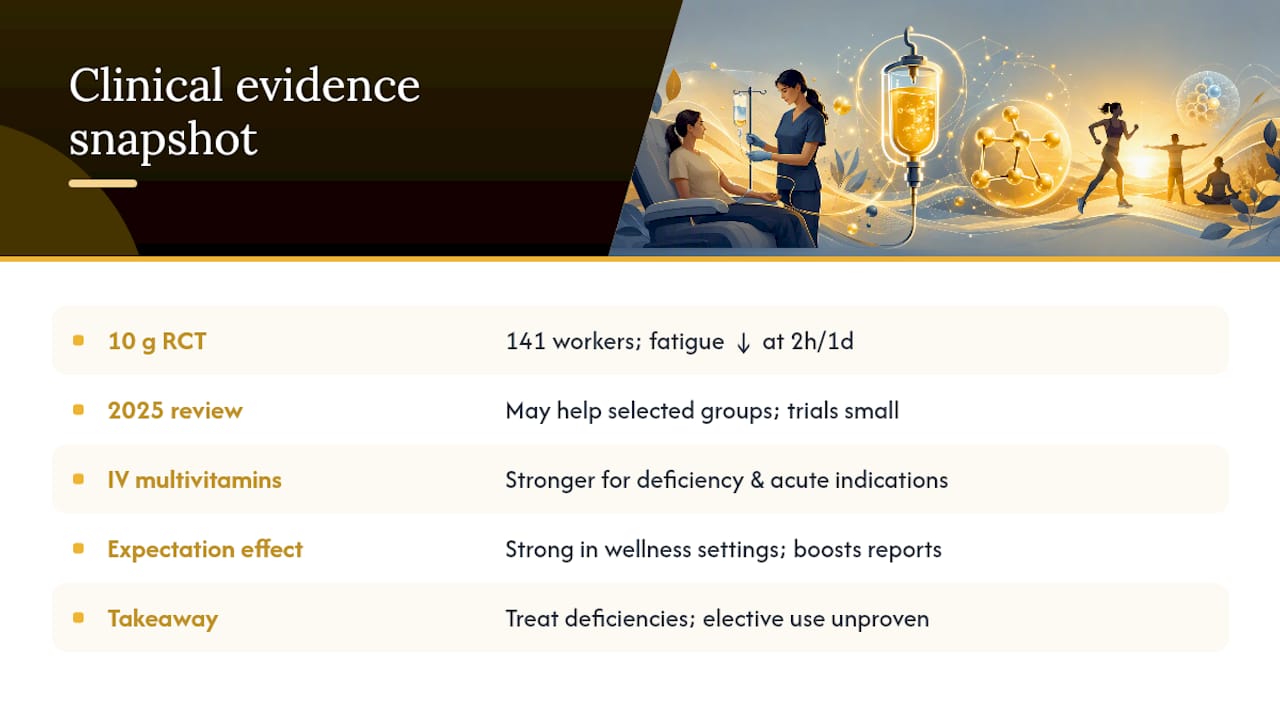
The strongest single piece of evidence for energy iv drip therapy is a randomized, double-blind trial of 141 healthy office workers given 10 grams of IV vitamin C in saline over 30 minutes. Fatigue scores dropped significantly at both the 2 hour and 1 day marks compared with placebo, and the effect was strongest among people who started with lower baseline vitamin C levels.
Participants receiving IV vitamin C reported measurably lower "fatigue right now" scores at 2 hours and again at 1 day after infusion, with the reduction most pronounced in those with lower starting vitamin C levels.
That is a genuinely useful data point, but it comes from one trial design, not a body of consistent replication. A 2025 systematic review looking at high-dose IV vitamin C concluded the approach may help fatigue in selected clinical populations, particularly post-viral and oncology-related fatigue, while flagging that most supporting studies are small and larger randomized trials are still needed.
The 10-gram IV vitamin C dose used in the office-worker trial produced a statistically significant fatigue reduction, one of the more rigorous data points in this entire field.
Separately, an analysis of IV multivitamin therapy found evidence is far stronger for targeted medical indications, like severe deficiency, malabsorption, or acute intoxication, than for general wellness use. That distinction runs through nearly every serious review of this therapy.
Wellness settings also carry an unusually strong expectation effect. Getting an IV, feeling the fluid enter your vein, and sitting in a calm clinic chair for 45 minutes primes people to report feeling better regardless of what's actually in the bag. Reviewers point to this as a reason blinded, placebo-controlled trials matter so much more here than in most areas of medicine. Put together, the honest reading of the evidence is this: targeted correction of a real deficiency or dehydration state has a defensible clinical basis. Elective use in someone with normal labs and adequate nutrition does not have the same footing yet.
Who Actually Benefits From Energy IV Drips?
Not everyone walks out of an infusion chair feeling the same lift, and the difference usually comes down to baseline nutritional status rather than willpower or hydration habits alone.
People more likely to notice a real effect include:
- Those with lab-confirmed low vitamin C or a diagnosed deficiency in B12, magnesium, or iron.
- Anyone with malabsorption issues (certain GI conditions) that limit how well oral nutrients are absorbed in the first place.
- People recovering from acute dehydration, whether from illness, heat, or heavy exertion.
- Selected post-viral fatigue or oncology-related fatigue cases, managed under a clinician's direction rather than as a stand-alone wellness visit.
- Iron-deficient patients specifically: a randomized trial of IV iron in iron-deficient, non-anemic women found a single infusion significantly reduced fatigue compared with placebo, even when hemoglobin looked normal on paper.
People less likely to see meaningful benefit are healthy adults with no measurable deficiency who are hoping for a competitive edge or a hangover fix. That group is exactly where the evidence is weakest and the placebo effect strongest.
Pro Tip: Ask for basic labs, not just a symptom checklist, before your first visit. A CBC, ferritin and iron panel, B12 level, and a comprehensive metabolic panel for kidney function take one blood draw and tell a clinician whether IV correction actually makes physiological sense for you.
A pregnancy test and a review of current medications round out a responsible pre-treatment workup, especially before iron or high-dose vitamin C infusions.
Is IV Therapy for Energy Safe? Side Effects to Know
Most people tolerate energy IV drips without incident, but "most people" is not the same as "no risk," and a reputable clinic should be upfront about both ends of that spectrum.
Common, mild reactions include bruising at the injection site, brief lightheadedness, and occasional nausea. Rarer but more serious risks include infection at the IV site, allergic reaction to an additive, vein inflammation (phlebitis), and electrolyte imbalances if a drip is dosed carelessly.
A too-rapid infusion rate is one of the most common preventable causes of nausea, dizziness, and general intolerance during treatment. Clinicians recommend slow, monitored infusion paces tailored to how a patient is responding in real time, not a fixed timer.
A few groups need extra caution:
- People with renal impairment should avoid high-dose vitamin C, since it's cleared through the kidneys and can strain compromised function.
- People with G6PD deficiency face a risk of severe hemolysis from high-dose vitamin C and should be screened before treatment.
- People with diabetes need dextrose-containing drips reviewed carefully, since sugar-based fluids can spike blood glucose.
- Iron infusions require monitoring for rare but serious allergic reactions, which is why they belong in a medically staffed setting, not a mobile pop-up.
Ask any provider directly about medical screening protocols, who is licensed to place the IV, whether monitoring continues throughout the infusion, and what their emergency response plan looks like. Mayo Clinic's guidance on IV vitamin therapy specifically flags these gaps as a reason to vet a provider's clinical rigor before assuming a wellness setting carries hospital-grade safety by default.
How Long Does an IV Energy Session Take, and What Does It Cost?
A typical energy drip takes 30 to 90 minutes, depending on volume and how fast your body tolerates the infusion rate. NAD+ and other specialty formulas often run longer, sometimes over 1 to 2 hours, because higher doses need to be given slowly to avoid discomfort.
- During the infusion: some people report feeling more alert or less foggy while the drip is still running, particularly with vitamin C or hydration-heavy formulas.
- Hours afterward: the office-worker trial's fatigue reduction was still measurable at the 1 day mark, suggesting effects for some ingredients extend well past the appointment itself.
- After a series: chronic fatigue, post-viral recovery, or ongoing deficiency correction usually call for repeat sessions over weeks rather than a single visit, since one infusion rarely resolves a standing nutritional gap.
Cost tracks closely with what's in the bag. Basic hydration and B-vitamin blends sit at the lower end, while NAD+ and antioxidant-heavy formulas cost more because the raw ingredients themselves are more expensive and require longer, slower administration. Clinic setting matters too. Mobile IV services and membership-based clinics price differently than a single walk-in session, and recurring memberships often work out cheaper per visit for people planning ongoing care rather than a one-off treatment.
How to Choose a Reputable IV Therapy Provider
The gap between a well-run clinic and a risky one usually isn't visible until something goes wrong, which is why the vetting has to happen before you sit in the chair.
Confirm these basics before booking:
- A licensed clinician (RN or MD) places the IV and supervises the visit, not an unsupervised technician.
- The clinic requires or offers pre-visit screening, even a brief health history and vitals check.
- Emergency equipment and protocols exist on-site in case of an allergic reaction.
- Ingredient amounts and doses are disclosed clearly, not hidden behind a proprietary blend name.
- Supplies are sterile and single-use, with visible packaging opened in front of you.
- You receive aftercare instructions and a way to reach the clinic if you feel unwell later.
Seven questions worth asking directly: Do you require labs before certain infusions? Who places the IV, and what's their license? Have you treated my specific concern before? What's in this exact formula and at what dose? What's your infusion rate policy? What's your cancellation or refund policy? What happens if I have a reaction?
Pro Tip: Walk away from any provider that guarantees a cure, pressures you into a multi-session bundle before any assessment, or won't tell you the exact milligram dose in your bag. Confidence about outcomes should come with equal transparency about ingredients.
Regulatory Status and Guidelines for IV Therapy for Energy
IV nutrient therapy occupies a gray zone in U.S. regulation. The individual ingredients (saline, vitamin C, B12, magnesium) are FDA-approved substances, but the practice of combining them into wellness "cocktails" for energy or immunity isn't governed by a specific federal guideline the way a prescription drug protocol would be.
What is regulated is who can administer an IV at all. Nursing boards and state medical practice laws require that IV placement and monitoring happen under a licensed clinician, typically an RN, nurse practitioner, or physician, often working under a medical director's standing orders. That's the real compliance layer that protects patients, since there is no FDA-approved "energy drip" formula with an official dosing standard.
This regulatory gap is part of why professional bodies stay cautious. A health-technology assessment of IV multivitamin therapy specifically notes the lack of evidence-based guidelines for routine use, meaning clinics are largely setting their own protocols rather than following a uniform standard of care. For readers, that makes provider credentials and screening practices a bigger safety signal than any marketing claim about "medical-grade" formulas, since no independent body is certifying those claims industry-wide.
How Long Do the Energy Effects of IV Therapy Last?
Most people who respond to an energy IV drip notice something within the first few hours, sometimes during the infusion itself if it's hydration or vitamin C based. The randomized trial on office workers found fatigue scores were still reduced a full day after a single 10 gram vitamin C infusion, which is about as long a documented window as the current trial data supports for a single session.
Beyond that first day, most reported benefit fades unless the underlying issue, whether dehydration or a nutrient gap, was fully corrected. That's an important distinction: if fatigue returns because you're still not getting enough B12 or magnesium through your diet, the infusion treated a symptom, not the cause. For deficiency-driven fatigue, clinicians typically recommend a short series of sessions spaced over several weeks, followed by reassessment, rather than a single visit and no follow-up. Chasing a permanent energy fix through repeat infusions without ever correcting diet, sleep, or an underlying medical issue is where people tend to overspend for diminishing returns.
IV Therapy vs. Oral Supplements and Other Energy Fixes
Oral supplements remain the lowest-cost, lowest-risk option for most nutrient gaps, and for people without malabsorption issues, a well-chosen multivitamin or B12 supplement closes most deficiencies over weeks rather than minutes. The tradeoff is speed and peak concentration. Oral vitamin C absorption plateaus at a fraction of what IV delivery achieves, which is exactly why researchers keep testing the IV route specifically for fast, short-term fatigue relief rather than long-term maintenance.
Sleep correction, hydration through plain water, and addressing underlying conditions like anemia or thyroid dysfunction all outperform any infusion for chronic fatigue when the root cause sits outside nutrient status entirely. IV therapy isn't a replacement for those fixes. It's a faster on-ramp for correcting a specific, measurable deficit, best used alongside foundational habits rather than instead of them, according to clinician commentary from Cleveland Clinic. Energy drinks and caffeine, by contrast, mask fatigue temporarily through stimulation rather than correcting any physiological shortfall, which is a meaningfully different mechanism than replenishing an actual deficiency.
What Do Patients Typically Report After IV Energy Treatments?
Clinician experience suggests responses vary more than marketing materials tend to admit. Some patients feel a noticeable lift during the infusion itself, particularly with hydration-heavy or vitamin C formulas, while others don't notice a clear change until they've completed a short series of sessions.
That variability tracks with what the trial data shows: the participants who benefited most from IV vitamin C were the ones who started with lower baseline levels, not everyone across the board. In practice, this means an individualized plan matters more than a fixed protocol. Someone recovering from a viral illness with documented deficiency has a different expected course than someone who is generally healthy and simply had a rough week. A clinician-led approach that adjusts the plan based on how you actually respond, rather than pushing a standardized multi-session package on day one, better reflects what the evidence and clinical experience both point to.
A Clinician-Minded Take on the Energy IV Trend
The wellness industry sells IV therapy as a universal reset button. The evidence doesn't back that framing, and pretending otherwise does readers a disservice. What it does support is narrower and, frankly, more useful: correcting a real, measurable deficit, whether that's dehydration, low vitamin C, or iron deficiency, produces a documented improvement that a multivitamin gummy can't match on speed.
That distinction shapes how energy-focused treatments can be approached at some clinics. Nurse-led care often emphasizes baseline screening and conservative, tolerance-based infusion pacing before assumptions about what a client needs. Some practices offer community-focused pricing for first responders and college students, supporting people managing real physical demands, shift work, exam stress, recovery from illness, rather than a one-size-fits-all wellness fad. The honest answer to "will this fix my fatigue" is: it depends on what's actually causing it, and a good clinician will tell you that before your first infusion, not after your fifth.
— Debbie
Book an Energy-Focused IV Session at Vitaluxe Drip Lounge
Vitaluxe Drip Lounge is the clinician-led option for readers who want energy-focused IV care without guessing at ingredient quality or dosing. Every visit starts with an assessment, not a fixed script, so the formula you receive matches what your body actually needs.

The service menu includes energy-specific options like Energy Vital Spark, Reboot, and Myers+, alongside NAD+ IV formulas in 125mg, 250mg, and 500mg doses for clients seeking a more intensive protocol, each priced individually and listed with full detail on the services page. First-time clients go through a brief screening before their first visit, and the nursing team adjusts infusion pace to comfort rather than a fixed clock. For anyone planning ongoing care, the Essential ($205/month) and Elite ($415/month) membership plans build in recurring sessions at a lower per-visit cost than booking one-off appointments. First responders and college students receive dedicated discounts as part of Vitaluxe's community wellness commitment. Book your first assessment through the services page to find the formula that matches your actual labs, not just your symptoms.
Sources
- To IV or Not to IV: The Science Behind Intravenous Vitamin Therapy - PMC
- Is IV Vitamin Therapy Worth Trying? with Melissa Young, MD - Cleveland Clinic
- IV vitamin therapy: Understanding the lack of proven benefit and potential risks - Mayo Clinic Press
This article is general information, not a substitute for advice from a qualified doctor. Consult a qualified healthcare professional about your own circumstances before acting on anything here.
FAQ
Does IV Therapy Work for Energy?
It can, but mainly when it's correcting a real deficit like dehydration or a documented nutrient deficiency. A randomized trial found IV vitamin C reduced fatigue scores at 2 hours and 1 day post-infusion, with the strongest effect in people who started with lower vitamin C levels.
Can IV Therapy Help With Fatigue?
Yes, for specific groups: people with iron deficiency, low vitamin C, dehydration, or certain post-viral recovery cases under clinician guidance. A trial of IV iron in iron-deficient women found a single infusion significantly reduced fatigue even when hemoglobin was normal. Healthy adults without a measurable deficiency are less likely to see the same benefit.
Which IV Fluid Is Best for Energy?
There's no single "best" formula. Basic hydration with electrolytes helps fatigue tied to dehydration, while high-dose vitamin C has the strongest trial support for short-term fatigue reduction. The right choice depends on what labs and symptoms actually show, which is why a screening visit matters more than picking a drip by name.
What Is the Best IV Drip for Energy?
Formulas like Vitaluxe's Energy Vital Spark and Myers+ combine B-vitamins, magnesium, and vitamin C for general energy support, while NAD+ IV options target a different, less-studied mechanism popular for cognitive and energy claims. Matching the drip to a documented need, rather than the most heavily marketed option, gives you the best odds of actually noticing a difference.