
IV therapy can help abort a refractory migraine attack, especially when vomiting or gastric stasis blocks oral medication from working. It typically combines fluids with targeted drugs like antiemetics or magnesium, given under clinician supervision. It's not a universal fix, and it works best as one piece of a physician-guided prevention plan, not a standalone cure.
TL;DR:
- IV therapy is primarily effective for refractory migraines, especially during severe attacks with vomiting or gastric stasis, by delivering medications directly into the bloodstream.
- The most supported ingredients for migraine relief include magnesium sulfate, antiemetics, and DHE, while hydration-only infusions show limited evidence of effectiveness.
- Outpatient infusion centers using targeted drugs can reduce emergency visits and improve symptom management, unlike vitamin-only infusions with little proven benefit.
- Risks such as bruising, allergic reactions, and contraindications exist, particularly for pregnant women or those with cardiac conditions, requiring careful screening.
- Choosing a provider involves verifying physician oversight, personalized protocols, emergency preparedness, and clear communication on costs, avoiding clinics that push unsubstantiated vitamin infusions.
Table of Contents
- What Is IV Therapy for Headaches and How Does It Work?
- Who Should Consider IV Therapy for Migraines?
- What's Actually in a Migraine IV Cocktail?
- What Happens During an Infusion Appointment?
- Does the Research Actually Support IV Therapy for Migraines?
- What Are the Risks and When Is a Headache an Emergency?
- How Do You Choose a Provider for Headache IV Therapy?
- How Vitaluxe Drip Lounge Approaches Headache-Related IV Support
- A Straight Answer About IV Therapy and Migraines
- Book a Personalized Infusion Plan With Vitaluxe
- Sources
- FAQ
What Is IV Therapy for Headaches and How Does It Work?
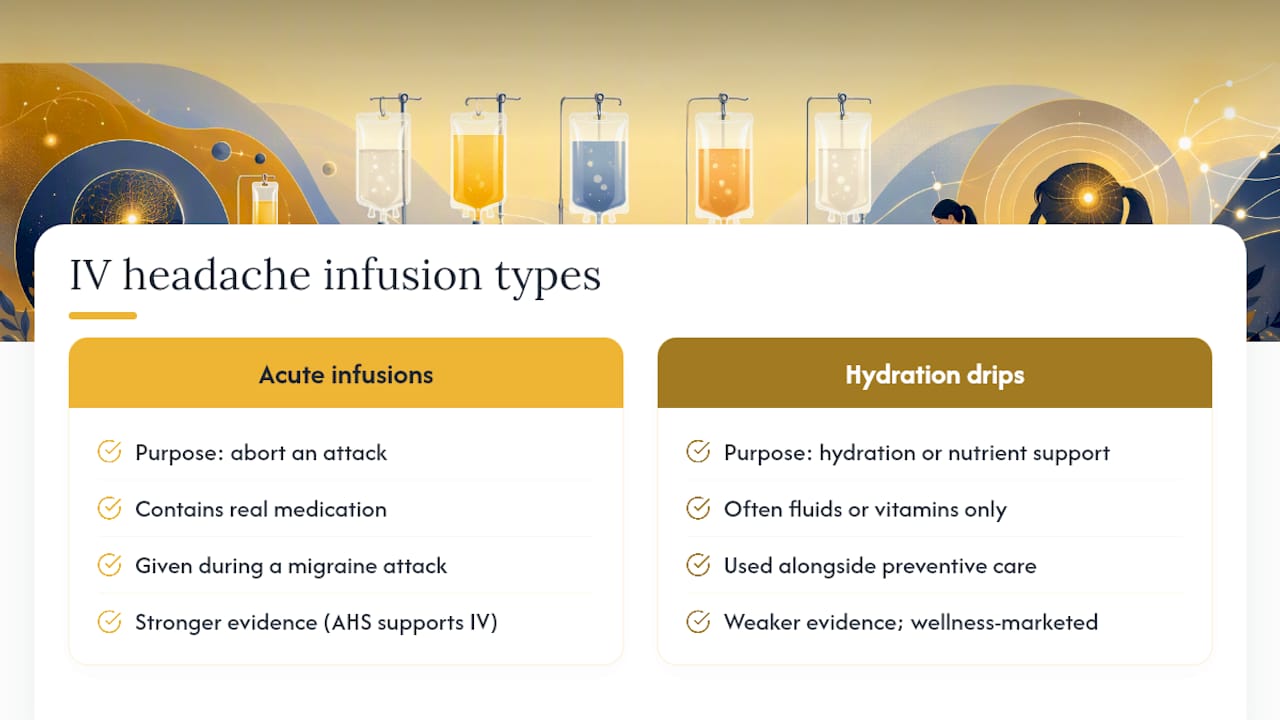
IV infusion therapy for headaches falls into two broad camps: acute treatment during an attack and, less commonly, hydration or nutrient support used alongside preventive care. Acute infusions almost always include real medication, not just fluids. Hydration-only drips exist, but they're a smaller piece of the picture.
The mechanism is straightforward. During a severe migraine, the gut often slows down or shuts down partially, a condition called gastric stasis. Pills sit in the stomach undissolved and unabsorbed. Delivering medication directly into the bloodstream skips that bottleneck entirely, which is why the American Headache Society points to IV delivery as a faster, more reliable route when oral drugs have already failed.
This is also where evidence-based infusion therapy parts ways with general wellness vitamin drips. One treats a specific, drug-responsive medical event. The other is often marketed on far thinner science, a distinction worth holding onto as you read further.
Who Should Consider IV Therapy for Migraines?
IV therapy makes the most sense for a fairly specific set of situations, not for every bad headache day. The clearest candidates are people dealing with status migrainosus (an attack lasting more than 72 hours), refractory migraine that hasn't responded to oral or injectable medication, or vomiting so severe that pills won't stay down long enough to absorb. Some cluster headache patients also receive infusion-based treatment during active cycles.
Where you go matters:
- Emergency department: sudden severe headache, neurological symptoms, or any red-flag sign (covered below)
- Outpatient infusion center or headache clinic: known migraine pattern, refractory to home treatment, no emergency signs
- Home infusion with visiting nurse: rare, typically reserved for patients with an established diagnosis and physician order
Pediatric and adolescent patients need pediatric-specific dosing and a clinician familiar with headache in younger patients. Pregnant patients require extra medication screening, since several common infusion drugs aren't appropriate during pregnancy.
What's Actually in a Migraine IV Cocktail?
There's no single standard migraine drip. What goes into the bag depends on your symptoms, history, and how you've responded to treatment before. That said, a handful of ingredients show up again and again in headache infusion protocols:
- Normal saline for rehydration, especially useful after vomiting
- Magnesium sulfate, which has shown promise for migraine specifically, according to Cleveland Clinic
- Antiemetics like ondansetron or metoclopramide to stop nausea and vomiting
- Ketorolac, an anti-inflammatory painkiller
- Dihydroergotamine (DHE), a longtime infusion-center staple for refractory attacks
- Dexamethasone, a steroid sometimes added to prevent rebound headache
- Lidocaine or ketamine in select refractory or specialty settings
- Eptinezumab, a newer infused CGRP antibody used for prevention rather than acute rescue
Pro Tip: Ask what's actually in your bag and why. A protocol built around your symptoms, allergies, and history looks completely different from a generic "hydration plus vitamins" package, and that's exactly the point.
Evidence strength varies a lot by ingredient. DHE and magnesium sulfate have the most support in outpatient infusion literature, while some additions rest more on clinical experience than large trials.
What Happens During an Infusion Appointment?
Sessions run in emergency departments, hospital-based infusion units, dedicated outpatient infusion centers, headache clinics, and occasionally at home through a visiting nurse for patients with an established treatment plan. Most outpatient visits fall somewhere between 30 and 90 minutes, though multi-drug protocols can stretch past that once you factor in monitoring time.
Expect a nurse or clinician to check vitals before, during, and after the infusion, particularly if the protocol includes DHE or sedating antiemetics. Some medications can cause drowsiness, so plan for a ride home rather than driving yourself.

Before you go, have your current medication list and allergies ready, and confirm transportation. It's also worth calling ahead about insurance coverage and out-of-pocket costs, since infusion billing varies widely between an emergency department visit and a dedicated outpatient center.
Does the Research Actually Support IV Therapy for Migraines?
The evidence is stronger for targeted medication than for fluids alone. Trials looking at IV fluids by themselves in the emergency department have produced mixed results, with hydration doing less heavy lifting than many patients assume. The real signal shows up when specific drugs, not just saline, are part of the protocol for refractory cases.
Outpatient infusion centers using agents like DHE and magnesium sulfate have been shown to ease symptoms and cut down on unnecessary healthcare use, according to a review published in Practical Neurology.
That same outpatient model tends to reduce emergency room visits and improve treatment consistency for patients who'd otherwise cycle back through the ED every few weeks. The gap in the evidence sits squarely with general wellness IV vitamin therapy: robust randomized data supporting broad "vitamin boost" infusions for headache is thin, a point Harvard Health has raised directly about IV vitamin marketing in general.
What Are the Risks and When Is a Headache an Emergency?
IV therapy carries the same basic infusion risks as any needle-based treatment: bruising, phlebitis at the injection site, and occasional infection. Certain medications add their own risk profile. DHE isn't appropriate for people with cardiac disease or uncontrolled hypertension, and anyone with known drug allergies needs a careful medication review before treatment starts.
Pregnancy also changes which drugs are safe, so this isn't a decision to make without a clinician's input.
Some symptoms mean skip the infusion center and go straight to the ED:
- Sudden, "worst headache of your life" onset
- Any new neurological deficit, like slurred speech, vision loss, or weakness on one side
- Fever combined with neck stiffness
- Headache following a head injury
Pro Tip: If your headache pattern has suddenly changed, don't assume it's "just a bad migraine." A new pattern deserves a fresh evaluation before any infusion.
How Do You Choose a Provider for Headache IV Therapy?
Picking a clinic for migraine infusions comes down to a short list of real questions, not marketing language.
- Ask who's overseeing the infusion. Nurse-led care under a physician's protocol is the standard to look for, not a tech running a preset IV.
- Ask what their standard migraine protocol includes and whether it's adjusted based on your history and allergies.
- Ask how they monitor you during the infusion and what their emergency procedure is if you have a reaction.
- Ask whether they'll coordinate with your neurologist or primary care provider for follow-up.
- Ask directly about run time, total cost, and insurance handling before you sit down.
A clinic that leans entirely on high-dose vitamin marketing without mentioning any of the above is worth a second look before booking.
How Vitaluxe Drip Lounge Approaches Headache-Related IV Support
Vitaluxedriplounge offers several infusions relevant to headache and dehydration support, including Normal Saline, Myers+, High Dose Vit C, and NAD+ options, alongside magnesium-containing formulations built around individual symptoms rather than a one-size-fits-all bag.
Every drip is nurse-led, with formulations personalized based on individual needs rather than a fixed general-wellness recipe. That matters given how much the evidence diverges between targeted medication and generic vitamin marketing.
Discounts for first responders and college students are offered, recognizing groups who often experience dehydration-driven headaches due to irregular schedules and physical or academic strain.
A Straight Answer About IV Therapy and Migraines
IV therapy earns its place for a specific patient: someone with a refractory or vomiting-driven attack that oral medication can't reach. It's not a replacement for preventive treatment, and it shouldn't become a monthly habit that substitutes for a real management plan with your neurologist. Used the right way, occasionally and deliberately, it's a legitimate tool. Used as a substitute for prevention, it's a patch on a bigger problem worth solving with your primary care provider.
— Debbie
Book a Personalized Infusion Plan With Vitaluxe
Vitaluxedriplounge gives you an alternative to guessing which drip might help: a nurse-led, boutique setting where your formulation is built around your symptoms rather than pulled off a generic menu.

If dehydration, nausea, or recovery from a rough stretch keeps triggering headaches, browse the full drip menu to see options like Normal Saline, Myers+, and magnesium-containing formulas. If you're looking at ongoing support rather than a one-off visit, the Essential and Elite membership plans are built for people who expect to need repeated sessions. First responders and college students get a discount, a nod to two groups who deal with dehydration and stress-driven headaches more than most. Book a consultation and talk through what's actually driving your symptoms before you commit to any drip.
This article is general information, not a substitute for advice from a qualified doctor. Consult a qualified healthcare professional about your own circumstances before acting on anything here.
Sources
- Top 10 Things to Know About Infusions for Headache — American Headache Society
- Intravenous treatment of headache at outpatient infusion centers — Practical Neurology
- Intravenous Fluid for the Treatment of Emergency Department Patients With Migraine Headache — PubMed
- IV therapy for vitamin replenishment: Health boost or expensive placebo? — Harvard Health
FAQ
What Is the IV Cocktail for Migraines?
There's no single standard formula, but common components include normal saline, magnesium sulfate, an antiemetic like ondansetron, and sometimes DHE or ketorolac, chosen based on your symptoms and history.
How Long Does an IV Migraine Cocktail Last?
The infusion itself typically runs 30 to 90 minutes, though relief from the medications can last well beyond that. How long the headache stays away depends on your migraine pattern and whether preventive treatment is also in place.
What Is the Best IV Infusion for Migraines?
There's no universal "best" option. The strongest evidence points toward protocols using DHE or magnesium sulfate for refractory attacks rather than hydration-only or general vitamin drips.
Can I Get IV Therapy for Migraines at Home?
Home infusion exists but is uncommon, generally limited to patients with an established diagnosis and a physician-ordered protocol delivered through a visiting nurse, not a general at-home option.
Does Vitaluxe Drip Lounge Offer Headache-Related IV Therapy?
Vitaluxedriplounge offers nurse-led infusions like Normal Saline, Myers+, and magnesium-containing formulations that support dehydration and symptom relief, with pricing listed on the services page.