NAD (nicotinamide adenine dinucleotide) is a coenzyme found in every cell, cycling between its oxidized form, NAD+, and its reduced form, NADH, to drive energy production, DNA repair, and sirtuin signaling. The biochemistry is well established. What is not settled is whether raising NAD with supplements or IV therapy produces measurable health benefits in humans, since most positive results still come from rodent studies rather than people.
TL;DR:
- Human studies show that while NAD precursors reliably raise blood biomarkers, they do not yet demonstrate consistent improvements in physical or cognitive functions.
- The effectiveness of supplements like NR and NMN heavily depends on dosage, duration, and tissue-specific uptake, which vary widely among individuals.
- Parenteral NAD therapy (IV/IM) is currently unproven for anti-aging benefits and carries safety risks due to unregulated compounded products, requiring clinical oversight.
- Lifestyle factors such as exercise, sleep, and a nutrient-rich diet are the most supported and safest methods to maintain NAD levels and mitochondrial health.
- Future breakthroughs depend on well-powered trials measuring meaningful clinical outcomes in tissues, with ongoing research focusing on safety, dosage, and long-term effects.
Table of Contents
- What Is NAD? Forms, Compartments, and Why the Difference Matters
- Core Functions: How NAD Supports Metabolism, DNA Repair, and Sirtuin Signaling
- Biosynthesis and Salvage: How Cells Make and Recycle NAD
- NAD and Aging: Preclinical Promise vs Human Clinical Evidence
- Practical Options to Support NAD: Lifestyle, Oral Precursors, and IV/IM Therapy
- Safety, Adverse Events, and Regulatory Cautions
- Research Gaps and Ongoing Trials: What Would Change Practice
- A Balanced Clinical Take on NAD Interventions
- How Vitaluxe Drip Lounge Approaches NAD-Focused Care
- Sources
- FAQ
What Is NAD? Forms, Compartments, and Why the Difference Matters
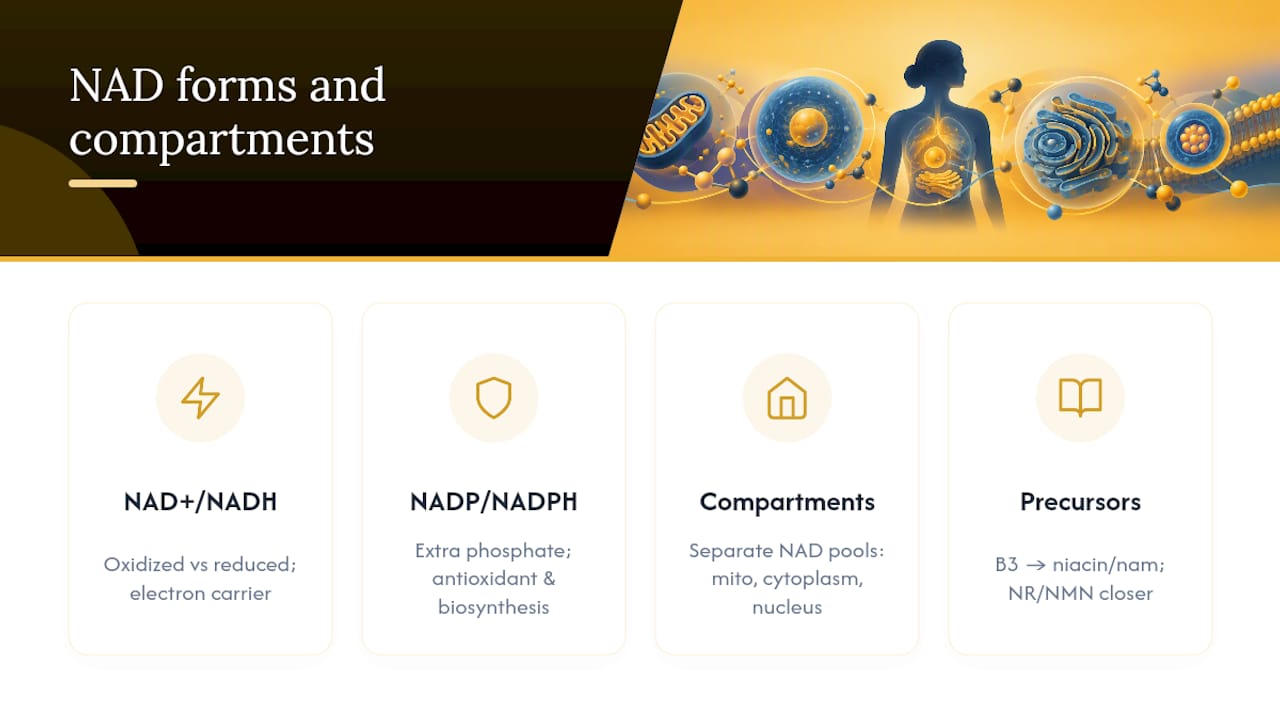
NAD exists as two interconvertible molecules. NAD+ is the oxidized form, meaning it is ready to accept electrons during metabolic reactions. NADH is the reduced form, carrying those electrons after accepting them. Every cell in the body relies on this back and forth to move energy from food into a usable form, and the Cleveland Clinic describes NAD as essential to how muscles, the brain, and the heart generate the fuel they run on.
A related pair, NADP and NADPH, often gets confused with NAD and NADH. They share a near-identical structure, but NADP carries an extra phosphate group that routes it toward different jobs: antioxidant defense and building molecules like fatty acids and cholesterol, rather than the catabolic energy reactions NAD handles. Confusing the two is a common misstep even among people who have read a fair amount on the topic. They are cousins, not synonyms.
Where NAD sits inside the cell matters as much as how much of it exists. Mitochondria, the cytoplasm, and the nucleus each maintain their own NAD pools, and these compartments do not mix freely. A supplement that raises NAD in the bloodstream does not automatically mean more NAD reaches the mitochondria, where a large share of cellular energy production happens. This compartmentalization is one reason blood biomarker increases from oral supplements do not always translate into the tissue-level effects people hope for.
NAD also has a close relationship to vitamin B3, though the terms are not interchangeable. Niacin (nicotinic acid) and niacinamide (nicotinamide, sometimes called NAM) are both forms of vitamin B3 that the body converts into NAD through separate biochemical routes. Nicotinamide riboside (NR) and nicotinamide mononucleotide (NMN) are more specialized precursor molecules, one step closer to NAD in the synthesis chain than plain niacin or niacinamide. Marketing copy sometimes uses "NAD," "NAD+," "B3," and "NMN" as if they were the same thing. They are related, but each occupies a distinct spot in the pathway, and that distinction becomes important once you start comparing supplement claims.
Core Functions: How NAD Supports Metabolism, DNA Repair, and Sirtuin Signaling
Every cell needs NAD to convert food into usable energy. During glycolysis, the breakdown of glucose in the cytoplasm, NAD+ picks up electrons and becomes NADH. That NADH then travels into the mitochondria, where the tricarboxylic acid (TCA) cycle generates more of it, and oxidative phosphorylation uses it to build ATP, the molecule cells spend as currency. Without a steady NAD+/NADH cycle, this entire chain stalls.
NAD does more than shuttle electrons, though. It also acts as a raw material, a substrate that gets consumed rather than just transformed, for three important groups of enzymes: PARPs, sirtuins, and CD38.
- PARPs (poly-ADP ribose polymerases) use NAD+ to repair damaged DNA, an urgent, energy-intensive process that can rapidly deplete local NAD stores after significant cellular stress.
- Sirtuins, a family of proteins tied to metabolic regulation and cellular stress resistance, require NAD+ as fuel to run their enzymatic activity, linking NAD levels directly to the pathways researchers associate with aging biology.
- CD38 is an enzyme that breaks down NAD, and its activity tends to increase with age and inflammation, creating a drain on the NAD supply exactly when cells need it most.
When NAD runs low, the consequences show up at the mitochondrial level first. Cells lose efficiency in energy production, and unrepaired DNA damage accumulates. Some cells respond by entering senescence, a state where they stop dividing but do not die, instead lingering and releasing inflammatory signals that affect neighboring tissue. Preclinical work has connected this cascade, NAD decline leading to mitochondrial dysfunction leading to senescence, across multiple animal models, and it forms the mechanistic backbone for why researchers care about NAD and aging in the first place.
Animal studies illustrate the point concretely. Rodent research has shown that restoring NAD+ levels through precursor compounds improves mitochondrial function and boosts resilience against metabolic and oxidative stress, and these findings hold up across several independent reviews of the preclinical literature. Mice given NAD-boosting compounds have shown improved muscle endurance and metabolic markers in aging models. That is a meaningfully different claim than saying the same effect has been confirmed in aging humans, and the gap between those two claims is exactly where the science currently sits.
Biosynthesis and Salvage: How Cells Make and Recycle NAD
Cells build NAD through several distinct routes, and understanding them explains why different supplements target different points in the chain.
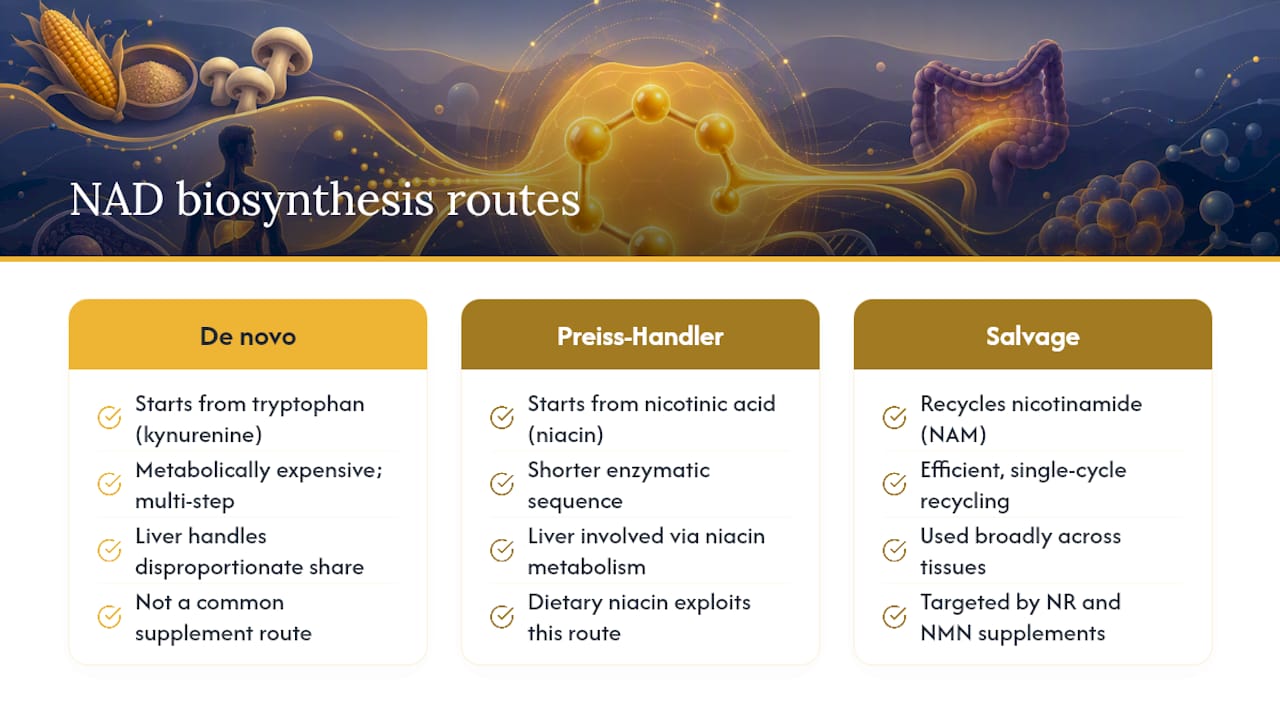
The de novo pathway starts from tryptophan, an amino acid obtained through diet, and converts it through a multi-step process called the kynurenine pathway. This route is metabolically expensive and varies significantly by organ. The liver handles a disproportionate share of de novo synthesis, while other tissues rely more heavily on recycling existing NAD components.
The Preiss-Handler pathway starts from nicotinic acid (niacin) and converts it into NAD through a shorter sequence of enzymatic steps. This is the route dietary niacin supplementation exploits, and it is also why extremely high niacin doses can cause the well-known flushing reaction, a side effect distinct from anything related to NR or NMN.
The salvage pathway recycles nicotinamide (NAM), a byproduct generated when PARPs, sirtuins, and CD38 consume NAD, back into usable NAD+. NR and NMN both feed into this salvage route, just at slightly different entry points. NR gets converted into NMN first, then NMN converts into NAD+ in a final step catalyzed by an enzyme called NMNAT.
The pharmacokinetics of NR and NMN in humans are reasonably well documented for blood biomarkers but murkier for tissue-level effects. Oral NR and NMN reliably raise circulating NAD-related metabolites, a finding confirmed across multiple controlled studies, but that does not guarantee proportional increases inside muscle, brain, or liver tissue. The gut and liver metabolize a portion of any oral dose before it reaches systemic circulation, and cells regulate their own NAD uptake and synthesis through feedback mechanisms that can blunt the effect of simply adding more raw material. This is also why individual responses vary so widely. Age, baseline metabolic health, and even the specific precursor form used all shape how much of a bump someone actually gets, a variability that comprehensive reviews of the human trial data flag as a persistent complication for interpreting results.
NAD and Aging: Preclinical Promise vs Human Clinical Evidence
Rodent studies paint a consistent, encouraging picture. Mouse and rat models given NAD+ precursors show improved mitochondrial function, better metabolic markers, and in some studies, extended healthspan, the period of life spent free of major age-related decline. These effects replicate across independent research groups, which is part of why NAD attracted so much attention as a target for human aging research.
Human trials tell a narrower story. Across the controlled studies conducted so far, oral NR and NMN reliably do one thing well: they raise NAD-related biomarkers in blood, confirming that the compounds are absorbed and metabolized as expected. What they have not reliably done is produce consistent improvements on functional clinical endpoints, things like measured muscle strength, cognitive test scores, or validated markers of cardiovascular risk. A systematic review covering the available human trials concluded that oral NAD-boosting compounds appear safe and effective at raising biomarkers, but flagged the complete absence of adequately powered outcomes trials, especially for IV and IM NAD administration, as anti-aging interventions.
A few factors explain why promising preclinical signals have not translated cleanly into human results:
- Dose and duration mismatches. Rodent studies often use doses, adjusted for body weight, that are difficult to replicate safely or practically in humans over comparable timeframes.
- Tissue uptake barriers. Blood biomarker changes do not confirm that muscle, brain, or cardiac tissue actually received a meaningful NAD boost, given the compartmentalization issue discussed earlier.
- Endpoint selection. Many human trials measure biochemical markers because they are easy to quantify over a short study period, while the clinical outcomes people actually care about, frailty, cognitive decline, disease risk, require years of follow-up to assess properly.
- Population heterogeneity. Trial participants vary in age, baseline NAD status, and metabolic health, and this variability can wash out modest effects that might be real but small.
Some recent commentary in the field has been blunt about this gap, noting that commercial enthusiasm for NAD-based anti-aging products has outpaced what the clinical evidence currently supports. That is not a dismissal of the biology. It is a statement about where the proof currently stands versus where the marketing has already gone.
Practical Options to Support NAD: Lifestyle, Oral Precursors, and IV/IM Therapy
Not every route to supporting NAD carries the same evidence weight, and it helps to rank them by how well they are actually studied.
- Exercise. Regular aerobic and resistance training is one of the most consistently supported ways to support mitochondrial function and metabolic health generally, and mitochondrial health is directly tied to how efficiently cells use NAD. This option requires no purchase and carries essentially no safety downside for most healthy adults.
- Sleep and circadian consistency. NAD metabolism follows circadian rhythms, and chronic sleep disruption is associated with metabolic dysfunction broadly. Prioritizing consistent sleep timing is a low-cost, evidence-aligned habit rather than a targeted NAD intervention, but it supports the same underlying systems.
- Dietary patterns. Diets adequate in tryptophan and niacin sources, lean protein, fish, and whole grains support the raw material cells need for the de novo and Preiss-Handler pathways. This is baseline nutrition, not a supplement strategy.
- Oral precursors (NR, NMN, niacin). Clinical trials of NR and NMN have typically used doses in the range of a few hundred milligrams to around a gram daily, and these doses reliably raise blood NAD metabolites within days to weeks. What they have not reliably done is move the needle on the functional outcomes, strength, cognition, disease markers, that most people actually want. Niacin, at high doses, raises NAD through a different route but causes flushing and carries its own tolerability issues.
- Parenteral NAD (IV/IM). IV and intramuscular NAD administration bypasses digestion entirely, but no adequately powered outcomes trials currently support its use for anti-aging or general wellness. Pharmacokinetic data on how much administered NAD actually reaches target tissues intact is limited. This approach remains experimental despite its popularity in wellness settings.
Pro Tip: Before starting any NAD-focused regimen, ask what outcome you are actually trying to improve, energy, recovery, or something else, and track it. Blood NAD levels rising is not the same as feeling or performing better, and separating the two keeps expectations grounded.
The practical decision rule is straightforward: talk to a clinician first, especially if you take other medications or manage a chronic condition. For most people, well-sourced oral precursors or straightforward lifestyle changes carry the better risk-to-evidence ratio. Parenteral NAD belongs in supervised clinical settings where screening and monitoring are part of the protocol, not a casual add-on.
Safety, Adverse Events, and Regulatory Cautions
Short-term reports on oral NR and NMN generally describe them as well tolerated, with occasional mild gastrointestinal upset. Long-term data on sustained high-dose use remains thin, which is a gap worth taking seriously rather than dismissing.
Compounded injectable NAD products carry a different risk profile entirely. The FDA has issued warning letters targeting compounding operations over misbranding and quality control failures, and compounded injectables are not FDA-approved products in the way a standard pharmaceutical is. The agency has separately investigated adverse events tied to a different compounded injectable product, citing concerns like chemical instability and inaccurate ingredient content, the exact category of risk that applies to any compounded parenteral product, NAD included.
Before agreeing to any injectable NAD therapy, ask the provider these questions:
- Where does the active pharmaceutical ingredient (API) come from, and is it from a registered facility?
- What sterility testing does the compounding pharmacy perform on each batch?
- What is the beyond-use date, and how is it determined?
- Is a licensed clinician directly overseeing administration, not just present in the building?
- What is the emergency protocol if a reaction occurs during infusion?
Pregnant women, people managing unstable medical conditions, and those on medications with narrow safety margins should avoid parenteral NAD therapies without direct clinician guidance, the same caution that applies to oral high-dose precursor use in those same groups. A comparable clinical-safety perspective on IV therapy protocols reinforces that screening and oversight, not just the product itself, determine how safe an infusion actually is.
Research Gaps and Ongoing Trials: What Would Change Practice
The field's biggest open question is tissue specificity: does raising blood NAD markers actually raise NAD where it matters, muscle, brain, cardiac tissue, and by how much? Long-term safety data for sustained high-dose precursor use, and for any form of parenteral NAD, is still thin. Researchers also need trials built around clinically meaningful endpoints, cognitive scores, frailty measures, disease incidence, rather than biomarkers alone, along with better dose-finding work comparing administration routes.
Clinicaltrials currently lists multiple studies examining NR, NMN, and related compounds for metabolic and neurodegenerative conditions, and these are worth tracking over the next few years.
When a new trial gets published, four questions separate a meaningful result from noise: What was the primary endpoint, a biomarker or a real clinical outcome? Was the study adequately powered, meaning it had enough participants to detect a real effect? How long did it run? And was it pre-registered, meaning the researchers stated their hypothesis before seeing the data? A trial that answers all four well deserves more weight than one that does not.
A Balanced Clinical Take on NAD Interventions
The biochemistry behind NAD is genuinely compelling, and the rodent data gives real reason to think NAD decline matters for aging biology. What gets lost in most marketing is the size of the gap between that mechanistic story and confirmed human benefit. Raising blood NAD levels is not the same achievement as improving how someone actually feels or functions.
My honest read: treat oral precursors and lifestyle changes, exercise, sleep, diet, as reasonable first-line steps, since they carry the strongest safety track record. Reserve parenteral NAD for a supervised clinical setting where a provider is actually screening for contraindications, not just running an infusion line. And watch for the next round of properly powered trials rather than adjusting your regimen based on today's incomplete picture.
— Debbie
How Vitaluxe Drip Lounge Approaches NAD-Focused Care
Vitaluxe Drip Lounge is the alternative to unsupervised, order-it-online NAD regimens: every NAD+ session here runs through nurse-led screening before a single IV line goes in. If you are weighing whether NAD+ IV or IM therapy fits your situation, that clinical layer, not just the product itself, is what actually matters given the safety questions this article walked through.
The service menu lists NAD+ IV options at 125mg, 250mg, and 500mg doses, alongside NAD+ IM at 25mg, so you can start at a level that matches your comfort and goals rather than a one-size dose. Supportive IV formulas are also available for clients interested in broader recovery or cellular support alongside or instead of NAD therapy. For anyone considering ongoing sessions rather than a one-off, the Essential and Elite membership plans build in recurring visits at a fixed monthly cost.
Every visit includes medical screening, so bring your medication list and any relevant health history, and ask directly about sourcing and sterility protocols before you commit. Book a consultation through the Vitaluxe Drip Lounge site to talk through which option actually fits your health picture.
Sources
For deeper reading beyond this article, the Cleveland Clinic's overview of NAD offers an accessible clinical primer, while the systematic review on NAD+-boosting compounds and the human aging clinical evidence review cover the trial data in detail. FDA warning letters on compounding practices are worth checking directly on fda.gov before choosing any injectable provider.
This article is general information, not a substitute for advice from a qualified doctor. Consult a qualified healthcare professional about your own circumstances before acting on anything here.
- NAD (Nicotinamide Adenine Dinucleotide) - Cleveland Clinic
- NAD precursor supplementation in human ageing: clinical evidence (review)
- Roles of NAD+ in health and aging (review)
- Nova Vascular LLC dba NOVARX - Warning letter (FDA)
FAQ
What Is NAD Supplement Used For?
NAD-boosting supplements like NR, NMN, and niacin are used to raise circulating NAD-related biomarkers, and human trials confirm they do this reliably. People typically take them hoping for improved energy, metabolic health, or slower aging, but clinical trials have not consistently confirmed those functional benefits yet.
Is NAD Like Ozempic?
No. Ozempic is a GLP-1 receptor agonist prescribed for diabetes and weight management with extensive outcome trial data behind it. NAD is a cellular coenzyme involved in energy metabolism and DNA repair, and its supplements lack the large-scale clinical outcome trials that back GLP-1 medications.
What Is the Downside of NAD Supplementation or Therapy?
The main downsides are unproven clinical benefit relative to cost, and for parenteral NAD specifically, safety uncertainty tied to compounded injectable products that the FDA has flagged for quality control issues. Oral precursors are generally well tolerated, though long-term high-dose data remains limited.
Is NAD Just Vitamin B3?
Not exactly. NAD is synthesized from vitamin B3 compounds, niacin and niacinamide, through distinct biochemical pathways, plus from the amino acid tryptophan through a separate route. NR and NMN are more specialized precursor molecules, one step closer to NAD itself, so calling NAD "just B3" oversimplifies a multi-step biosynthesis process.
Does Vitaluxe Drip Lounge Offer NAD+ Therapy?
Yes. Vitaluxe Drip Lounge offers NAD+ IV therapy at 125mg, 250mg, and 500mg, along with NAD+ IM at 25mg, all administered under nurse-led screening. Exact pricing and scheduling are available on the services page.