Most people paying for supervised peptide therapy land between $150 and $400 a month for a single peptide protocol, with brand-name or concierge-level programs running $500 to $1,500. Your first month costs more, typically $500 to $1,400 once you add the initial consult, baseline labs, first supply, and injection supplies. Gray-market vials look cheaper on paper, but they skip the oversight that makes the price worth paying. Insurance rarely touches anything outside a handful of FDA-approved drugs.
TL;DR:
- Peptide therapy costs typically range from $150 to $400 per month for most protocols, but brand-name GLP-1 drugs can exceed $1,000 monthly without insurance.
- In-person clinics charge significantly higher, up to $1,500 monthly, compared to telehealth options that are often 20 to 40 percent cheaper due to lower overhead.
- The initial month often costs between $375 and $1,710 due to labs, supplies, and consult fees, with costs decreasing afterward as baseline testing is completed.
- Budgeting should include medication, dosage, provider fees, lab testing, supplies, shipping, and possible memberships; transparency with itemized quotes is essential.
- Supervised programs with licensed oversight ensure safety and verification, whereas gray-market vials save money but lack monitoring and quality assurance.
Table of Contents
- What Does Peptide Therapy Cost by Category?
- How Does the Delivery Route Change Peptide Injection Costs?
- What Line Items Actually Drive Your Peptide Therapy Bill?
- What Should You Budget for the First 3 to 6 Months?
- How Can You Lower Peptide Therapy Costs Without Cutting Corners?
- What Labs and Monitoring Should You Budget For?
- Is Peptide Therapy Worth the Cost for You?
- Why Choose Vitaluxe Drip Lounge for Supervised Peptide Therapy
- Budgeting Advice From a Clinic Operator's Perspective
- Ready to Start Peptide Therapy the Right Way?
- Sources
- FAQ
What Does Peptide Therapy Cost by Category?
Not all peptides carry the same price tag, and the category you're shopping for tells you more about the bill than almost anything else. A telehealth sermorelin protocol and a brand-name GLP-1 prescription can differ by $1,000 a month even though both get lumped under "peptide therapy" in casual conversation.
Here's how pricing typically breaks down by category:
- Brand-name GLP-1s (semaglutide, tirzepatide): generally cost several hundred to over a thousand dollars per month at list price, though manufacturer savings programs and insurance can drop eligible patients' costs substantially.
- Growth-hormone secretagogues (sermorelin, CJC-1295, ipamorelin): usually $150 to $350 per month through telehealth bundles.
- Healing peptides (BPC-157, TB-500): often $100 to $300 per month, though sourcing quality varies wildly.
- Sexual-health peptides (PT-141): commonly cost under a few hundred dollars per month depending on dose frequency.
- NAD+ therapy: prices vary per session or per milligram, with intramuscular doses at tens of dollars and high-dose IVs costing several hundred dollars.
- OTC collagen peptide supplements: generally cost tens of dollars per month, sold without a prescription and not considered clinical peptide therapy.
Insurance almost never covers the middle four categories because they're prescribed off-label for wellness goals rather than an FDA-approved condition. GLP-1 drugs are the exception, and only when prescribed for an approved diagnosis like type 2 diabetes or obesity. That distinction, FDA-approved versus elective wellness use, is the single biggest reason two people can pay wildly different amounts for what sounds like the same treatment.
How Does the Delivery Route Change Peptide Injection Costs?
The route you choose to get peptides, more than the peptide itself, usually decides your final bill. Four paths dominate the market, and each bakes a different set of services into its price.
- Telehealth platforms: $99 to $299 a month for the medication, virtual prescriber visits, and shipping bundled together, landing most single-peptide programs in the $150 to $400 all-in monthly range.
- In-person clinics and med-spas: add a physical visit, staff time, and often a facility fee on top of medication, pushing premium clinic programs to $500 to $1,500 a month.
- Compounding pharmacies: sell directly to patients with a valid prescription, cutting out clinic markup but requiring you to verify the pharmacy's 503A or 503B registration yourself.
- Gray-market research vials: the cheapest option on the shelf, sold without prescriber involvement, lab verification, or quality testing.
Statistic Callout: Telehealth bundles run 20 to 40 percent cheaper than comparable in-person clinic programs, largely because they skip the brick-and-mortar overhead while still providing prescriber oversight and shipping.
The price difference includes onboarding fees of significant amounts plus clinic markups on medication, which explains why the same sermorelin protocol can cost substantially more at a clinic compared to telehealth ordering source. Gray-market vials save money in the short term, but you lose the licensed prescriber, the lab monitoring, and any guarantee the vial contains what the label claims.
What Line Items Actually Drive Your Peptide Therapy Bill?
Every invoice breaks down into the same handful of variables. Understanding which ones you can control, and which you can't, is how you actually budget instead of guessing.
- Medication cost. Brand-name drugs cost more than compounded versions, and stacking two or three peptides multiplies your medication line rather than adding a flat fee.
- Dosage and supply format. A multi-dose vial usually costs less per unit than a pre-filled pen, but pens simplify dosing for people new to injections.
- Refill cadence. Monthly refills cost more per dose than quarterly bulk orders from the same pharmacy.
- Provider fees. Initial consults run $50 to $250; follow-up visits are usually cheaper but recur every one to three months.
- Lab testing. Baseline panels and periodic follow-ups add a separate, often front-loaded, cost.
- Injection supplies. Syringes, alcohol wipes, and sharps containers rarely cost more than $10 to $20 a month but do add up.
- Shipping. Cold-chain shipping for temperature-sensitive peptides can run $15 to $40 per shipment.
- Clinic markup or membership fees. This is the most variable line item and the one most worth negotiating.
Pro Tip: Ask any provider for an itemized quote before you commit. If they can't separate medication cost from service fees, that's a sign the pricing isn't as transparent as it should be.
What Should You Budget for the First 3 to 6 Months?
Your first month always costs more than every month after it, because baseline labs and starter supplies get front-loaded into that initial bill. A realistic first-month breakdown looks like this: consult ($50 to $250), baseline labs ($150 to $500), first supply of medication ($150 to $900 depending on the peptide), injection supplies ($10 to $20), and shipping ($15 to $40). That puts most people between $375 and $1,710 in month one, though the $500 to $1,400 range covers the majority of realistic scenarios.
Stacking multiple peptides multiplies costs because each peptide has its own medication and monitoring needs. Baseline labs usually incur the highest expense in month one and reduce the average monthly cost over longer periods, explaining why extended totals appear relatively lower monthly.
How Can You Lower Peptide Therapy Costs Without Cutting Corners?
Affordability doesn't have to mean gray-market risk. A few levers actually move the needle on price while keeping the oversight that matters.
- Check insurance and manufacturer savings cards for FDA-approved drugs like GLP-1s. Coverage and savings programs are the single biggest lever on out-of-pocket cost for eligible patients.
- Use an HSA or FSA if your plan allows it. Peptide therapy tied to a diagnosed condition often qualifies.
- Compare telehealth bundles against pharmacy direct fills, and verify any compounding pharmacy's 503A or 503B registration before ordering.
- Ask about membership pricing. Committing to three or six months upfront often lowers the effective monthly rate versus paying month to month.
Pro Tip: If a vial's price seems too good to explain, that's usually because the seller skipped the parts that cost money: lab testing, prescriber review, and cold-chain shipping. Cheap peptides and safe peptides are rarely the same product.
Chasing the lowest price per vial is how people end up with contaminated or mislabeled product. Surveillance studies on online-sourced peptides have found real mislabeling and contamination problems, which is a expensive lesson to learn after the fact.
What Labs and Monitoring Should You Budget For?
Monitoring costs are part of the real price of peptide therapy, not an optional add-on, and skipping them to save money short-term is how small problems turn into expensive ones later.
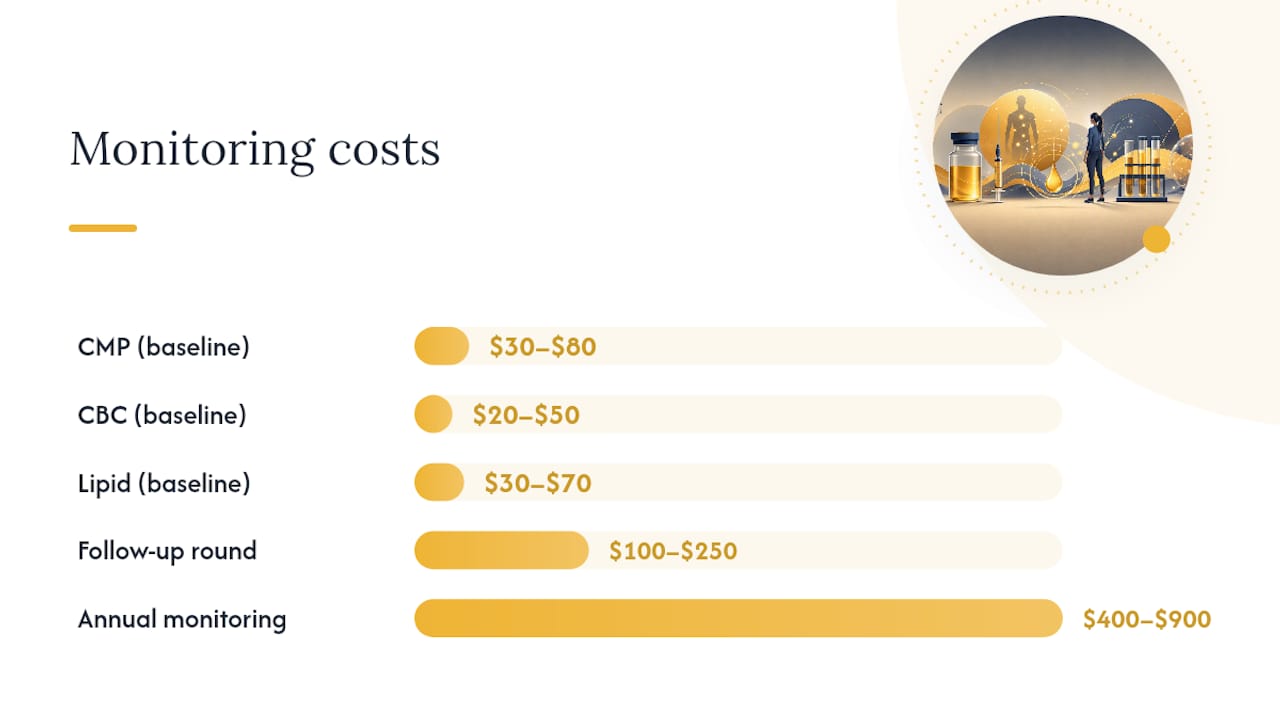
Baseline testing typically includes a complete metabolic panel ($30 to $80), a CBC ($20 to $50), a lipid panel ($30 to $70), and, depending on the peptide, an IGF-1 level, HbA1c, or hormone panel ($75 to $200 each). Most protocols call for a follow-up round every one to three months, running $100 to $250 per round once you add the visit. A reasonable annual monitoring budget for a single-peptide program lands between $400 and $900. Peer-reviewed clinical literature supports baseline and periodic monitoring for many peptide protocols, and research on dosing cadence backs the same one-to-three-month follow-up window. Skipping these tests trims your monthly bill, but it also means you're guessing whether the dose is doing what it's supposed to, or causing a problem you can't see yet.
Is Peptide Therapy Worth the Cost for You?
Cost only tells half the story. Whether peptide therapy is worth paying for depends on whether you actually meet a short checklist before you commit.
- You have a clear, specific goal, not a vague sense that "peptides might help."
- You can budget for 3 to 6 months, including labs, not just the first supply.
- You're willing to commit to follow-up monitoring rather than skipping it to save money.
- You're starting with one supervised peptide rather than stacking three from the outset.
Statistic Callout: Telehealth programs bundling a single peptide with prescriber oversight run 20 to 40 percent cheaper than comparable in-person clinic stacks, which makes a single-peptide telehealth start the most budget-friendly way to test whether a protocol works for you.
If you're weighing an FDA-approved option like a GLP-1 against an elective compounded peptide, check your insurance first. The approved drug might actually cost less out-of-pocket than the "cheaper looking" compounded alternative once savings programs apply.
Why Choose Vitaluxe Drip Lounge for Supervised Peptide Therapy
Vitaluxe Drip Lounge specializes in advanced wellness therapies, including Red Light Therapy, IV Vitamin Therapy, and personalized peptide services built around cellular repair, immunity, hydration, and mental clarity. The clinic pairs medical expertise with high-quality nutrients to build a personalized, results-driven plan rather than a one-size-fits-all protocol.
Clients may experience gains in energy and overall wellness, particularly after intense physical activity or during high-stress periods. The clinic supports community wellness with discounts that can help first responders and students access supervised wellness care.
If you want peptide therapy delivered with prescriber oversight rather than a mystery vial from an unverified seller, that structure is exactly what you're paying the premium for.
Budgeting Advice From a Clinic Operator's Perspective
Budget for the first 3 to 6 months up front, not just the starter supply. That window is where labs, dose adjustments, and follow-up visits actually happen, and it's where most people underestimate their real spend.
Gray-market vials look like a bargain until you account for what you're not getting: prescriber oversight, verified sourcing, and monitoring that catches problems early. Supervised programs cost more because they include the parts that keep the treatment safe. Talk to a licensed clinician before committing to any protocol. Your budget, and your bloodwork, will thank you for it.
— Debbie
Ready to Start Peptide Therapy the Right Way?
If you're past the research phase and ready for a supervised approach, Vitaluxe Drip Lounge gives you something a gray-market seller never can: a licensed provider reviewing your baseline labs before you inject anything.

Your first visit includes a consult, baseline labs, and a supervised dosing plan built around your actual goals, not a generic protocol pulled off a forum. Vitaluxe's Peptide Services sit alongside IV therapies like NAD+ and Myers+ for people building a broader wellness routine, and the Essential and Elite membership plans can lower your effective monthly cost if you're planning to stay on a protocol for several months. If you're also curious about topical options, copper peptides like GHK-Cu work differently than injectable peptides and are worth understanding before you compare the two. Book a consultation and get an itemized quote before you commit to anything.
Sources
Pricing figures in this article come from published peptide therapy cost breakdowns, cross-checked against FDA guidance on compounding risks and peer-reviewed monitoring literature. Provider credentials can be verified through the NPI Registry. Prices vary by provider and region, so treat every range here as a starting point for your own quote, not a guarantee.
This article is general information, not a substitute for advice from a qualified doctor. Consult a qualified healthcare professional about your own circumstances before acting on anything here.
- How Much Does Peptide Therapy Cost? Full 2026 Pricing Guide | Peptides DB
- Peptide Therapy Cost: Full Pricing Breakdown by Type (2026) | The Peptide Effect
- Peer-reviewed clinical literature relevant to peptide therapy monitoring (PMCID)
FAQ
How Much Do 3 Months of Peptide Therapy Cost?
A telehealth single-peptide program typically totals $850 to $1,300 over 3 months, while a clinic-based stacked protocol can run $2,200 to $3,800 in the same window. The gap comes down to markup, onboarding fees, and how many peptides you're running at once.
Are Peptide Injections Worth It?
That depends on whether you have a clear goal, a realistic 3 to 6 month budget, and a willingness to commit to lab monitoring rather than skipping it. Starting with one supervised peptide instead of stacking several is the more budget-friendly way to find out if a protocol works for you.
How Long Does a Peptide Injection's Effect Last?
It varies by peptide category. Growth-hormone secretagogues and healing peptides are typically dosed daily or several times a week for weeks to months, while some GLP-1 formulations are dosed weekly. Ask your prescriber for the exact schedule tied to your protocol, since dosing cadence directly affects your monthly cost.
What Peptides Does Vitaluxe Drip Lounge Offer?
Vitaluxe Drip Lounge provides personalized Peptide Services alongside NAD+ IV and IM treatments, Red Light Therapy, and IV vitamin therapies. Pricing for peptide services is available directly on the clinic's site since it's tailored to your individual protocol.