Peptides for hair growth work best as supportive adjuncts, not standalone regrowth drugs. GHK-Cu (copper peptides), redensyl, and biotinoyl tripeptide-1 dominate the conversation, and each has plausible biology behind it, but none has the large randomized trial base that minoxidil or finasteride can claim. Expect early shedding changes around 8 to 12 weeks and any real density shift closer to 3 to 6 months, if it happens at all.
Finasteride is FDA-indicated for men only. Women who are or may become pregnant must not handle crushed or broken finasteride tablets, due to the risk of harm to a male fetus. It can also cause sexual side effects (reduced libido, erectile dysfunction) in a minority of men, which usually resolve after stopping treatment. Discuss these risks with a physician before starting.
TL;DR:
- Peptides mainly support scalp health and inflammation reduction rather than directly regrowing hair, with early signs appearing after 8 to 12 weeks.
- Most peptide studies are small, lack large placebo-controlled trials, and cannot match the clinical evidence backing minoxidil or finasteride.
- Delivery methods like serums, microneedling, or injections influence how much peptide reaches hair follicles, affecting their potential efficacy.
- Peptides are most beneficial for early thinning, scalp irritation, or post-stress shedding, and are less effective for advanced or hormonal-related hair loss.
- Use peptide products with realistic expectations, track results carefully over 3 to 6 months, and consider combining them with proven treatments for better outcomes.
Table of Contents
- What Peptides Are and How They're Supposed to Work on Hair
- How Strong Is the Clinical Evidence for Peptides?
- How to Use Peptides for Hair Growth: Delivery, Dosing, and Timeline
- Who Actually Benefits From Peptide Treatments
- Safety, Side Effects, and How to Spot a Quality Product
- How Vitaluxe Drip Lounge Approaches Peptide-Based Hair Protocols
- Why Peptides Don't Work the Same Way for Everyone
- An Evidence-First Way to Think About Trying Peptides
- Start a Clinician-Guided Peptide Protocol at Vitaluxe Drip Lounge
- Sources
- FAQ
What Peptides Are and How They're Supposed to Work on Hair
Peptides are short chains of amino acids, smaller than a full protein, that can signal cells to behave differently. In skin and scalp science, certain peptides mimic natural growth-factor activity or help stabilize the extracellular matrix around a hair follicle. That's the theory behind most peptide-for-hair products on the market right now.
The standard industry term for this category is "peptide-based hair growth therapy," and it covers a wider range of formulations than most marketing copy admits. Some are cosmetic-grade serums you rub on your scalp. Others show up in clinical or research settings at concentrations you won't find in a drugstore bottle. Knowing which type you're looking at matters more than the ingredient name alone.
Here's how the major peptide categories differ in claimed mechanism:
- Copper peptides (GHK-Cu): A naturally occurring copper complex studied for decades in wound healing and skin repair. In hair contexts, it's proposed to support dermal papilla activity, encourage collagen and laminin production in the follicle bed, and calm local inflammation that can interfere with normal growth cycling.
- Signal peptides (palmitoyl tetrapeptide-20, acetyl tetrapeptide-3): These are designed to mimic the messages that trigger tissue repair, theoretically nudging follicles that have gone dormant back toward an active growth phase.
- Biomimetic peptides: Built to imitate naturally occurring growth factors like those involved in angiogenesis, the process of forming new blood vessels that feed the follicle.
- Redensyl: A patented complex, not a single peptide, that combines a specific molecule (DHQG) with glycine to target hair follicle stem cells rather than the whole follicle structure.
- Biotinoyl tripeptide-1: A peptide studied for its potential to support keratin production and improve the strength of the hair shaft rather than trigger new growth outright.
The mechanistic story researchers point to most often involves VEGF (vascular endothelial growth factor) upregulation, which theoretically improves blood supply to the follicle, alongside direct stimulation of dermal papilla cells, the small cluster at the base of the follicle that governs hair cycling. Some peptides also appear to reduce local inflammatory signals that can push hair into the resting (telogen) phase prematurely.
None of that amounts to proof the product on the shelf regrows hair on a human scalp. Mechanistic plausibility, meaning "this makes biological sense in a dish or an animal model," is a different category of evidence than a controlled human trial showing measurable density gains. A 2026 review in PMC covering short peptides for hair loss makes exactly this distinction: promising cell biology, but a real gap before that translates into confirmed clinical results. Keep that gap in mind every time a product label uses the words "clinically proven."
How Strong Is the Clinical Evidence for Peptides?
The evidence for peptides sits well below the bar set by FDA-approved hair loss drugs, and that gap is the single most important thing to understand before spending money on a peptide regimen.
The PMC review referenced above lays out the current landscape plainly: short peptides show real biological activity, including some encouraging signals from compounds like PP405 in early small studies, but the field lacks the large, multi-site, placebo-controlled trials that would let a dermatologist confidently say "this peptide regrows hair in most patients." Smaller PMC-indexed studies add to the picture. Some report dermal papilla stimulation and VEGF upregulation in preclinical models, plus modest improvements in small human cohorts. A separate peer-reviewed analysis in Biomedicines covers additional peptide classes under investigation, again framing the data as mechanistically interesting rather than conclusively proven.
What does "small" actually mean here? In practice, most peptide hair studies enroll a few dozen participants at most, run for a matter of months, and often lack a true placebo arm or blinding. That's not disqualifying, early-stage cosmetic science often starts this way, but it means you should read "clinically studied" on a product label as "has been looked at in a limited setting," not "proven effective in the way minoxidil has been proven effective."
Compare that to the two drugs peptides get measured against constantly:
- Minoxidil, approved by the FDA for topical use, has decades of randomized controlled trial data behind it, across multiple large studies with defined dosing and measurable outcomes.
- Finasteride carries a similarly deep base of phase III trial evidence for androgenetic hair loss in men, with well-documented efficacy rates and known side effect profiles.
- Peptide-only formulations have no equivalent phase III RCT of comparable scale. The best available data comes from small human studies, animal models, and in vitro cell work.
The evidence gap, in one number: Zero. That's roughly how many large-scale, phase III randomized controlled trials exist for peptide-only hair growth products as of this writing, compared to the multi-thousand-patient trial histories behind minoxidil and finasteride. That doesn't mean peptides don't do anything. It means the confidence level is fundamentally different.
Dermatologist-facing consumer coverage tends to land in a similar place. Reporting from TODAY quotes clinicians describing peptides as useful for improving scalp hydration and calming inflammation, particularly for people catching early-stage thinning, rather than a fix for advanced hair loss. Harvard Health's overview of treating pattern hair loss frames things the same way: established treatments come first, and peptides fit in as an adjunct once those are already part of the picture, not a replacement for them.
None of this means skip peptides entirely. It means treat product marketing claims with appropriate skepticism and calibrate your expectations to what small studies and mechanistic research can actually support.
How to Use Peptides for Hair Growth: Delivery, Dosing, and Timeline
How you deliver a peptide to your scalp changes how much of it actually reaches the follicle, and that's where a lot of product confusion starts.
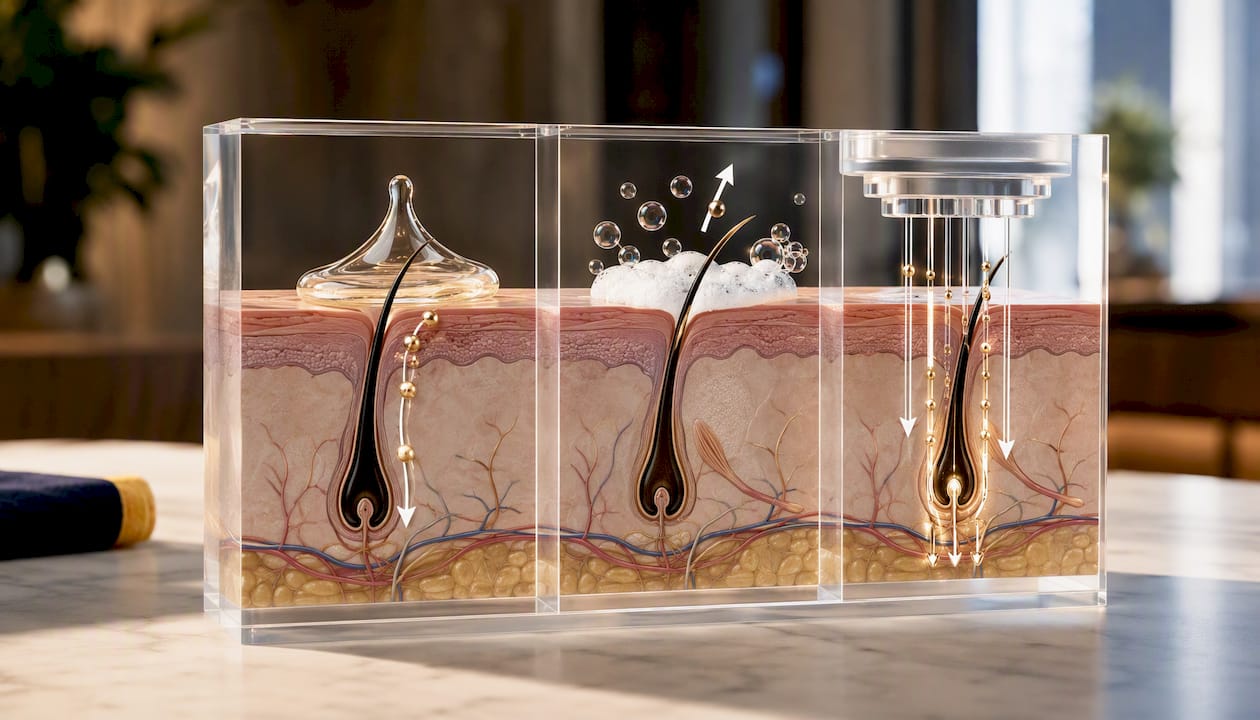
Leave-on serums give peptides the longest contact time with the scalp, which matters because most peptides need sustained exposure to have any chance of penetrating the outer skin layer. Shampoos containing peptides look appealing but offer minimal contact time, often under a minute before rinsing, which limits how much active ingredient can actually reach the follicle. Microneedling or microinfusion methods create temporary micro-channels in the scalp that may improve peptide absorption, and some clinics pair this with topical application for a stronger combined effect. Clinic-administered injectable peptides represent the most direct delivery route, bypassing the skin barrier altogether under professional supervision.
Concentration matters more than most shoppers realize. Cosmetic-grade copper peptide serums typically sit in a low percentage range designed for safety and shelf stability, while research-grade concentrations used in some studies run higher. That's a reason to read labels closely rather than assume "more is better."
Pro Tip: Patch test any new peptide serum on a small patch of skin, like the inside of your wrist, for 48 hours before applying it to your full scalp. Copper peptides in particular can cause contact irritation in people with sensitive skin, and you want to catch that before you've committed a full bottle to the experiment.
A practical rollout looks something like this:
- Take baseline photos under consistent lighting, same angle, same time of day, before you apply anything. Without this, you're relying on memory to judge results months later, and memory is unreliable for gradual change.
- Patch test first, then apply the serum to a clean, dry scalp, focusing on areas of visible thinning rather than the whole head if the product is expensive or concentrated.
- Follow the labeled frequency, typically once or twice daily, and resist the urge to double up thinking it will speed results. It usually just increases irritation risk.
- Stagger application with minoxidil if you're using both, applying one in the morning and the other at night, to reduce the odds of combined irritation and to make it easier to identify which product is causing any reaction.
- Store the product correctly. Many peptide serums are formulated with stabilizers that degrade under heat or direct sunlight, so a bathroom shelf near a shower isn't ideal. A cool, dark cabinet extends shelf life meaningfully.
- Reassess at 8 to 12 weeks for early signs like reduced shedding when you shower or brush, and hold off on a final verdict until the 3 to 6 month mark, which is when density changes, if they're coming, tend to become visible in photos.
Realistic expectations matter here. Reviews of copper peptide evidence, including a FormBlends breakdown of GHK-Cu research, consistently point to a 12 to 16 week window before any early signal shows up, with density assessment reserved for the 3 to 6 month mark. If you haven't seen anything by then, that's useful information, not a reason to keep going another six months hoping it kicks in.
Who Actually Benefits From Peptide Treatments
Peptides tend to help most in situations involving early, diffuse thinning rather than long-standing, advanced hair loss. If you're noticing more strands in the shower drain over the past few months, or you're recovering from a stressful period, illness, or postpartum shedding (a condition called telogen effluvium), that's the profile where a peptide serum has the best shot at making a visible difference.
Scalp barrier recovery is another good-fit case. If your scalp has been irritated by harsh treatments, chemical processing, or an inflammatory skin condition, peptides with anti-inflammatory properties may help create a healthier environment for existing follicles to function normally again.
Peptides alone are a weaker bet in a few specific situations:
- Advanced follicular miniaturization, where follicles have shrunk significantly over years, tends to need pharmaceutical intervention rather than a topical peptide serum working alone.
- Established androgenetic hairline recession without any adjunct treatment rarely responds to peptides by themselves, since the underlying hormonal driver isn't something a topical peptide addresses directly.
A few signs mean it's time to see a dermatologist instead of experimenting further on your own: patchy hair loss in distinct spots (which can indicate alopecia areata), visible scalp inflammation or scaling, or a sudden, dramatic change in shedding volume over a short period. Those patterns often point to something a serum won't fix, and a workup that includes bloodwork for thyroid function and ferritin (iron storage) levels can rule out common underlying causes before you spend months on a topical trial.
Safety, Side Effects, and How to Spot a Quality Product
Peptide serums are generally well tolerated, but they're not risk-free. The most common issues are mild: localized irritation, contact dermatitis in people with sensitive skin, and occasionally a short-lived increase in shedding when a follicle transitions phases faster than expected. None of these are usually dangerous, but they're worth tracking so you can tell the difference between "this isn't working" and "this is causing a reaction."
The dose-dependent copper concern deserves a second mention here because it's easy to miss on a label. In vitro research has flagged a fibrosis signal at high copper-peptide concentrations, meaning cell studies observed tissue stiffening at elevated doses, well above what most cosmetic serums contain. That's not a reason to panic over a standard drugstore product, but it is a reason to avoid unregulated, high-concentration formulations sold without clear labeling.
Worth stating plainly: no peptide currently carries FDA approval specifically for hair regrowth. Minoxidil and finasteride do. Peptide products are typically sold as cosmetics, which means they face a lighter regulatory bar than a drug does, and "not FDA-approved" doesn't necessarily mean unsafe, but it does mean the efficacy claims on the box haven't cleared the same evidentiary hurdle.
A quick quality checklist before you buy:
- Look for a transparent, stated concentration on the label rather than a vague "peptide complex" with no percentage listed.
- Check the vehicle and preservative system. A well-formulated serum should list stabilizers that protect the peptide from breaking down before it ever reaches your scalp.
- Favor brands that link to actual published research rather than just using the word "clinical" as an adjective with nothing behind it.
- Be cautious of unusually high concentrations marketed as "stronger, faster results," particularly with copper peptides, given the fibrosis signal noted above.
How Vitaluxe Drip Lounge Approaches Peptide-Based Hair Protocols
A results-driven clinic doesn't hand a patient a bottle of serum and send them home. The more useful model starts with an actual assessment: a review of hair loss pattern, timeline, and relevant health history, followed by a personalized protocol rather than a one-size-fits-all product recommendation.
At Vitaluxe Drip Lounge, that typically means combining Peptide Services with complementary therapies already shown to support cellular repair and circulation, such as Red Light Therapy for its effect on cellular energy at the follicle level, alongside IV nutrient therapy to address any underlying deficiencies that could be contributing to shedding.
A clinic-based approach also allows for objective tracking that's hard to replicate at home: standardized photographic records taken under consistent lighting, periodic hair density counts in a defined scalp area, and structured check-ins on patient-reported shedding.
Pro Tip: If you're combining peptide therapy with an established treatment like minoxidil, ask your provider to document your protocol in writing, including exact products, frequencies, and start date. It makes the 3 to 6 month reassessment far more accurate than trying to reconstruct your routine from memory.
The workflow generally looks like this:
- Initial consult to assess hair loss pattern, duration, and any red flags warranting bloodwork.
- A personalized combination protocol built around the individual's findings rather than a generic package.
- A defined trial period, typically aligned with the 3 to 6 month window the evidence supports, before reassessing and adjusting.
Why Peptides Don't Work the Same Way for Everyone
Peptide response varies more than most marketing suggests, and a few real factors explain why. Genetics play a role in how sensitive an individual's follicles are to any topical or signal-based intervention, which is part of why the same serum can produce visible results for one person and nothing for another. The underlying cause of hair loss matters just as much. A peptide targeting inflammation or blood flow won't do much for hair loss driven primarily by a hormonal process like androgenetic alopecia, since that requires a different biological lever entirely.
Consistency and duration also break more attempts than people expect. Because measurable change from these products, when it happens, usually takes 3 to 6 months, a lot of people stop using a serum at 6 or 8 weeks out of impatience, right before any real signal would have appeared. Product quality adds another variable. An under formulated serum with an unstable peptide, or one stored improperly and allowed to degrade, may deliver essentially no active ingredient to the scalp regardless of what the label claims.
Finally, severity sets a ceiling on what any topical or adjunct treatment can do. Peptides work at the margins, supporting an already functioning follicle environment, not reversing years of advanced follicular miniaturization on their own.
An Evidence-First Way to Think About Trying Peptides
Treat a peptide serum like a controlled experiment, not a leap of faith. Take baseline photos, pick a defined trial window of 3 to 6 months, and track shedding honestly rather than looking for reasons to feel encouraged after two weeks. That discipline is the difference between an informed decision and money spent on hope.
The strongest results tend to show up in combination protocols, not solo peptide use. Pairing a peptide serum with an established, evidence-backed treatment like minoxidil when it's clinically appropriate gives you the mechanistic support of the peptide alongside the proven efficacy of the drug, rather than betting everything on a category of ingredients still building its human trial base.
Safety comes before optimism. Patch test before a full application, and if you're dealing with sudden, patchy, or unexplained hair loss, see a dermatologist before you spend three months experimenting with a serum that was never designed to address whatever is actually going on underneath. Peptides reward patience and realistic expectations. They punish anyone hoping for a quick fix.
— Debbie
Start a Clinician-Guided Peptide Protocol at Vitaluxe Drip Lounge
Vitaluxe Drip Lounge gives you what a bottle off a shelf can't: a nurse-led team that builds your peptide protocol around your actual scalp, history, and goals, instead of a generic label instruction. That personalized, results-driven approach is the core of how the clinic operates, and it matters most with a category of ingredients where response varies as much as peptides do.

The clinic's Peptide Services sit alongside complementary offerings like Red Light Therapy and IV nutrient therapies, which means your protocol isn't limited to a single serum bottle. If you're already dealing with fatigue, stress, or recovery needs alongside hair thinning, a combined visit can address multiple concerns in the same appointment. For readers planning a longer trial period, the Essential and Elite membership plans make ongoing sessions more manageable than booking one-off visits every time, which fits the 3 to 6 month timeline that peptide response actually requires. Book a consult, get a personalized plan built around your specific pattern of thinning, and let a defined trial period, not guesswork, tell you whether it's working.
Sources
For readers who want to verify the science directly rather than take any product's marketing at face value, these sources cover the strongest available evidence:
- Overview of Short Peptides for Hair Loss - PMC
- Treating female-pattern hair loss — Harvard Health
- Minoxidil topical route — Mayo Clinic
- Biomedicines article (DOI:10.3390/biomedicines14040864)
This article is general information, not a substitute for advice from a qualified doctor. Consult a qualified healthcare professional about your own circumstances before acting on anything here.
FAQ
What Is the Best Peptide for Hair Growth?
There's no single peptide proven superior across the board, but GHK-Cu (copper peptides) has the deepest research history, spanning decades of wound-healing and skin studies before its hair applications were explored. Redensyl and biotinoyl tripeptide-1 are the next most discussed, each targeting a different part of the growth cycle, which is why some formulations combine more than one.
Do Peptides Really Help Hair Grow?
Peptides show real mechanistic activity in cell and animal studies, including effects on dermal papilla stimulation and local blood flow, but human evidence remains limited to small studies rather than large controlled trials. The most honest answer is that peptides can support a healthier scalp environment and may reduce shedding for some people, without being a guaranteed regrowth solution.
Does GHK-Cu Really Regrow Hair?
GHK-Cu has preclinical and small human-study signals suggesting it can support follicle activity, but it lacks the large randomized controlled trials that back FDA-approved treatments like minoxidil. Most dermatologists frame it as a supportive option for early thinning rather than a proven fix for established hair loss.
What Did Jennifer Lopez Use for Hair Loss?
Celebrity hair regimens are frequently reported in entertainment and lifestyle media, but specific ingredient claims attributed to any celebrity aren't independently verified in peer-reviewed research and fall outside what this article's clinical sources cover. The safest approach is judging any peptide product by its own published evidence rather than a celebrity endorsement.
How Much Do Peptide Services Cost at Vitaluxe Drip Lounge?
Pricing for Peptide Services at Vitaluxe Drip Lounge is available on request through the services page. Membership plans that support ongoing multi-session protocols, Essential and Elite, are listed on the membership page.