No peptide is definitively proven to reliably fix sleep in humans. Familiar names like DSIP, Epithalon, and Selank each have some data behind them, but that data is thin: small trials, biomarker studies, or evidence borrowed from related hormones like ghrelin and GHRH. The rest of this guide covers what's actually been studied, what the mechanisms suggest, and where clinical caution belongs before anyone considers peptide therapy for a sleep problem.
TL;DR:
- Human studies on peptides like DSIP and Epithalon show weak or indirect evidence, with DSIP not demonstrating significant benefits in controlled trials.
- Most peptides aim to influence hormone or neurotransmitter pathways, but none function as direct sedatives comparable to conventional sleep medications.
- Sourcing safety remains a concern, as unregulated products from online vendors carry risks of mislabeling, contamination, and inconsistent quality.
- Proper evaluation and addressing treatable causes like sleep apnea or medication effects are essential before considering peptide therapy.
- Physiological data support GHRH and ghrelin's role in sleep regulation, but commercial peptide analogues lack large-scale clinical proof of effectiveness.
Table of Contents
- Which Peptides Come Up in Sleep Research?
- How Might These Peptides Affect Sleep Biology?
- What Does Human Evidence Actually Show?
- Are Sleep Peptides Safe, and Are They Regulated?
- How Do Clinicians Decide If a Peptide Is Worth Considering?
- What Do Real-World Protocols and Patient Reports Look Like?
- How Vitaluxedriplounge Thinks About Peptides and Sleep
- Ready to Talk Through Your Sleep Concerns With a Nurse?
- Sources
- FAQ
Which Peptides Come Up in Sleep Research?
Anyone who spends an evening searching "peptides for sleep" runs into the same five or six names again and again. They're not interchangeable, and the quality of evidence behind each one varies more than most marketing pages let on.
Delta sleep-inducing peptide (DSIP) is the oldest name in this conversation, isolated from rabbit brain tissue decades ago and studied off and on ever since. Its receptor and exact mechanism still aren't fully mapped out, and a ScienceDirect overview of DSIP notes that results across species and small human studies have been mixed. The peptide is named for a proposed link to delta wave activity during deep sleep, but naming something after an effect doesn't prove the effect holds up in a clinic.
Epithalon (sometimes marketed under the Epithalamin lineage) gets pitched as an anti-aging and circadian-support peptide. The actual human data measures melatonin secretion in elderly subjects, not sleep quality itself. That's an important distinction covered in more depth below.
Selank is a Russian-developed peptide studied mostly for anxiety and cognitive effects. Any sleep benefit shows up as a secondary finding in small trials focused on anxiolytic outcomes, not as a primary sleep endpoint.
Ghrelin and GHRH aren't obscure research peptides. They're hormones with a real, measured role in sleep physiology, backed by actual polysomnography data. The catch is that the popular peptide "analogues" sold for sleep and recovery, including ipamorelin, CJC-1295, and sermorelin, work on the same growth hormone secretagogue pathway but haven't been tested directly for sleep outcomes. Ipamorelin specifically acts as a ghrelin-receptor agonist, which is a reasonable mechanistic story, but a mechanism isn't a clinical trial.
A handful of other names circulate in forums and vendor sites without carrying real sleep-specific evidence:
- BPC-157, studied mostly for gut and tissue repair, with no meaningful sleep trial data
- GHK-Cu, a copper-binding peptide studied for skin and wound healing, occasionally rebranded for "recovery" claims that stretch past what's been tested
- Pinealon, a peptide bioregulator marketed for pineal gland support with almost no independent human sleep research behind it
The honest summary: two peptides here (DSIP and Epithalon) have actual human study data, though weak or indirect. Selank has anxiety-focused human data. Ghrelin and GHRH have solid physiologic data, but the commercial products built around that pathway are extrapolations, not proven sleep treatments.
How Might These Peptides Affect Sleep Biology?
Sleep isn't controlled by one switch. It's regulated by a network of hormones and neurotransmitters that rise and fall across the night, and each peptide discussed here is thought to nudge a different part of that system.
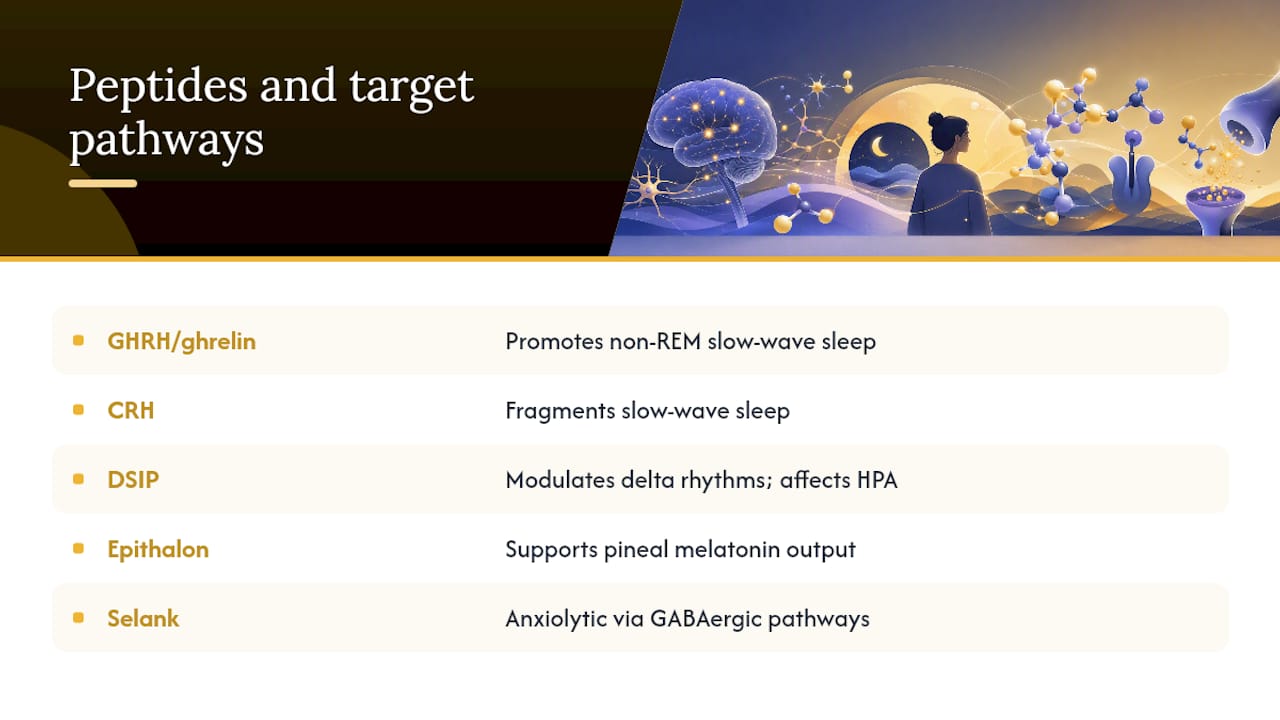
GHRH and ghrelin sit closest to a mechanism backed by real physiology. Growth hormone release is tightly coupled to slow-wave sleep, the deep, restorative stage that also happens to decline sharply with age. A review on peptides and sleep disorders describes how GHRH promotes non-REM slow-wave sleep, while corticotropin-releasing hormone (CRH), a stress peptide, does the opposite and fragments it. That push-pull relationship between growth-promoting and stress-related hormones is one of the better-established stories in sleep neuroendocrinology.
DSIP's proposed role is different and murkier. It's theorized to modulate delta EEG rhythms directly and interact with the hypothalamic-pituitary-adrenal (HPA) stress axis, potentially blunting cortisol responses that keep people wired at bedtime. A research overview from Blackwell BioLabs points out that DSIP appears to touch multiple hormone systems, including CRH/ACTH and growth hormone patterns, rather than acting on a single dedicated sleep receptor. That multi-axis behavior is part of why trial results have been inconsistent. A peptide that nudges four different systems a little is harder to standardize than one that hits a single target hard.
Epithalon's story runs through the pineal gland, the small structure responsible for producing melatonin, the hormone that governs your circadian clock. The theory is that Epithalon supports pineal function well enough to normalize melatonin output, particularly in older adults whose natural production has declined. That's a biomarker effect, not a sleep-outcome effect, and the difference matters more than most marketing copy admits.
Selank works through a different route entirely: anxiolytic and GABAergic pathways. GABA is the brain's primary calming neurotransmitter, and drugs that boost GABA signaling (including benzodiazepines) are sedating for exactly that reason. If Selank meaningfully reduces anxiety, it's plausible that people fall asleep faster simply because their minds are quieter at bedtime, not because the peptide is acting as a sleep-specific agent.
Pro Tip: If your sleep problem is "I can't shut my brain off," an anxiolytic mechanism like Selank's is theoretically more relevant than one aimed at deep-sleep architecture, like DSIP's. Matching the peptide's mechanism to your actual complaint matters more than picking whatever is trending.
None of these peptides functions like a sedative. Zolpidem and similar sleep drugs bind GABA-A receptor sites directly and force the nervous system down. These peptides, at best, modulate hormone rhythms and stress signaling that indirectly shape sleep. That's a meaningfully different (and weaker) kind of intervention.
What Does Human Evidence Actually Show?
This is where enthusiasm runs into data, and the gap is bigger than most product pages suggest.
The most direct test of DSIP for insomnia is also one of the oldest and most sobering. A controlled, double-blind trial published by Bes and colleagues tested short-term DSIP treatment in 16 chronic insomniacs and concluded it was "not likely to be of major therapeutic benefit." That's not a hedge from a marketing team. That's the actual language from a controlled clinical trial, and it's more than three decades old. Nothing in the interim has produced a large, well-designed study that overturns it.
Epithalon's human data tells a different but equally limited story. Work summarized by Korkushko and colleagues found normalization or increases in nighttime melatonin secretion in elderly subjects given Epithalon. That's a real, measurable biological effect. What it isn't: a trial that tracked whether those subjects actually slept better, longer, or with fewer awakenings. Biomarker movement and clinical improvement are two different things, and conflating them is one of the most common sleight of hand moves in peptide marketing.
Ghrelin and GHRH have the strongest physiologic backing of the group. Small polysomnography studies, the gold-standard method for objectively measuring sleep stages, found that infusing ghrelin or GHRH in healthy men increased slow-wave sleep, according to research summarized in a review of ghrelin and GHRH infusion studies. That's genuine, EEG-confirmed evidence for a mechanism. The problem is scope: those studies used infused native hormone in controlled lab settings, not the injectable analogues sold commercially. Ipamorelin, CJC-1295, and sermorelin ride on that mechanistic coattail without their own sleep-specific trial data.
Here's the pattern across all four peptide categories, laid out plainly:
| Peptide | Type of human evidence | Sleep-outcome trial? |
|---|---|---|
| DSIP | Controlled trial, small sample | Yes, but negative/weak result |
| Epithalon | Biomarker study (melatonin levels) | No, biomarker only |
| Selank | Anxiolytic trials, secondary sleep notes | No, not primary endpoint |
| Ghrelin/GHRH (native hormone) | Polysomnography, small samples | Yes, positive for slow-wave sleep |
| Ipamorelin/CJC-1295/sermorelin | Mechanistic inference only | No direct sleep trials |
A review examining trial registries found few or no registered large-scale clinical trials testing DSIP, Epithalon, or Pinealon specifically for sleep. That's not a gap that quietly closed. It's an active, current absence of the kind of evidence (large, randomized, placebo-controlled) that would let anyone say a peptide reliably improves sleep in humans.
The honest summary: the mechanisms are interesting and, in the case of GHRH/ghrelin, backed by real physiologic data. But interesting mechanisms and small or dated trials are not the same as clinical proof. Nobody should read "increased slow-wave sleep in a lab study of healthy men" and hear "proven treatment for insomnia."
Are Sleep Peptides Safe, and Are They Regulated?
None of the peptides discussed here are FDA-approved medications for sleep. That's a plain regulatory fact, not a technicality. They're sold, where they're sold at all, through a research-chemical market, compounding pharmacies, or wellness clinics operating under varying degrees of oversight, and the quality of what actually arrives in a vial can vary enormously.
Sourcing is the biggest practical risk. Peptides bought from unregulated online vendors carry real risk of mislabeling, incorrect dosing concentration, and contamination, since these products often aren't manufactured under the same quality controls as approved pharmaceuticals. Peer-reviewed commentary on peptide safety consistently flags this gap between what's marketed and what's been clinically validated, and recommends clinician oversight and licensed sourcing as the baseline for reducing risk, not an optional upgrade.
Beyond sourcing, a few safety concerns come up specifically with the sleep-related peptides:
- Injection-site reactions and infection risk from repeated self-administered subcutaneous injections, especially with non-sterile technique or reused needles.
- Endocrine disruption, particularly relevant for anything touching the GH/ghrelin axis, since chronic manipulation of growth hormone pathways can affect glucose metabolism and other hormone systems over time.
- Allergic or immune reactions, which are possible with any injected peptide, especially ones with variable manufacturing quality.
- Unknown long-term effects, since most human data on these compounds comes from short trials or small cohorts, not multi-year safety follow-up.
If any of this sounds like it should involve a clinician rather than a vendor's dosing chart, that instinct is correct.
Pro Tip: Ask specifically where a peptide product is manufactured and whether it comes with a certificate of analysis. A legitimate provider can answer that question in one sentence. A vague answer is itself useful information.
Harm reduction here isn't complicated: get baseline labs before starting anything, work with a licensed provider who can monitor for endocrine or metabolic changes, steer clear of anonymous online vendors regardless of how professional their packaging looks, and stop immediately if you notice new symptoms, whether that's swelling at an injection site, mood changes, or unusual fatigue.
How Do Clinicians Decide If a Peptide Is Worth Considering?
Peptides sit at the back of the line, not the front. Before any peptide enters the conversation, a proper evaluation should rule out the far more common and far better-treated causes of poor sleep.
That starts with screening for obstructive sleep apnea, which affects a substantial share of adults with chronic sleep complaints and is frequently missed until someone actually looks for it. It continues with a review of medications and substances (caffeine timing, alcohol, certain antidepressants, and stimulants all disrupt sleep architecture in well-documented ways), plus an honest look at mental health and circadian rhythm patterns. Clinical guidance consistently frames structured evaluation for treatable causes as the necessary first step, not a formality to rush past on the way to something more novel.
Once treatable causes are ruled out or addressed, matching a peptide's proposed mechanism to a patient's specific "failure mode" makes more clinical sense than reaching for whatever is trending online:
- Anxiety-driven difficulty falling asleep points toward Selank's anxiolytic mechanism, not DSIP.
- Loss of deep, restorative sleep architecture points toward the DSIP or GHRH rationale, weak as the DSIP trial data is.
- Circadian misalignment, particularly in older adults with blunted melatonin rhythms, points toward the Epithalon biomarker story.
Certain findings should stop the conversation entirely or push it toward a specialist rather than a peptide protocol: untreated obstructive sleep apnea, pregnancy, unstable endocrine disease, and active cancer are reasonable hard limits given how these peptides interact with hormone axes.
Any supervised trial of a peptide should include a monitoring plan from day one: a sleep diary at minimum, actigraphy or formal polysomnography when the situation calls for it, and periodic labs to track for the endocrine effects mentioned above. A short, defined trial window with clear stop criteria beats an open-ended "just keep taking it and see" approach every time.
What Do Real-World Protocols and Patient Reports Look Like?
Protocols circulating in clinician reports and peptide guides are consistent in one sense: none of them are backed by large validated trials. A protocol summary from DosagePeptide describes Epithalon typically used in cyclic patterns of roughly 10 to 20 days, while DSIP protocols range from single-night dosing to short multi-day courses. Those patterns reflect accumulated clinical experience, not standardized, trial-validated dosing.
Patient-reported outcomes follow a familiar pattern for anything with weak trial backing: results are mixed, some people report a single strong night followed by nothing notable, and expectation effects run high given how these products are marketed. That's not a dismissal. It's a reason to lean on objective measurement rather than subjective impression alone.
A few practical points for anyone working through this with a clinician:
- Track sleep with something more objective than memory. A basic sleep diary combined with a wearable actigraphy device, or formal polysomnography when warranted, catches real change that subjective "I think I slept better" impressions often miss or exaggerate.
- Set a defined trial length and a stop rule in advance. If a peptide hasn't produced a measurable change after that window, that's useful information, not a reason to add a second unproven compound on top of the first.
- Avoid stacking multiple unproven peptides at once. If something changes, you won't know which compound did it, and if something goes wrong, you won't know which one is responsible.
Pro Tip: If a protocol involves layering three peptides "for synergy," treat that as a red flag rather than a selling point. Combining unproven variables makes the outcome harder to interpret, not easier.
How Vitaluxedriplounge Thinks About Peptides and Sleep
Our approach starts with evaluation, not a peptide menu. A sleep complaint gets assessed for the common, treatable culprits before any peptide conversation happens, and any plan that follows is built around the individual, not a one-size protocol pulled off a vendor site.
Peptides used in our programs are clinic-sourced rather than pulled from unregulated online markets, and every plan runs under nurse-led medical oversight from intake through follow-up. That structure exists specifically because the evidence gaps covered above are real: peptides may support a broader wellness plan, but they're not presented as a guaranteed fix for insomnia or sleep architecture problems. If you're weighing a supervised consultation to talk through where peptides might reasonably fit into your situation, that conversation belongs with a clinician who can look at your actual sleep pattern, not a dosing chart on a forum.
— Debbie
Ready to Talk Through Your Sleep Concerns With a Nurse?
Some wellness clinics offer nurse-led evaluations and clinical oversight for peptide therapies, providing a more personalized starting point than online vendors. Instead of guessing which peptide might match your situation from a product description, you get an actual conversation about what's driving your sleep issue and whether a supervised approach, peptide-based or otherwise, makes sense for you.

The clinic's Peptide Services sit alongside broader recovery and wellness offerings, including IV therapies and other adjunctive treatments, so a consultation can address sleep in the context of your overall energy, stress load, and recovery rather than in isolation. For people interested in ongoing supervised care rather than a single visit, the Essential and Elite membership plans build in regular follow-up, which matters more than a one-off session when you're tracking something as variable as sleep. If you're ready to have that first evaluation conversation, book a visit through the services page and bring your sleep history with you.
This article is general information, not a substitute for advice from a qualified doctor. Consult a qualified healthcare professional about your own circumstances before acting on anything here.
Sources
- Bes et al., Controlled DSIP trial (PubMed record)
- Korkushko et al., Epithalon melatonin studies (PubMed record)
- Roles of peptides and steroids in sleep disorders (PubMed review)
- Weikel / Kluge - ghrelin/GHRH infusion polysomnography studies (PubMed record)
FAQ
What Peptides Make You Sleepy?
None of the commonly discussed peptides, including DSIP, Epithalon, and Selank, act as direct sedatives the way sleep medications do. They're theorized to modulate hormone rhythms or anxiety pathways that can indirectly affect sleep, but human trial evidence for an actual sedating effect is thin to negative, as the DSIP trial illustrates.
What Is the Most Powerful Supplement for Sleep?
There isn't a single peptide or supplement with strong, consistent human trial evidence for treating insomnia broadly. Standard first-line approaches, including cognitive behavioral therapy for insomnia and treating underlying causes like sleep apnea, currently have far stronger clinical backing than any peptide discussed here.
Is DSIP Actually Backed by Clinical Research?
DSIP has been studied since its discovery decades ago, but the most relevant controlled human trial, involving 16 chronic insomniacs, found it unlikely to offer major therapeutic benefit. Its mechanism also remains incompletely characterized, according to a ScienceDirect summary of DSIP research.
Does Epithalon Improve Sleep or Just Melatonin Levels?
Human studies of Epithalon measure melatonin secretion, not sleep quality directly. Research in elderly subjects found normalized or increased nighttime melatonin, but no trial has tracked whether that translates into measurably better sleep.
Can I Get Peptide Therapy Through Vitaluxedriplounge?
Yes, Vitaluxedriplounge offers peptide services as part of a broader wellness program under nurse-led oversight. Pricing for Peptide Services is available on request through the clinic directly, since it's individualized to the plan discussed during your evaluation.