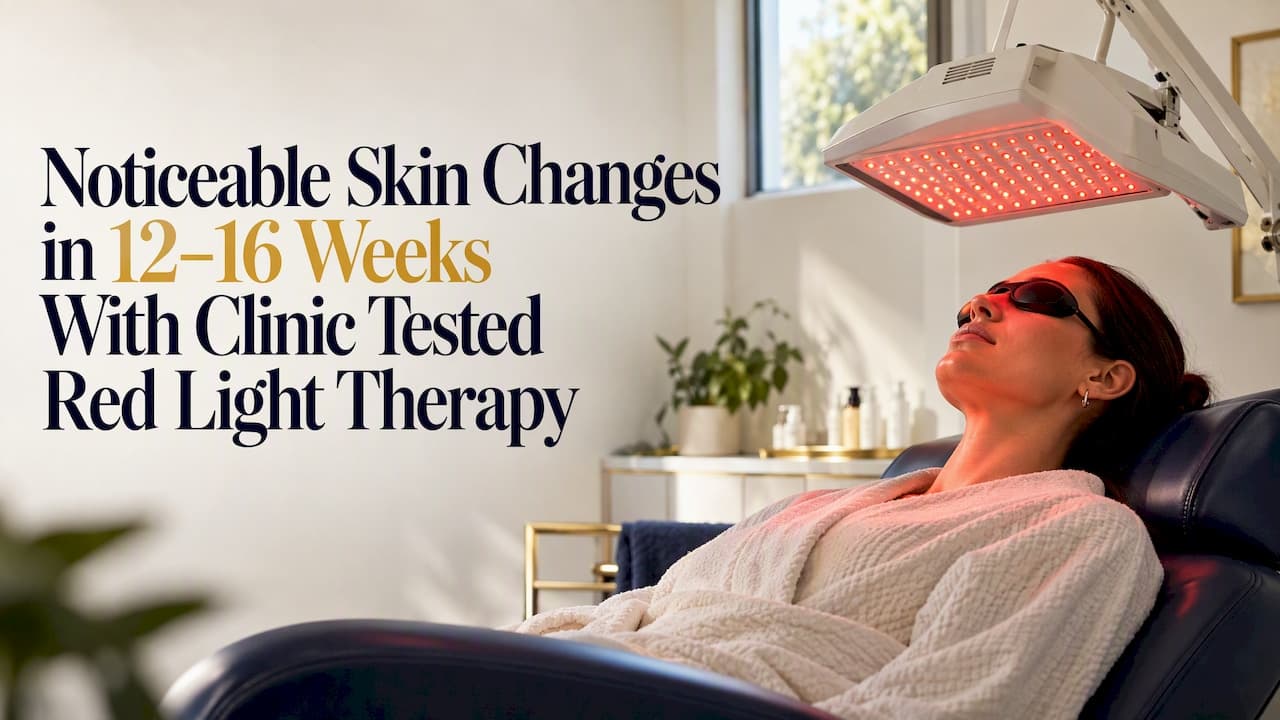
Red light therapy can modestly improve surface signs of skin aging, texture, and complexion when used consistently over weeks to months, not days. It works best as an addition to a solid skincare routine rather than a replacement for it. If you take photosensitizing medications or have a complex skin condition, check with a dermatologist before starting.
TL;DR:
- Red light therapy requires several weeks of consistent use, with optimal results typically seen after 12 to 16 weeks of multiple weekly sessions.
- Combining red and near-infrared wavelengths generally yields better outcomes for wrinkles and skin structure than using a single wavelength alone.
- Devices with higher irradiance and proper wavelength specifications deliver more meaningful results, but at-home panels usually produce milder effects compared to clinical systems.
- People on photosensitizing medications or with complex skin conditions should consult a dermatologist before starting red light therapy to avoid adverse reactions.
- Red light therapy offers modest, gradual improvements with minimal side effects, making it best suited as an adjunct to a comprehensive skincare routine rather than a quick fix.
Table of Contents
- What red light therapy is and how it works
- Clinical evidence: what trials and reviews say about skin outcomes
- Safety, side effects, and who should avoid red light therapy
- How to use red light therapy for skin: settings, frequency, and realistic timelines
- At-home devices versus professional or clinic treatments
- Getting the most out of red light therapy at home
- How to choose a red light therapy device
- How red light therapy compares to other skin treatments
- The honest gap between red light therapy marketing and results
- Getting red light therapy at Vitaluxe Drip Lounge
- FAQ
- Sources
What red light therapy is and how it works
Red light therapy, also called photobiomodulation or low-level light therapy, uses specific wavelengths of visible and near-infrared light to trigger changes inside skin cells. It does not involve heat or UV radiation the way tanning beds or ablative lasers do. Instead, light particles are absorbed directly by structures inside cells and set off a chain of biological responses.
The wavelengths that matter most fall into two bands. Red light sits around 600 to 700 nanometers and mostly affects the epidermis and upper dermis. Near-infrared light runs from roughly 800 to over 1000 nanometers and reaches deeper into the dermis, where collagen-producing fibroblasts live. Many clinical devices and trials combine both bands, since red light "acts" on surface texture while near-infrared supports structural layers beneath it.
The proposed mechanism centers on mitochondria, the energy-producing structures inside cells. A compound called cytochrome c oxidase absorbs red and near-infrared light particularly well. Once energized, it ramps up ATP production, the cell's basic fuel. This process also releases nitric oxide, a molecule tied to blood flow and cell signaling. The downstream effects researchers have measured include:
- Increased fibroblast activity, which supports new collagen synthesis
- Reduced inflammatory signaling, which may calm redness and irritation
- Improved microcirculation, which can support tissue repair
- Modest antioxidant effects that may offset some oxidative stress in skin cells
Penetration depth depends heavily on wavelength and the device's output. A weak at-home panel emitting low irradiance will not reach the same tissue depth as a calibrated clinical system, even if both claim "red light therapy" on the label. Fluence, the total light energy delivered to the skin over a session, is the variable that determines whether a dose is biologically meaningful or just a warm glow. Harvard Health notes that device output and session consistency affect results more than marketing claims do, and that the mechanism is biologically plausible even though optimal dosing is still being worked out.
Clinical evidence: what trials and reviews say about skin outcomes
The clinical picture for red light therapy on skin is encouraging but uneven. The strongest data comes from a handful of randomized controlled trials, and the results vary depending on what was measured, how long the study ran, and which wavelengths were used.
One of the better-designed trials, a prospective randomized controlled study with 136 volunteers, found statistically significant improvements in skin complexion, skin feeling, and profilometric roughness after 30 sessions of polychromatic or red-only light therapy compared with a control group. Blinded photo evaluation showed visible change, and ultrasound imaging confirmed increased intradermal collagen density, giving the subjective improvements objective backing.
A separate randomized, sham-controlled trial testing combined 630 nanometer and 850 nanometer light in a mask format found significant improvement in periocular wrinkles after 12 to 16 weeks of regular use, with improvement rates in some assessments that were notably higher than the sham device. That trial reinforces a pattern seen across this research: combining red and near-infrared wavelengths tends to outperform single-wavelength protocols for wrinkle-related outcomes, likely because the combination addresses both epidermal texture and deeper dermal structure at once.
A 2013 randomized trial on low-level light therapy for hair reported a 39% increase in hair counts after 16 weeks of treatment, a useful data point because it demonstrates that photobiomodulation can produce measurable, quantifiable biological change in human tissue when dosing is adequate, even though that particular trial measured hair rather than skin.
Where does the evidence hold up best, and where does it get shakier? A few patterns stand out:
- Fine lines, overall complexion, and collagen density have reasonably consistent trial support across multiple study designs.
- Mild to moderate skin roughness and texture improvements show up repeatedly in controlled trials with blinded evaluation.
- Some acne protocols using blue or combined red/blue light show promise, though red light alone has less acne-specific data than it does for texture and aging.
- Deep, established wrinkles and long-term durability of results are weaker areas. Most trials run 12 to 16 weeks, so what happens after a year of maintenance or after stopping treatment is not well documented.
Stanford Medicine's review of the science puts this in useful perspective: evidence for skin benefits is real but modest compared to some other photobiomodulation uses, like hair regrowth, and many consumer marketing claims go further than the data supports. That caution matters because trial protocols differ substantially. Some use polychromatic light, others isolate single wavelengths. Fluence and session frequency vary from study to study, and treatment courses range from a few weeks to several months. This methodological patchwork means dose optimization, the ideal combination of wavelength, intensity, and frequency, is still an open question, not a settled formula.
Safety, side effects, and who should avoid red light therapy
Red light therapy has a favorable safety profile compared to more invasive skin treatments, and Harvard Health describes it as generally safe with minimal short-term side effects. That does not mean it is risk-free for everyone.
Common effects people notice after a session are mild and temporary:
- Slight redness or warmth in the treated area, usually gone within hours
- Mild dryness or tightness, especially with frequent use and no moisturizer
- Rare eye strain or discomfort if protective eyewear is skipped during facial treatments
- Occasional temporary irritation in people with very reactive or sensitized skin
Clinical-grade devices deliver meaningfully higher irradiance than most at-home panels, which changes the safety calculus. A supervised session uses a calibrated dose matched to skin type and treatment goal. An unsupervised at-home device at close range for an extended period can still cause irritation, even though its absolute output is lower than clinical equipment.
Photosensitizing medications and conditions deserve real attention here. Certain antibiotics, retinoid medications, and conditions like lupus can increase skin sensitivity to light-based treatments. Harvard Health specifically recommends dermatologist consultation for people on photosensitizing medications or with complex skin conditions before starting red light therapy. This is not a formality: combining light exposure with a photosensitizing drug can amplify irritation or trigger a reaction that would not happen with either factor alone.
Eye protection matters during any facial session, since direct exposure to concentrated light sources can cause discomfort or strain even when the wavelength itself is not classified as damaging like UV light. For people with darker skin tones, a conservative approach is worth following: starting with lower intensity and frequency, then monitoring for any unexpected pigment changes before increasing the dose, since photosensitive reactions can be more noticeable on deeper skin tones.
Pro Tip: Start with the lowest recommended intensity and frequency for your device, then track your skin's response for two weeks before increasing either variable.
How to use red light therapy for skin: settings, frequency, and realistic timelines
Clinical trials give a reasonably consistent picture of what an effective protocol looks like, even though exact parameters vary by study. Most trials that showed measurable improvement ran sessions several times a week over a period of 12 to 16 weeks, with some longer protocols extending to 30 total sessions over roughly ten weeks.
Four variables determine whether a session is doing anything meaningful:
- Wavelength: Look for devices specifying output in the red (roughly 600 to 700 nanometers) or near-infrared (roughly 800 to 1000 nanometers) range, since these are the bands used in the trials showing benefit.
- Irradiance or fluence: This is the actual energy delivered to skin, usually listed in milliwatts per square centimeter or joules per square centimeter. Low-powered devices need longer sessions or closer distance to approach the doses used in trials.
- Distance from the skin: Most at-home panels specify an optimal distance, often 6 to 12 inches; moving farther away reduces effective dose substantially.
- Frequency per week: Three to five sessions weekly appears more often in trials showing results than once-weekly use.
A conservative starting routine looks like this: 10 minutes per session, three times a week, at the manufacturer's recommended distance, for the first two to three weeks. If skin tolerates this well with no irritation, many people extend to four or five sessions weekly, matching the frequency used in trials with stronger reported outcomes.
Realistic timelines matter for staying consistent. Visible changes in skin feel or mild roughness may appear within four to six weeks, but the collagen density and wrinkle improvements documented in trials generally required 12 weeks or more of regular use. Once initial improvement plateaus, a maintenance cadence of two to three sessions weekly tends to sustain results, though long-term durability beyond a year is not well studied yet.

At-home devices versus professional or clinic treatments
The core trade-off between at-home LED panels and clinic-based systems comes down to power and supervision. At-home devices are convenient and allow daily flexibility, but most operate at lower irradiance than clinical equipment, which means longer timelines to reach the cumulative dose used in trials. Clinic systems deliver higher, calibrated output under supervision, which can shorten the path to visible results and allows a practitioner to adjust the protocol to your skin's response in real time.
FDA clearance is worth understanding correctly. A device being FDA-cleared means it meets safety standards for its stated intended use, not that it has been proven effective for every skin concern someone might want to treat with it. As one product guide focused on photobiomodulation devices notes, clearance indicates safety for specified uses rather than a guarantee of results across conditions.
A few practical questions help decide which route fits:
- Is your goal cosmetic maintenance (texture, glow) or a more persistent concern like visible fine lines and uneven collagen density?
- Do you want to combine red light with other treatments, which usually requires professional oversight to sequence safely?
- Is your budget better suited to a one-time device purchase or pay-per-session professional care?
- Would you benefit from a practitioner adjusting dose and distance based on how your skin responds over several weeks?
If you are managing a more complex skin issue, especially one involving medication interactions or prior treatments like peels or lasers, a professional consultation is the safer starting point.

Getting the most out of red light therapy at home
Getting results from a home device comes down to consistency and preparation. Cleanse skin before each session so light is not blocked by makeup, sunscreen, or heavy product buildup, which can reduce how much light actually reaches skin cells. Keep the device at the distance specified in its manual; moving closer does not necessarily increase benefit and can increase irritation risk, while moving farther away reduces the effective dose below what trials used.

Apply red light therapy to bare or minimally treated skin, then follow with your regular skincare products afterward rather than before. Many people pair sessions with a vitamin C serum or a peptide-based moisturizer, since both support the same collagen-related pathways that red light appears to stimulate, though combining treatments has not been tested as rigorously as red light alone in controlled trials.
Protective eyewear is worth using for facial sessions, even with lower-powered home devices, since direct exposure to concentrated light can cause discomfort. Track your skin weekly with the same lighting and angle so you can judge genuine change rather than day-to-day variation in appearance.
How to choose a red light therapy device
Device quality varies enormously, and price alone is not a reliable indicator of effectiveness. The features worth checking before buying are the ones tied directly to the biological mechanism: wavelength specification, irradiance output, and treatment area size.
Look for a device that states its wavelength output in nanometers rather than just calling itself "red light," since generic marketing language can mask a device emitting too narrow or too weak a spectrum to match trial conditions. Irradiance, measured in milliwatts per square centimeter, tells you how concentrated the light output actually is at the recommended distance. A practical product guide backed by photobiomodulation research recommends checking for third-party testing data on output, since self-reported specifications are not always accurate.
Price ranges for consumer devices span widely, from small handheld wands to full-face masks and larger panels, with cost generally scaling with treatment area and power output. For readers weighing an at-home purchase against trying the treatment first, guides on at-home red light use can help clarify what a given device is realistically capable of before committing to a purchase.
A device cleared by the FDA for cosmetic use at least confirms it meets baseline safety standards, which is worth confirming before relying on it for regular sessions.
How red light therapy compares to other skin treatments
Red light therapy occupies a specific niche within skin treatment options: low risk, low downtime, and modest, gradual results. Compared to ablative or fractional laser treatments, which work by creating controlled tissue damage to trigger a stronger healing and collagen response, red light therapy is far gentler and requires no recovery period, but it also does not produce the dramatic, faster improvements that lasers can achieve for deeper wrinkles or significant texture issues.
Chemical peels work through a different mechanism entirely, removing outer skin layers to reveal fresher skin underneath and stimulate renewal. Peels can show visible results faster than red light therapy but come with downtime, potential peeling, and sun sensitivity afterward. Red light therapy has none of that recovery burden.
Dermatology organizations frame red light therapy as most useful as an adjunct to other proven treatments rather than a standalone replacement for them, tailoring protocols to individual skin types and goals. In practice, that often means red light therapy complements a skincare routine or supports recovery after a more intensive procedure, rather than competing head-to-head with lasers or peels for someone who wants dramatic change quickly.
The honest gap between red light therapy marketing and results
The biggest disconnect in this space is not whether red light therapy works. It is how fast and how dramatically people expect it to work based on marketing rather than data. A review examining marketing claims against the clinical evidence found that consumer messaging often overstates both the speed and magnitude of benefit, positioning red light as something closer to a cure for deep wrinkles than the trials actually support.
My honest read of the research is that red light therapy earns its place as a legitimate, evidence-backed tool for texture, complexion, and collagen support, but it is a slow, cumulative intervention, not a quick fix. The trials showing real effect sizes required consistent use over months, not a few sessions before a big event. Anyone expecting laser-level results from a handheld wand used twice a week for a month will likely be disappointed, and that gap between expectation and reality is what drives most of the skepticism around this treatment. The people who get the most out of it tend to be the ones who treat it like a long-term skincare habit rather than a one-time fix, similar to how sunscreen or retinoids only pay off with months of consistent use.
— Debbie
Getting red light therapy at Vitaluxe Drip Lounge
We offer in-clinic Red Light Therapy sessions designed around the same principle the research supports: consistent, properly dosed exposure matters more than any single session. We calibrate sessions to your skin goals and can combine red light therapy with other offerings when that combination fits your broader wellness plan.

In-clinic care fits best if you want calibrated dosing without guessing at distance or intensity, or if you are already working with us on another protocol and want red light therapy folded into the same visit.
- A single Red Light Therapy session is $35, listed with our full services menu
- Our Essential and Elite membership plans are built for ongoing sessions at a predictable monthly cost
- We offer discounts as part of our commitment to community wellness
Book a session directly through our services page or reach out through Vitaluxedriplounge to ask which plan fits your goals.
This article is general information, not a substitute for advice from a qualified doctor. Consult a qualified healthcare professional about your own circumstances before acting on anything here.
FAQ
Is red light therapy actually effective for skin?
Evidence from randomized trials shows modest, measurable improvements in skin complexion, roughness, and collagen density after consistent use over 12 to 16 weeks or more. It works best as a gradual, adjunct treatment rather than a fast fix for deep wrinkles.
Why don't doctors recommend red light therapy more often?
Many physicians view the evidence as real but still modest compared to other skin treatments, and dosing protocols are not yet standardized across devices. Stanford Medicine notes that consumer marketing often overstates benefits beyond what current research supports, which makes some clinicians cautious about endorsing it broadly.
Are there any negatives to red light therapy?
Side effects are typically mild, including temporary redness or dryness, and serious risks are uncommon. People on photosensitizing medications or with complex skin conditions should consult a dermatologist first, since Harvard Health flags these as the main groups needing extra caution.
How long should I use red light therapy on my face?
A common starting routine is about 10 minutes per session, three to five times weekly, with visible texture changes often appearing within four to six weeks. Collagen-related improvements documented in trials generally required a longer course of 12 weeks or more of consistent use.