Selank is the peptide with the strongest evidence for anxiety and stress regulation, while Semax has more clinical weight behind cognitive recovery and neuroprotection, particularly after ischemic stroke. Neither is FDA-approved for general cognitive enhancement in healthy adults, and both remain under active regulatory review. The right choice depends entirely on your specific goal, and either one requires clinician oversight before use.
TL;DR:
- Semax's strongest evidence supports its use for stroke recovery and neuroprotection, especially in defined short courses under medical supervision.
- Selank has more robust clinical backing for reducing anxiety without sedation, but both peptides are not FDA-approved for healthy adult cognitive enhancement.
- Both peptides influence brain-derived neurotrophic factor levels, yet their primary benefits and research origins differ significantly.
- Reliable use requires clinician oversight, precise dosing confirmation, and understanding that current evidence does not support self-prescribing or widespread off-label use.
- Combining Selank and Semax lacks controlled trial support and presents unknown interaction risks, so consulting a healthcare professional before stacking is essential.
Table of Contents
- What Is Selank?
- What Is Semax?
- Why Do Semax and Selank Work Differently?
- What Do Clinical Trials Actually Show?
- Safety, Regulation, and Product Quality
- How Are Semax and Selank Actually Dosed in Studies?
- Semax or Selank: Which One Fits Your Goal?
- Can You Combine Selank and Semax?
- How Supervised Peptide Care Actually Works
- What Actually Matters Once You Get Past the Hype
- Ready for a Supervised Peptide Evaluation?
- Where to Read the Primary Research
- Sources
- FAQ
What Is Selank?
Selank is a synthetic peptide derived from tuftsin, developed and studied primarily in Russian clinical research for anxiety and immune modulation. Most trials administer it intranasally, though formulations and concentrations vary widely between research settings and commercial suppliers, which matters if you're comparing products rather than lab-grade study material.
The clinical signal that keeps showing up across Selank research is a reduction in anxiety scale scores without the sedation that comes with benzodiazepines. That's the headline finding people search for when they ask about selank for anxiety.
- Derived from tuftsin, an immune-regulatory peptide fragment
- Studied mainly through intranasal delivery in clinical settings
- Reported reducing anxiety without sedative side effects
- Some studies note secondary improvements in cognitive measures among treated patients
What Is Semax?
Semax comes from a different lineage entirely. It's derived from ACTH(4–10), a fragment of adrenocorticotropic hormone, and the bulk of its human evidence centers on ischemic stroke recovery, attention, and neuroprotection rather than everyday mental sharpness.
In stroke research, Semax has been given intranasally in short, defined courses, not as an open-ended daily supplement. Healthy-subject studies exist, but they're smaller, less consistent, and don't carry the same weight as the stroke trials. If you're comparing semax benefits against Selank's anxiety profile, the honest picture is that Semax's strongest human data comes from people recovering from neurological injury, not from healthy people chasing an edge.
- Derived from ACTH(4–10), a fragment of a stress hormone precursor
- Strongest human evidence tied to ischemic stroke recovery
- Intranasal administration used in defined short courses in trials
- Healthy-adult nootropic claims rest on thinner, less definitive data
Why Do Semax and Selank Work Differently?
The mechanistic split between these two peptides explains almost everything about why they get grouped into different use cases.
- BDNF and NGF signaling. Both peptides have been linked to increased brain-derived neurotrophic factor, a biomarker tied to neuroplasticity. This is the mechanistic anchor for nearly every modern review of these compounds, and it's why both peptides show up in discussions of cognitive support.
- Semax and dopaminergic modulation. Semax appears to influence dopamine pathways in addition to BDNF and NGF activity, which lines up with the attention and neuroprotective findings seen in stroke research.
- Selank and enkephalin/GABA pathways. Selank inhibits enkephalinase, the enzyme that breaks down enkephalins, and modulates GABA and serotonin activity. That combination produces anxiolytic effects without the sedation profile of a benzodiazepine.
Statistic to know: a study of 110 post-stroke patients found that two courses of Semax at 6,000 mcg per day for 10 days, spaced 20 days apart, raised plasma BDNF levels and improved functional recovery on the Barthel index compared to standard rehabilitation alone.
The overlap in BDNF activity explains why both peptides occasionally show secondary cognitive benefits in their respective trials. But the endpoint each was tested against, symptom relief for Selank, functional recovery for Semax, is what actually separates their evidence bases.
What Do Clinical Trials Actually Show?
Semax's most cited human data comes from stroke recovery, not healthy-user cognition. The 110-patient study mentioned above is the strongest modern reference point, but an older 1997 trial in acute hemispheric ischemic stroke also reported faster restoration of neurological function in patients given 12 to 18 mg per day compared to conventionally treated controls. That trial predates modern randomized, blinded standards, so it should be read as historical support rather than definitive proof.
- Semax stroke trials used defined dosing courses, not indefinite daily use
- Selank anxiolytic trials report reduced anxiety without dependence or sedation
- Sample sizes across both peptides' human trials are modest by modern standards
- Long-term safety data and healthy-adult cognitive enhancement remain the weakest evidence points
Selank's anxiolytic trials, run largely in Russian clinical settings, compared it against active anxiety treatments and consistently reported symptom reduction without the withdrawal risk associated with benzodiazepine-class drugs. That's a meaningful distinction for anyone asking whether selank for anxiety is a realistic alternative to standard prescriptions, though it's not a substitute for a psychiatric evaluation.
The gap to watch: promising biomarker changes, like a BDNF increase in a stroke patient, do not automatically translate into a noticeable cognitive boost for someone who is already healthy. Indication-specific evidence does not generalize cleanly, and that's the single most misunderstood point in most semax reviews you'll find online.
Safety, Regulation, and Product Quality
Neither Semax nor Selank carries FDA approval for cognitive enhancement in healthy adults. Both have appeared in FDA briefing materials prepared for the Pharmacy Compounding Advisory Committee, and it's worth being precise about what that means: committee review is an advisory step, not an endorsement or a safety clearance.
Recent PCAC meeting materials go further, proposing that Semax acetate and Semax free base not be included on the 503A Bulks List, a list that governs which substances compounding pharmacies can legally use. That proposal signals ongoing regulatory scrutiny, not a green light for wellness use.
- Semax free base and Semax acetate are chemically distinct; product labeling should specify which form is used
- Neither peptide has an established USP monograph, so purity and potency verification depend on the supplier
- Sterility and dosing accuracy vary significantly across compounding sources
- A full medication review, pregnancy status check, and psychiatric history review should happen before any use
Pro Tip: If you're evaluating a supplier, ask for a certificate of analysis specifying whether the product is Semax acetate or Semax free base. The distinction affects dosing equivalence and is a detail most casual sellers skip entirely.
How Are Semax and Selank Actually Dosed in Studies?
Intranasal delivery is the dominant route in nearly every clinical trial for both peptides, with occasional injectable formats used in older research contexts. The Semax stroke regimens, 6,000 mcg per day for 10 days in two separate courses, or 12 to 18 mg per day in the older trial, were designed for a specific injury window under medical supervision, not as templates for ongoing self-use.
- Onset and duration vary by indication; stroke recovery timelines differ completely from anxiety symptom relief timelines
- Reported study durations range from days to a few weeks, not months of continuous use
- No study regimen accounts for individual baseline health, medication interactions, or long-term use
- Self-prescribing from a stroke trial protocol without clinical monitoring is not a safe extrapolation
Semax or Selank: Which One Fits Your Goal?
Matching the peptide to the problem starts with an honest look at what you're actually trying to solve, not what you've read online.
- Define the goal. Persistent anxiety or stress-related impairment points toward Selank's evidence base; post-injury cognitive recovery or attention deficits point toward Semax's.
- Get a baseline diagnosis. A clinician should confirm whether your symptoms match an anxiety disorder, a cognitive deficit, or something else entirely before either peptide makes sense.
- Review current medications. Interactions with psychiatric medications, hormonal therapies, or other prescriptions haven't been well studied for either compound.
- Flag red-flag conditions. Unstable psychiatric illness, pregnancy, autoimmune disease, or any interacting medication regimen should trigger a clinician evaluation before proceeding, not after.
If your primary issue is anxiety without sedation risk, Selank has the more direct clinical support. If you're dealing with recovery from a neurological event or documented attention deficits, Semax's stroke and neuroprotection data carries more weight.
Can You Combine Selank and Semax?
Controlled trials testing Semax and Selank together don't exist. Anecdotal reports of stacking them for combined anxiolytic and cognitive effects circulate widely, but anecdote is not evidence, and unknown interaction risks compound when you combine two under-studied peptides at once.
- A cautious, clinician-led approach starts with baseline measures before any trial
- Introduce one peptide at a time at a conservative dose
- Keep the trial period short and document outcomes objectively, not just subjectively
- Reassess before extending or adjusting either dose
Pro Tip: If a clinician does consider a supervised trial of both peptides, running them sequentially rather than simultaneously makes it far easier to identify which one is producing which effect.
How Supervised Peptide Care Actually Works
Peptide therapies often form part of broader wellness models that include cellular repair, hydration, and recovery treatments, along with options like Red Light Therapy and IV Vitamin Therapy. The approach leans on nurse-led medical oversight rather than self-directed dosing, which matters given how much of the Semax and Selank evidence base still depends on clinical supervision. Individuals may seek support during high-stress periods, such as college semesters or after intense physical training, for energy, mental clarity, and recovery. Some wellness providers offer special pricing considerations for groups like first responders and college students, reflecting a focus on community wellness access.
What Actually Matters Once You Get Past the Hype
Most of the online chatter around semax vs selank treats both peptides like interchangeable nootropics you can just try. That's not what the evidence supports. Selank's anxiety data and Semax's stroke recovery data are two different evidence bases answering two different questions, and neither one was built to answer "will this make a healthy person sharper?"
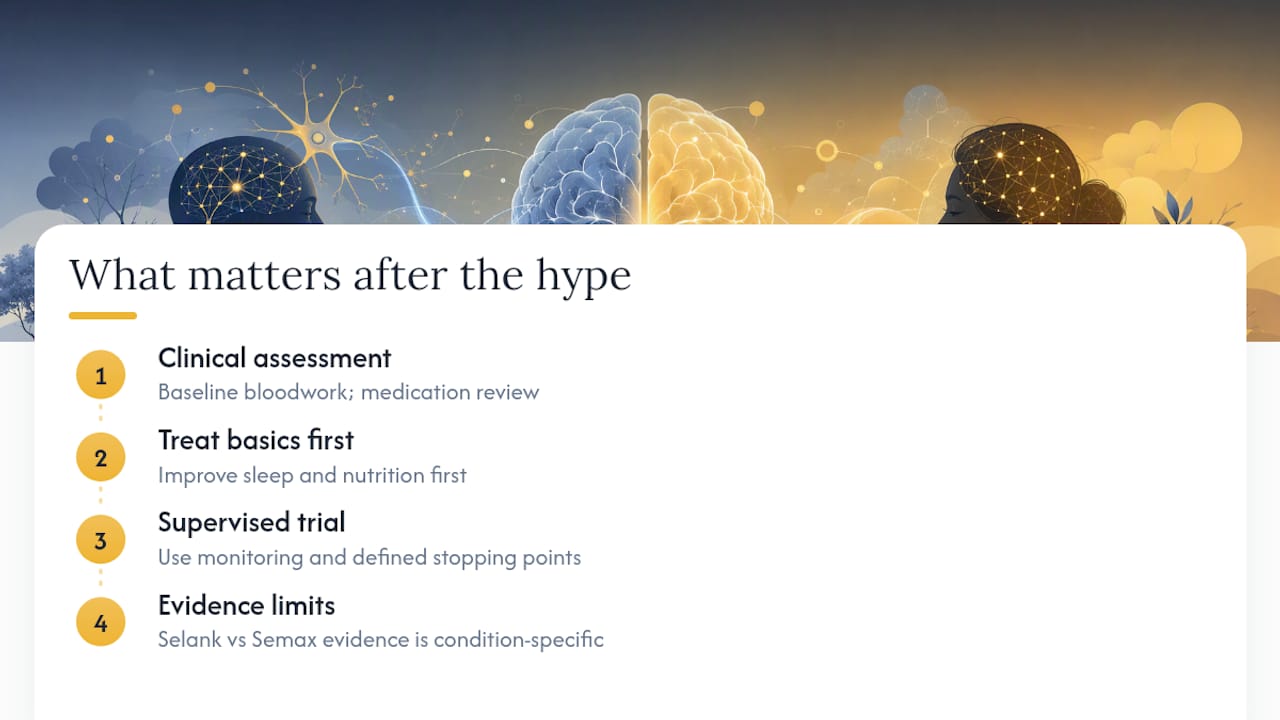
The smarter move is prioritizing a real clinical assessment before anything else: baseline bloodwork, a medication review, an honest look at sleep and nutrition. Half the time, what people call "brain fog" resolves with fixes that don't involve a peptide at all. If a supervised trial still makes sense after that, it should come with monitoring and defined stopping points, not guesswork.
— Debbie
Ready for a Supervised Peptide Evaluation?
If you're weighing Semax against Selank and want more than a forum thread's worth of guidance, Certain wellness providers offer peptide services with medical screening and nurse-led oversight, embodying the kind of supervision emphasized in this article.

A typical visit starts with a health screening and informed-consent conversation about what the current evidence does and doesn't support, followed by supervised administration and a follow-up check to track how you're responding. This isn't a walk-in vending-machine model. It's built around the same clinical caution outlined throughout this guide, matched with the personalized attention Vitaluxedriplounge applies across its wellness services. These include NAD+ therapy and Red Light Therapy. If ongoing supervised care fits your goals better than a one-off session, the membership plans offer recurring access starting with the Essential tier. Book a consultation to get a baseline evaluation before deciding whether a supervised peptide trial makes sense for you.
Where to Read the Primary Research
- FDA briefing and PCAC materials — for the actual regulatory status and 503A listing discussion, not secondhand summaries
- Peer-reviewed stroke and anxiolytic trials — for the clinical outcomes each peptide's reputation is built on
- Mechanistic reviews on BDNF and enkephalin pathways — for understanding why the two peptides diverge in effect
Clinicians and informed readers get more out of reading the FDA's own briefing document than any secondhand blog summary, since it lays out exactly what "under review" means in practice.
Sources
- FDA briefing document: Semax-related bulk drug substances (background material)
- Effectiveness of Semax in acute hemispheric ischemic stroke (PRIME/UnboundMedicine entry)
- Representative PMC article on peptide mechanisms and BDNF (PMC9030433)
FAQ
What Is the Difference Between Semax and Selank?
Semax is studied mainly for stroke recovery, attention, and neuroprotection, while Selank is studied mainly for anxiety and stress regulation without sedation. Both share a mechanistic link to BDNF, but their strongest clinical evidence comes from different patient populations entirely.
Can Selank and Semax Be Used Together?
No controlled trials have tested the two together, so any combination is experimental and should only happen under clinician supervision with baseline monitoring. Anecdotal stacking reports exist, but they don't substitute for controlled evidence.
Is Semax Good for ADHD?
Semax's evidence base centers on stroke recovery and attention-related outcomes in neurologically injured patients, not a diagnosed ADHD population. There's no established clinical trial data supporting Semax as an ADHD treatment, and it isn't FDA-approved for that use.
What Peptide Is Better Than Semax?
"Better" depends entirely on the goal. For anxiety and stress regulation, Selank has more direct supporting evidence; for cognitive recovery after neurological injury, Semax's stroke trial data is currently stronger than Selank's. A supervised evaluation, like the peptide services offered through Vitaluxedriplounge, is the most reliable way to determine which fits your specific situation.