
The right route depends on why you want the vitamin. If your gut absorbs nutrients well and you simply need a daily top-up, a pill does the job. If absorption is the problem, if you want a nutrient delivered at a measured dose, or if you want a nurse-supervised session timed around a hard week, an injection or IV is the more direct path. At Vitaluxe Drip Lounge, our nurse-led team helps you match the route to the goal, from a $25 B12 shot to a full IV session.
TL;DR
- A pill has to survive digestion. At high doses, the share of B12 your gut absorbs drops sharply, according to the NIH Office of Dietary Supplements.
- Injections bypass the gut. That matters most when a condition, a medication or age limits absorption.
- Low B12 can be silent or look like ordinary tiredness, so a blood test is the right first step before choosing any route.
- IV therapy delivers fluids and several nutrients in one session. It is a prescription-level treatment in the US and belongs in a clinical setting.
- We offer B12 shots, NAD+ injections, IV drips, and memberships, so you can pick the route that fits your routine.
Table of Contents
- What actually differs between a pill and an injection
- B12: shots, pills and sublingual tablets
- Do you actually need B12? Signs and testing
- Injections vs. IV: not the same thing
- Safe use: what to ask and what to tell us
- Matching the route to your goal
- What it costs at Vitaluxe
- Our perspective
- Book the route that fits
- FAQ
- Sources
What actually differs between a pill and an injection
A pill, capsule or sublingual tablet goes through your digestive system, or through the lining of your mouth. An injection goes into muscle, and an IV goes straight into a vein. That is the whole difference, and it shapes everything else: how much reaches your blood, how fast, and how much your own digestion gets a say.
For B12, the gut is a bottleneck. The NIH explains that the body absorbs roughly half of B12 at very small doses (under 1 to 2 micrograms), but only about 2% at 500 micrograms and about 1.3% at 1,000 micrograms. Absorption depends on stomach acid and a protein called intrinsic factor, and anything that disrupts either one lowers what you take in. The same fact sheet notes that for deficiency caused by pernicious anemia (an autoimmune condition that blocks B12 absorption) or other malabsorption, B12 is typically given by injection, usually into the muscle.
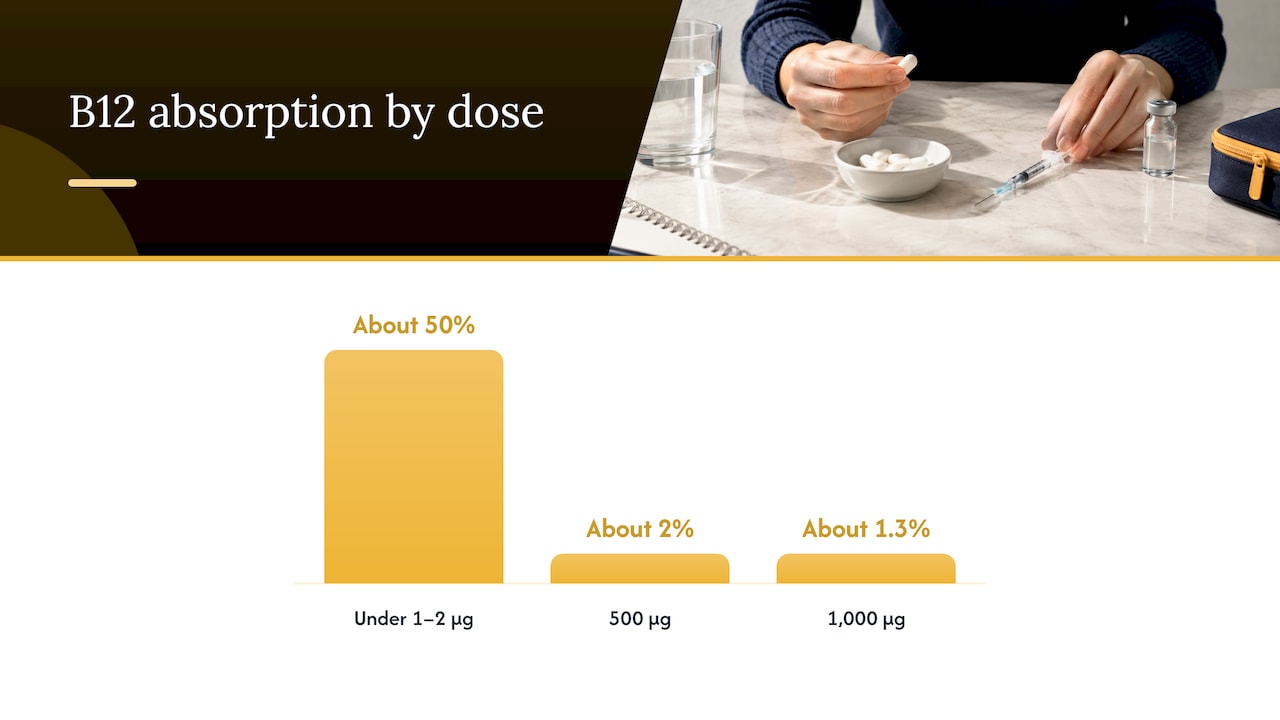
That is why a shot is a practical answer when the pill route is unreliable. It does not depend on your stomach, your intestine or your medication list.
B12: shots, pills and sublingual tablets
B12 is the most searched vitamin in this comparison, and the research is detailed.
Pills raise levels in many people. A 2025 meta-analysis in Frontiers in Pharmacology pooled 16 studies with 6,098 participants and found that B12 supplementation raised blood cobalamin and lowered homocysteine across oral, sublingual and intramuscular routes, with no statistically significant difference between routes. The American Academy of Family Physicians summarizes trial data showing that oral and intramuscular B12 normalize blood levels over one to four months, with the dose mattering: 1,000 micrograms daily by mouth matched 1,000 micrograms by injection.
Sublingual is a form of oral. A 2026 systematic review of 13 studies found that sublingual B12 raised serum levels about as well as the other routes in the short term. The NIH adds that evidence points to no difference in efficacy between swallowed and sublingual forms. In a 2016 trial of 34 people on metformin, sublingual methylcobalamin reached higher blood levels than injected hydroxocobalamin at three months (372.1 vs 251.7 pmol/L). That is a small study, but it shows that the form and the schedule both matter, not only the route.
Shots are the route built for malabsorption. A 2024 review in a SAGE journal states that when B12 malabsorption is the problem, injections are preferred and there is currently no evidence that oral or sublingual products can safely replace them in those cases. The review adds that up to half of people may need an individualized injection schedule. If you have pernicious anemia, have had stomach or ileal surgery, or your clinician has told you that you absorb poorly, the injection is the standard tool.
In practice, that gives a simple rule of thumb:
| Your situation | Route that usually fits |
|---|---|
| Healthy gut, occasional dips in intake | Daily oral or sublingual B12 |
| Confirmed malabsorption or pernicious anemia | Intramuscular B12 |
| Long-term metformin or acid-reducer use | Testing first, then oral or injection per your results |
| You want a quick, supervised dose without a daily habit | In-clinic B12 shot |
| Low B12 with numbness or tingling | See your physician promptly, injection is commonly used |
The last row is a safety point. According to the NIH, neurological symptoms can appear without anemia, and early diagnosis helps avoid damage that does not reverse. Numbness, tingling, trouble walking or memory changes call for a physician visit and a blood test.

Do you actually need B12? Signs and testing
American Family Physician (September 2025) reports that B12 deficiency affects roughly 2% to 3% of US adults. Risk factors include malabsorption, limited dietary intake, long-term metformin or proton pump inhibitor use, and older age. Symptoms can include fatigue, brain fog, depression, peripheral neuropathy and unsteadiness.
Because fatigue and fog have many causes, the testing path matters:
- Total serum B12. The same AAFP article says a result under 180 pg/mL is diagnostic of deficiency.
- Borderline results. A level of 180 to 350 pg/mL calls for a follow-up marker called methylmalonic acid (MMA), which confirms deficiency when elevated.
- Context. Testing makes the most sense if you have at least one risk factor and at least one symptom.
The NIH also notes that marginal status, roughly 200 to 300 pg/mL, is common in Western populations and often comes without classic symptoms. Bring recent lab results to your visit and we can talk through which route fits your numbers. If your labs point to a medical condition, your physician leads the diagnosis and we work alongside that plan.
B12 has no established upper intake limit, since the body does not store the excess, according to the NIH. That is part of why B12 shots are among the gentlest entries on a vitamin menu. One caution from the AAFP: levels that stay above 1,000 pg/mL on two separate tests deserve a physician's evaluation, so repeat shots are best paired with periodic blood work. For more on who benefits and what to expect, see our guide to when B12 shots help.
Injections vs. IV: not the same thing
People often lump all non-pill options together, but they are different services.
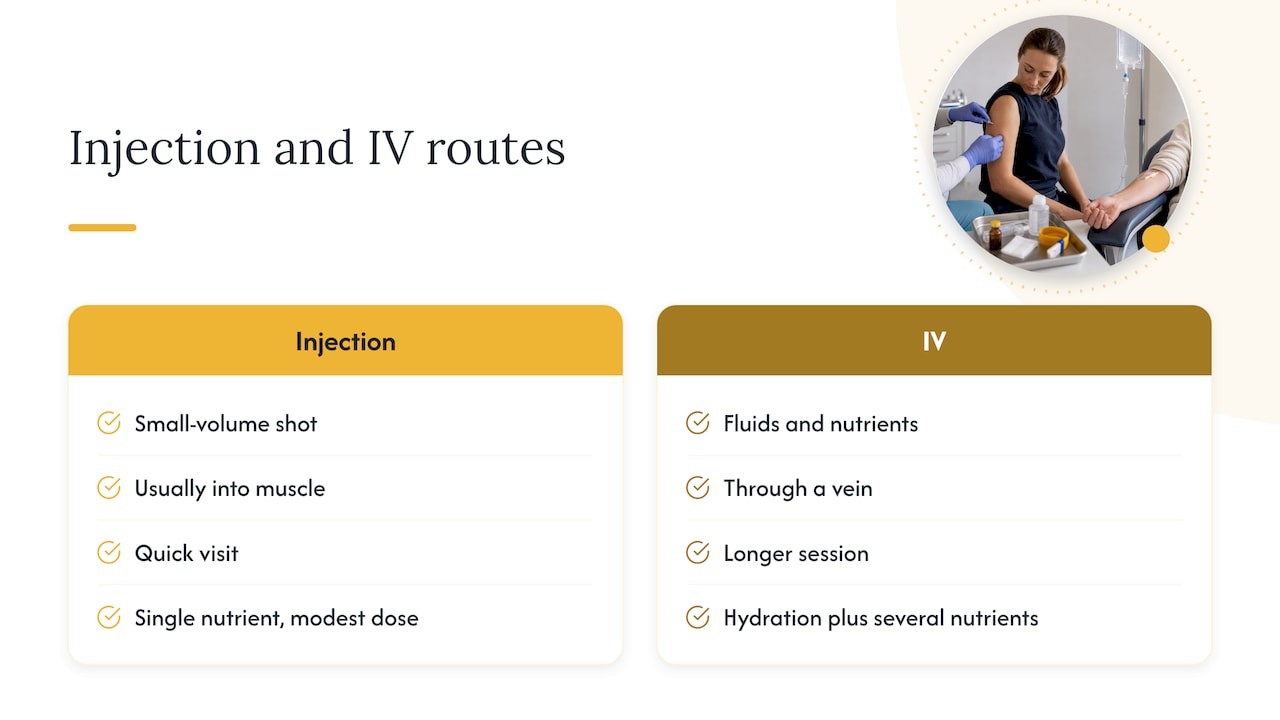
Vitamin injections are small-volume shots, usually into the muscle. They are quick, and they suit single nutrients such as B12, L-Carnitine, or NAD+ at a modest dose. They are also the better fit when you want a fast visit between classes, shifts or workouts. If you are curious about blends, our overview of the B-complex injection covers dosing and frequency.
IV therapy runs fluids and nutrients through a vein over a longer session. IV delivery bypasses the digestive tract, so the nutrients enter the bloodstream directly. A 2025 review describes bioavailability near 100% for IV nutrients. This is the route to consider when hydration plus several nutrients at once is the goal: after heavy exertion, a rough stretch of exams, a demanding run of shifts, or a seasonal slump. Our post on what is actually in an IV bag explains the ingredients in plain terms.
The two routes also differ legally. A 2021 article in Nutrition Today notes that in the US, IV nutrients are treated as drugs or parenteral nutrition, and that IV fluids, electrolytes and vitamins are prescription drugs. In plain terms, an IV should be administered under clinical oversight, by a licensed professional who screens you first. That is the reason a nurse-led setting matters.
Safe use: what to ask and what to tell us
For any injection or infusion, the useful safety habits are the same.
- Share your medications and conditions. Metformin, acid reducers, kidney or heart conditions, and pregnancy all change what is appropriate. A 2025 review lists the risks of IV therapy as infection, vein irritation, electrolyte imbalance, fluid overload and allergic reactions, which is why screening and sterile technique come first.
- Mind the dose of water-soluble vitamins. MD Anderson physician Meroë Morse, M.D., notes that IV infusions can push blood vitamin levels more than 100 times higher than oral intake, and that too much B-6 can be toxic. She advises discussing IV therapy with a physician first, which is especially important during cancer treatment.
- Do not stack products without a plan. Taking a daily high-dose supplement and getting regular shots of the same vitamin deserves a conversation about your total intake.
- Know the side effects. Our write-up on IV hydration side effects explains what to watch for and when to call a physician or seek emergency care.
If you take prescription medication or have a chronic condition, check with your physician before starting any IV or injection program. Their go-ahead, plus a nurse who screens you at each visit, is the safe way to begin.
Matching the route to your goal
Here is how the choice tends to look for the people we see most.
Energy and focus. If a blood test shows low B12, a shot or a daily sublingual tablet are both established ways to replenish it. If your results are normal and you want a boost, an energy-focused drip or a NAD+ option is a different tool aimed at cellular energy, rather than a replacement for a pill.
College students. Late nights, irregular meals and dehydration are the usual drivers. A hydration-focused IV or a quick B12 shot fits a packed schedule better than remembering several supplements, and we offer discounts for college students.
First responders. Long shifts and irregular sleep leave little room for a daily routine. A single in-clinic visit for recovery support is easy to schedule, and we offer discounts for first responders.
Immunity during seasonal changes. Pills can cover everyday intake. For concentrated support at the start of cold and flu season, see how immunity drips are timed.
Anti-aging and beauty. Glutathione and NAD+ are the common requests here. If you are also planning aesthetic treatments, sequencing matters, and this guide to microneedling and Botox timing explains how providers space them out.
Peptides. Peptide therapies are personalized, so we discuss them in a consultation rather than from a menu. Ask us about them at your visit.
Vitamin D. Many people assume a pill is the only option. If your levels are low, our guide to the vitamin D injection explains who it suits and what it costs.
What it costs at Vitaluxe
Our published prices (read from our site in September 2026) let you compare routes by what you want out of the visit.
| Service | Price |
|---|---|
| B12 shot | $25 |
| L-Carnitine shot | $25 |
| NAD+ IM 25mg | $65 |
| Red Light Therapy | $35 |
| Normal Saline IV | $120 |
| NAD+ IV 125mg | $199 |
| NAD+ IV 250mg | $334 |
| NAD+ IV 500mg | $624 |
| Signature drips (Energy Vital Spark, Reboot, Myers+, Clarity Boost, LeanLuxe, Endurance, Glutathione) | $220 each |
| High Dose Vit C | $185-$395 |
| Essential membership | $205 per month |
| Elite membership | $415 per month |
Peptide services have no published price, so we quote those after a consultation.
Our perspective
Most people who ask us about shots versus pills are really asking a different question: what is getting in the way? Sometimes it is a diet gap, and a daily supplement is a fine answer. Sometimes it is absorption, a medication, a long schedule, or a body that needs a dose delivered reliably. That is where a nurse-led visit earns its place.
We built Vitaluxe around personalized care in a boutique setting. You are not handed a menu and sent to a chair. You talk with a clinician about your goals, your history and what you already take, and the route follows from that. A $25 B12 shot, a hydration drip after a brutal week, a NAD+ session or a monthly membership are all tools, and the point is choosing the right one.
Pills are part of a healthy routine for many of our clients. Injections and IV therapy are for the moments when you want something more direct, measured and supervised. We would rather you leave with a clear plan than a bag of supplements you forget to take.
Debbie
Book the route that fits
If you have decided a shot or a drip fits your goal, our services page lists every option with its price, from single injections to IV sessions. For ongoing support, our Essential and Elite memberships are $205 and $415 per month. We serve clients across Long Island, from Massapequa and Wantagh to Babylon and Lindenhurst, and first responders and college students receive special discounts.

FAQ
Are B12 shots better than pills?
It depends on why your level is low. Shots go around the digestive system, so they are the standard route when a condition or surgery limits absorption. For people with normal absorption, a daily oral or sublingual dose also raises blood levels, as pooled research shows. A blood test tells you which situation you are in.
Is sublingual B12 as good as an injection?
For raising blood levels in people who absorb normally, sublingual B12 performs similarly to other routes in the research, and the NIH finds no difference in efficacy between swallowed and sublingual forms. If you have confirmed malabsorption, injections are the preferred route. Your physician can confirm which applies to you.
Are IV vitamins the same as vitamin injections?
No. An injection is a small shot of one nutrient or a short blend, usually into the muscle. An IV runs fluids and nutrients through a vein over a longer session, which makes it a good fit for hydration and multi-nutrient support. Both should be given under clinical oversight.
How often can I get a B12 shot?
Because B12 has no established upper intake limit, it is generally well tolerated, but the schedule should match your labs and symptoms. Your clinician can set the frequency, and periodic blood tests help confirm your levels stay in a healthy range.
Sources
- Vitamin B12 Health Professional Fact Sheet, NIH Office of Dietary Supplements
- Efficacy of sublingual and oral vitamin B12, Frontiers in Pharmacology, 2025
- Oral vs. Intramuscular Vitamin B12, American Family Physician, 2022
- Comparative efficacy of vitamin B12 supplementation routes, PMC, 2026
- Sublingual vitamin B12 compared to intramuscular injection, PubMed, 2016
- A Brief Overview of the Diagnosis and Treatment of B12 Deficiency, 2024
- Vitamin B12 Deficiency: Common Questions and Answers, American Family Physician, 2025
- To IV or Not to IV: The Science Behind Intravenous Vitamin Therapy, PMC, 2025
- IV vitamin therapy: Is it safe to use during chemo? MD Anderson, 2025
- Consumer Intravenous Vitamin Therapy, Nutrition Today, 2021