
IV fluids can help with food poisoning, but only for one job: replacing the water and salts you lose through vomiting and diarrhea. They do not kill the bug. They keep you hydrated while your body clears it. For most people the first step is oral rehydration at home, severe cases belong in an emergency room, and nurse-led IV hydration fits in the recovery window once the worst has passed and you still feel wrung out. At Vitaluxe Drip Lounge we offer a $120 Normal Saline drip for exactly that kind of hydration support. Below is how to tell which situation you are in.
TL;DR
- Food poisoning is mainly a fluid-loss problem. The goal of any treatment, oral or IV, is replacing water and electrolytes (the salts your body needs to function).
- Start with small, frequent sips of an oral rehydration solution. Most food poisoning improves without treatment, usually within 48 hours.
- If you cannot keep fluids down, or you show signs of dehydration, get medical care. Severe cases are treated with IV fluids in a hospital.
- Fever, bloody stools, diarrhea past 3 days, confusion or severe pain are not drip-lounge problems. They need a doctor or the ER.
- Once you are through the acute phase, a nurse-led saline drip can help you rehydrate and get back on your feet.
Table of Contents
- What food poisoning actually does to your body
- Can IV fluids help with food poisoning?
- What to do first at home
- Oral or IV: what the research shows
- When to skip the lounge and go to a doctor or ER
- The recovery window: where IV hydration fits
- Who tends to need the recovery option
- How to prevent a repeat
- Our perspective
- Book your recovery session
- FAQ
- Sources
What food poisoning actually does to your body
Food poisoning is an infection or toxin exposure from contaminated food. The symptoms are familiar: nausea, vomiting, watery diarrhea, cramps. The danger is not the bug itself in most adults. It is what the vomiting and diarrhea take with them.
According to Cleveland Clinic, severe dehydration is the most common complication of food poisoning, and symptoms typically last 12 to 48 hours. When you vomit or have diarrhea, you lose both salt and water, which is why plain water alone is not always the best replacement. That is also why the treatments doctors talk about, from sports-style electrolyte drinks to hospital drips, all aim at the same thing: getting fluid and electrolytes back in.
Most people never need more than rest and fluids. The NIDDK, part of the National Institutes of Health, says most people recover without medical treatment and that replacing lost fluids and electrolytes is the most important treatment.
Can IV fluids help with food poisoning?
Yes, when dehydration is the problem. Mayo Clinic explains that after vomiting or loose stools you should replace fluids, and that serious dehydration may require a hospital stay to get fluids and electrolytes through a vein. The Merck Manual, a standard clinical reference, says mild dehydration can be treated with oral glucose-electrolyte solutions or broth, while isotonic IV fluids such as Ringer's lactate or normal saline are given for severe dehydration.
Isotonic simply means the fluid has a salt concentration similar to your blood, so it replaces volume without pulling water in or out of your cells. Normal saline is the plain version: sterile water with salt.
The American Medical Association, quoting a physician, notes that people with a lot of diarrhea or vomiting might need IV fluids to treat or prevent dehydration. The same article points out that most people do not need antibiotics, even with a bacterial infection. So an IV is not a cure for the infection. It is a way to restore fluid quickly when your gut cannot do it.
Why an IV works when drinking does not
If you are vomiting every time you swallow, oral fluids never get absorbed. An IV delivers fluid straight into the bloodstream, bypassing the stomach. MedlinePlus, the National Library of Medicine's health encyclopedia, says that if you cannot drink or keep down fluids, you may need fluids through a vein. The Merck Manual adds that an anti-nausea medicine such as ondansetron can help patients who cannot tolerate oral fluids because of vomiting. A clinician decides on that medicine, which is a prescription drug.
What to do first at home
For a typical case, begin here, and begin early. Do not wait until you feel parched.
- Take small, frequent sips. Gulping triggers more vomiting. Sip a few teaspoons every few minutes, then increase gradually.
- Choose an oral rehydration solution. The NIDDK names products such as Pedialyte, Naturalyte, Infalyte and CeraLyte and says older adults, adults with a weakened immune system and anyone with severe diarrhea or signs of dehydration should drink them. A 2026 American Family Physician review recommends reduced-osmolarity oral rehydration solution as first-line therapy for mild to moderate dehydration in people with acute vomiting or diarrhea.
- Use broth or a homemade mix if that is what you have. MedlinePlus gives a recipe: half a teaspoon of salt, half a teaspoon of baking soda and 4 tablespoons of sugar in 1 liter of water. Measure carefully, because too much salt or sugar works against you.
- Ease back into food. Start with bland foods once the vomiting settles.
- Track what is going in and what is coming out. If urine is dark or you have not urinated in many hours, you are behind on fluids.
How dehydration shows up
The AMA lists excessive thirst, dry mouth, muscle cramps, dizziness or confusion, dark urine, and not urinating for more than 5 hours. The NIDDK adds light-headedness, decreased skin elasticity and sunken eyes, and says anyone with signs of dehydration should see a doctor or go to the ER right away.

Oral or IV: what the research shows
The research that compares oral and IV rehydration is mostly in children, and it points to a clear sequence. A Cochrane review of 17 trials with 1,811 children found no clinically important difference between oral and IV rehydration for gastroenteritis dehydration, with roughly one in 25 children treated orally eventually needing an IV. American Family Physician likewise reports that oral rehydration is as effective as IV for mild to moderate dehydration, while hospitalization and IV fluids are recommended for children who do not respond to oral therapy and for severe dehydration.
What this means in practice: oral rehydration is the first move, and IV fluids are the step up when the first move fails or dehydration is already significant. That step up is the reason IV fluids exist in food poisoning care. It is not a competition between the two. It is a sequence.
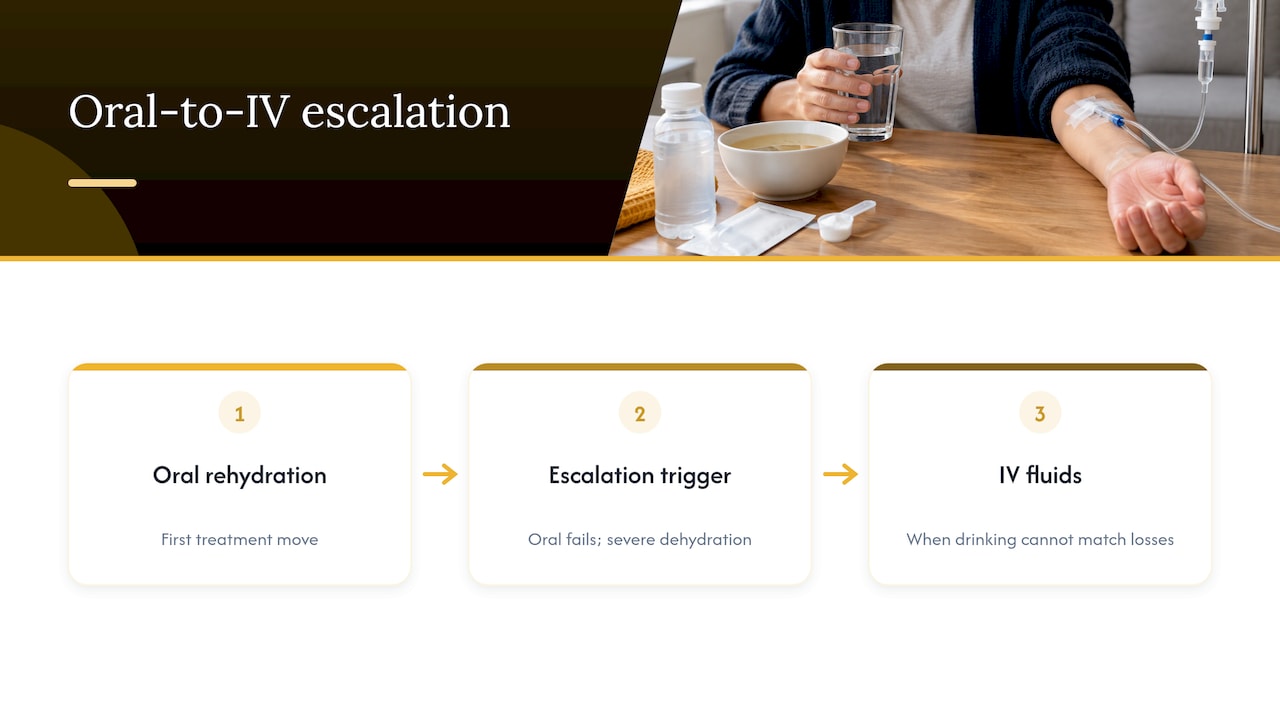
Adult-specific numbers are thinner, so the adult guidance leans on the same principle. Clinicians reach for a vein when you cannot drink enough to match your losses.
When to skip the lounge and go to a doctor or ER
Some situations are beyond what any wellness setting should handle. The NIDDK tells adults to seek care right away for:
- a change in mental state
- high fever
- frequent vomiting
- six or more loose stools in a day
- diarrhea lasting more than 3 days
- nervous system symptoms
- severe abdominal or rectal pain
- black, tarry or bloody stools
- signs of dehydration
Older adults, pregnant women and people with weakened immune systems should seek care for any food poisoning symptoms. MedlinePlus adds that you should contact a provider for fever above 101°F with diarrhea, or if you cannot drink because of nausea and vomiting, and that food poisoning from mushrooms, seafood or botulism can be fatal. The Veterans Affairs health library lists bloody vomit or diarrhea, trouble breathing, a racing heart and botulism symptoms among the reasons to go to the ER, where you will likely be given IV fluids to replace water and minerals.
For children, the thresholds are lower: MedlinePlus advises contacting a provider when a child has been vomiting for more than 12 hours or when diarrhea has not improved in 2 days for infants and children. Our services are for adults. A sick child goes to a pediatrician.
If you are in any of these groups, the next step is a doctor, urgent care or the ER. The hospital can test, give IV fluids and anti-nausea medicine, and monitor you.
The recovery window: where IV hydration fits
There is a stretch after a stomach bug that many people recognize. The vomiting has stopped, you are keeping water down, and you still feel flat: headache, fatigue, a dry mouth that sipping does not fix, little appetite. Your gut is irritable and you are working to catch up on fluids and salts.
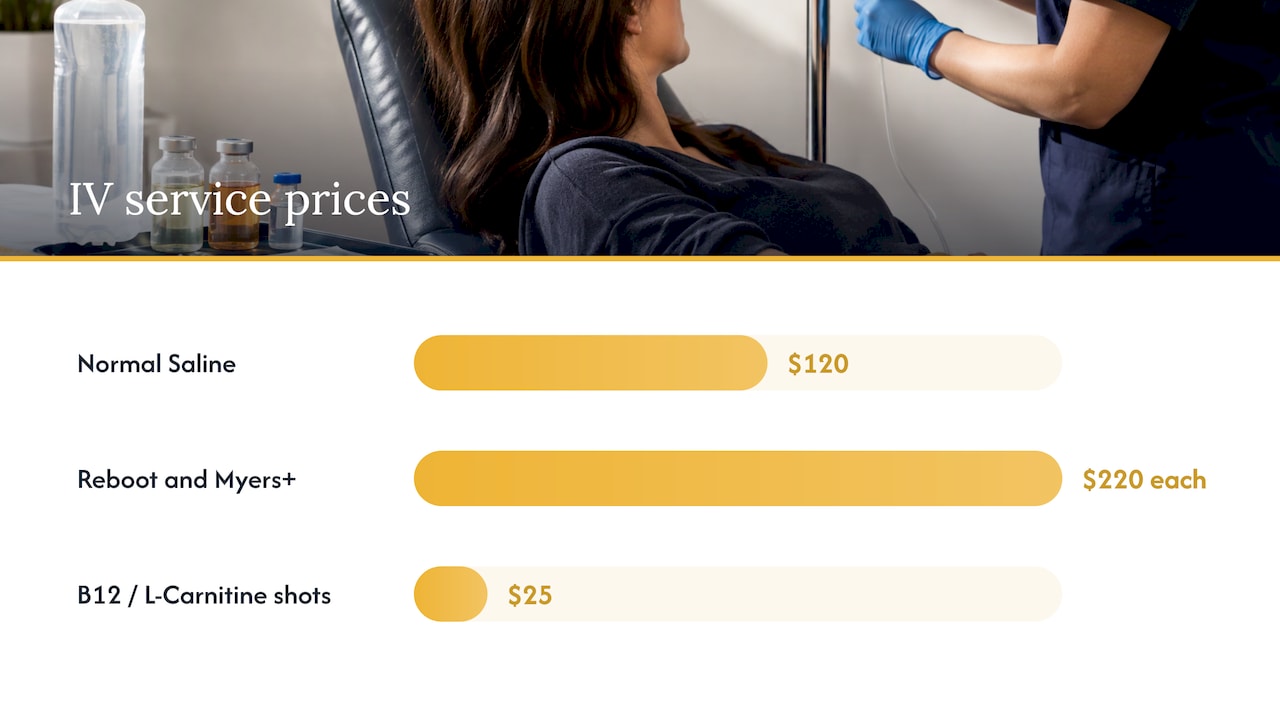
This is where a nurse-led IV session makes sense. Our Normal Saline drip is listed on our services page at $120. It is plain isotonic fluid, the same type of fluid the Merck Manual describes for rehydration. If you want more than fluid, we offer Reboot and Myers+ at $220 each, and single B12 or L-Carnitine shots at $25. Our nurses are there to run the session in a clinical setting, which is what makes IV hydration a safe choice and not a guess.
For a closer look at the question of oral versus IV in non-emergency situations, we have written up what the evidence says on IV versus oral hydration and when an IV is actually needed for dehydration. If you want to know what goes into the bag and what to expect afterward, read our guides to IV drip ingredients and IV hydration side effects.
A simple way to decide
| Your situation | Best next step |
|---|---|
| Mild nausea or a few loose stools, drinking fine | Oral rehydration solution, rest, bland food |
| Vomiting past 12 hours, cannot keep fluids down | Call a doctor or go to urgent care |
| Fever, blood in stool, confusion, severe pain, diarrhea over 3 days | ER or doctor right away |
| Illness is over, eating and drinking again, still drained | Nurse-led saline drip, with or without added nutrients |
Who tends to need the recovery option
College students. Shared dining halls, late nights and a bug that sweeps through a dorm make for slow recoveries and missed exams. We offer a discount for college students, which is worth asking about when you book.
First responders. Shifts do not stop for a stomach bug, and long hours in gear make fluid balance harder. We offer first responder discounts as well.
Active, health-conscious adults. If you train, a bout of food poisoning can set you back by days. Hydration is the first thing to rebuild before you go back to hard efforts. Our Endurance drip is $220, and our red light session is $35 for those who want recovery support afterward.
People heading into cold and flu season. A stomach bug on top of seasonal illness is a double hit. If you want ongoing support, our membership plans are Essential at $205 per month and Elite at $415 per month.
How to prevent a repeat
The best treatment for food poisoning is not getting it. Wash hands before eating and after the bathroom, cook meat and eggs through, refrigerate leftovers promptly and avoid food that has sat out. When you do get sick, begin rehydrating at the first symptom instead of waiting for thirst. People who start sipping electrolyte fluids early are less likely to end up in the ER with dehydration.
Our perspective
We see IV therapy as a precision tool, not a cure-all. In food poisoning, the problem is fluid and salt lost faster than you can drink them back. A clinician-run IV answers that problem directly, and it does so without relying on a stomach that is still unsettled.
That is why we put clinical care first. Our approach is nurse-led, personalized and built around safety in a boutique setting, so you are not rushed through a menu. We match the drip to where you are in recovery. For many people coming off a stomach bug, plain Normal Saline at $120 is exactly the right fit. For those who want added support, Reboot and Myers+ add nutrients on top of the fluid.
We also believe in being clear about the line between recovery and emergency. If you have a high fever, blood in your stool, confusion or you cannot keep anything down, the right place is a doctor or the ER, and we will tell you so. When you are past that point and need to rebuild, we are here to help you feel like yourself again.
Debbie
Book your recovery session
If you are over the worst of a stomach bug and want to rehydrate in a calm, clinical setting, our team serves East Massapequa and the surrounding South Shore communities, including Massapequa, Wantagh, Merrick, Babylon and Lindenhurst. You can see every drip, the injections and the red light session, with published prices, on our services page. Prices start at $25 for a B12 shot, and Normal Saline is $120.

If you expect to need regular support, look at our packages or monthly memberships.
FAQ
Can IV fluids help with food poisoning?
Yes, they replace the fluid and electrolytes lost through vomiting and diarrhea. Doctors use them when dehydration is significant or when you cannot keep oral fluids down. They treat the dehydration, not the infection itself, which in most cases clears on its own within about 48 hours.
What should I drink first when I have a stomach bug?
Small, frequent sips of an oral rehydration solution are the standard first step. Broth also helps replace salt. Avoid gulping, which can bring the vomiting back.
Will insurance pay for IV hydration?
Policies differ. Medicare's billing guidance requires documented medical necessity for IV hydration, such as an inability to take fluids or abnormal fluid losses. A hospital visit for severe dehydration is a medical encounter. A research study of IV hydration spas found that 30 of 87 mentioned payment with health savings accounts, so ask your plan administrator about eligibility.
Is an IV a good idea for vomiting that will not stop?
Persistent vomiting that keeps you from drinking is a reason to see a doctor, urgent care or the ER now. A medical team can evaluate you, rule out complications and give IV fluids and anti-nausea medicine if needed. Once vomiting has stopped and you are drinking again, a nurse-led session can help you rebuild.
How soon after a stomach bug can I get a drip?
Wait until the acute symptoms are over and you are keeping fluids down. If you still have fever, bloody stools or severe pain, see a doctor first. When in doubt, call us and describe how you are feeling, and we will tell you whether to come in or get medical care.
Sources
- Mayo Clinic: Food poisoning, diagnosis and treatment
- American Medical Association: What doctors want patients to know about food poisoning
- Merck Manual: Staphylococcal food poisoning
- Cleveland Clinic: Food poisoning
- NIDDK: Treatment for food poisoning
- NIDDK: Symptoms and causes of food poisoning
- MedlinePlus: Food poisoning
- American Family Physician: Foodborne illness, diagnosis and management
- American Family Physician: Gastroenteritis in children
- Cochrane review: Oral versus intravenous rehydration
- Veterans Affairs health library: Food poisoning
- CMS: Billing and coding for hydration services
- JAMA Internal Medicine: State policies and facility practices of IV hydration spas