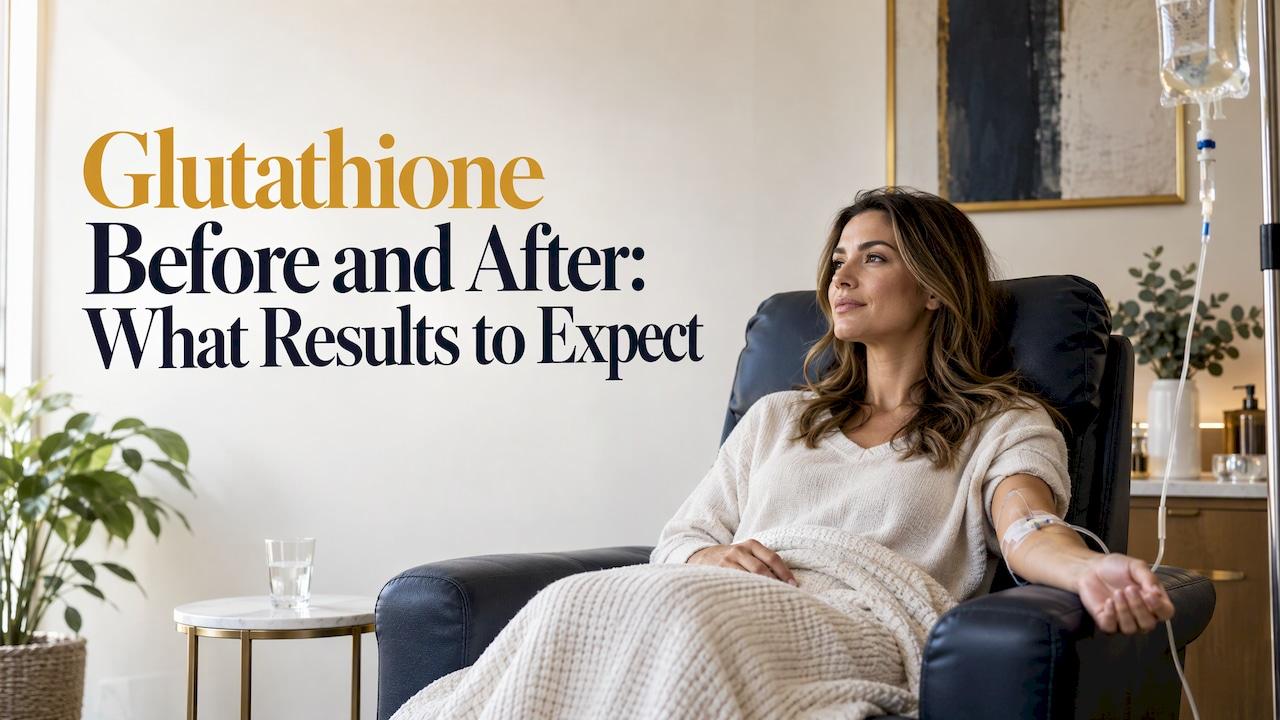
Glutathione before-and-after photos usually show brighter, more even-looking skin. The research behind them is thinner than the photos suggest. Controlled human data on IV glutathione for skin tone is limited, and what exists points to modest, short-lived changes that vary a lot from person to person. Below, you'll see how to read those photos, what a realistic timeline looks like, what the studies found for melasma and dark spots, and how to approach an infusion safely.
TL;DR
- Photos online are not standardized. Lighting, filters, makeup and tanning can change how skin looks between two images, so they are weak proof on their own.
- In the only placebo-controlled IV study identified, 6 of 16 treated people improved versus 3 of 16 on placebo. The difference was not statistically significant.
- Evidence for melasma and hyperpigmentation is stronger for topical and intradermal routes than for IV, so a dermatologist should diagnose the spot first.
- Safety depends on where the glutathione comes from and who gives it. The FDA has flagged supplement-grade ingredients as unsuitable for injection.
- At Vitaluxe, a nurse-led team handles glutathione infusions at $220 per session.
Table of Contents
- What glutathione before-and-after photos actually show
- What the research says about glutathione and skin tone
- How long results take and how long they last
- Glutathione for melasma and hyperpigmentation
- Safety: how to approach IV glutathione well
- A quick word on liver health
- Our perspective
- Booking glutathione at Vitaluxe
- FAQ
- Sources
What glutathione before-and-after photos actually show
Most galleries show a face or arms photographed weeks apart, with skin that looks lighter or less blotchy in the second frame. That can reflect real change. It can also reflect a different camera angle, softer light, less sun exposure over the winter, or a skincare routine that changed at the same time.
The research world has the same problem. The one controlled IV trial relied on subjective visual grading with the Taylor scale. A 2018 dermatology review described that scale as unreliable for subtle pigment changes and preferred objective melanin-index measurement. In other words, a photo is a starting point for a conversation, not a measurement.
If you want your own before-and-after to mean something, build it properly:
- Take photos in the same room, at the same time of day, with the same phone distance and no filter.
- Photograph bare skin, no makeup, in indirect daylight.
- Repeat at the same intervals, for example every four weeks.
- Keep sunscreen use, skincare products and sun exposure as consistent as you can, so you know what you are really seeing.

What the research says about glutathione and skin tone
Glutathione is an antioxidant your body already makes. It plays a role in how cells handle oxidative stress, and it interacts with melanin production, which is why it became popular for brightening. How well that translates into visible change depends heavily on the route it is given.
| Route | What studies found | Strength of evidence for skin tone |
|---|---|---|
| IV | In a placebo-controlled trial, 37.5% of treated people versus 18.7% of placebo improved at six weeks; the gap was not significant and the effect was short-lived | Limited |
| Topical (2% oxidized glutathione lotion) | Lower melanin index than placebo over 10 weeks, 243.47 versus 265.50 at week 10, with no marked adverse effects reported | Small trial, topical only |
| Oral | Better tolerated, but a review of systemic glutathione found limited, non-lasting whitening evidence | Limited |
| Intradermal | Improvement in melasma patients in a comparative study (see below) | Condition-specific |
The honest takeaway: no one has yet shown a reliable, long-lasting skin-tone shift from IV glutathione in a large, well-designed trial. The topical result is encouraging, but it is a different treatment and does not describe what an infusion does.
What a before-and-after can reasonably look like
People who report a change after infusions typically describe a fresher, more even complexion rather than a dramatic color change. That fits with glutathione's role as an antioxidant and with the way skin looks when you are well hydrated, rested and eating well. We would never promise a lighter skin tone. Results are individual, and the trial data above is the reason to keep expectations modest.
How long results take and how long they last
Gallery pages often quote ranges such as one to three months for lighter skin and much longer for darker skin. Those figures come from clinic marketing rather than from controlled studies, so treat them as anecdotes. What the research does say is more cautious:
- The 2024 systematic review found that skin tone is expected to return to its starting point once treatment stops, whatever the route.
- A 2025 narrative review reported that the IV trial's apparent benefit faded by six months.
- IV dosing schedules in practice are arbitrary, and treatment duration has not been established.
So if you decide to try a series, plan on a defined trial period with a clear check-in, not an open-ended course. Take your photos on schedule, and review them with your provider rather than adding sessions by default.
Why results vary so much
Skin tone is set by genetics, sun exposure, hormones, inflammation, medications and age. Two people can receive the same infusion and look different weeks later. Hydration, sleep, diet and sunscreen use can each move how skin looks, which is also why a single infusion photo is hard to credit to glutathione alone.
Glutathione for melasma and hyperpigmentation
Melasma and dark spots are medical skin conditions with several possible causes, and what works for one may not suit another. The 2024 review says there is not enough data to comment on IV glutathione for melasma. It does summarize improvements in some topical, oral and intradermal studies.
A few findings worth knowing:
- A 2025 review reported a 67.4% reduction in mMASI after 90 days of 2% topical glutathione in a melasma study. That was a cream, not an infusion.
- A comparative study of 64 melasma patients found both glutathione and tranexamic-acid microinjections improved the condition by weeks eight and 12, with tranexamic acid more effective. Those were intradermal injections.
- The 2018 review concluded there is little convincing evidence for glutathione as a hyperpigmentation treatment, and that IV data is minimal and contradictory.
If your concern is melasma, start with a board-certified dermatologist so the condition is diagnosed and treated appropriately, as the Philippines FDA advisory advises. Daily broad-spectrum sunscreen matters for every pigment concern. An infusion can sit alongside that care as part of a wellness plan, but it should not replace it.
Pairing with light-based skin support
Many clients ask what else supports a clearer, healthier-looking complexion. Red light therapy is one option we offer, and it has its own photo-tracking habits worth learning. This guide to red light therapy before and after shows how to document change over time. Our own write-up on what red light before-and-after photos show covers session counts and timelines.
Safety: how to approach IV glutathione well
Safety is where the details matter most, and it is the reason to choose a medically supervised setting.
Source and grade of the product. The FDA reported at least 30 patients with adverse events after IV glutathione, alone or with other ingredients. Reported events included fever, chills, pain, dizziness, shock signs and sepsis-like symptoms, and some people were hospitalized. The FDA advises compounders not to use ingredients labeled for dietary-supplement use in injectables, because they may contain impurities or endotoxins unsuitable for injection, and says testing alone cannot ensure quality. Ask any provider where their glutathione comes from and how it is prepared.
Long-term, high-dose use. A 2016 review found safety data inadequate for chronic, high-dose injectable glutathione used for cosmetic lightening and called for large trials with long follow-up. The 2025 narrative review also reported adverse events in 32% of participants in the IV trial, including liver dysfunction and one anaphylaxis case. That is a reason to keep treatment supervised, intentional and reviewed, not to self-direct a high-frequency schedule.
Who should talk to a clinician first. If you have a history of allergic reactions, liver or kidney conditions, are pregnant or breastfeeding, take regular medications, or have a skin condition like melasma, speak with your doctor or a dermatologist before booking. Tell the nurse about all of it at intake.
For a deeper look, our guides on glutathione injections and the FDA advisory and clinic checklist walk through what to ask before your first session.
A quick word on liver health

Glutathione also comes up in liver conversations. The evidence is early. In a small, uncontrolled pilot of oral glutathione for fatty liver disease, ALT levels dropped significantly, but the authors said large trials are needed. A 2025 literature review of three open-label studies with 109 participants saw generally improved ALT, and called the findings promising but preliminary, since lifestyle change or other treatment can't be separated out. If liver health is your goal, your physician should lead, and glutathione is a conversation to have with them.
Our perspective
We see glutathione as one tool in a broader plan for cellular wellness, not a quick color change. Clients come to us for energy, recovery, hydration and a healthier look, and glutathione fits alongside those goals when it is given with care.
What we focus on is the setup around the infusion: a nurse-led team, a thorough intake, a clear conversation about what you hope to see, and a plan to check in. Photos help, but only when they are taken consistently. We encourage every client to track change with the same light, the same angle and the same schedule, and to judge the result honestly.
Because skin concerns like melasma deserve a proper diagnosis, we encourage clients to see a dermatologist for pigment questions and to bring us into the wellness side of the picture. Combined with hydration, sleep, sun protection and supportive therapies like red light, a well-supervised glutathione series can be a sensible part of how you take care of yourself.
Debbie
Booking glutathione at Vitaluxe
Our Glutathione infusion is $220 per session. It is given by our nurse-led team in a boutique setting built around clinical safety and personal attention, and we serve clients across Massapequa, Wantagh, Bellmore, Merrick, Babylon, Lindenhurst and nearby Long Island communities. First responders and college students can ask about our discounts.
If you want to add skin-focused support, Red Light Therapy is $35 per session, and our monthly memberships (Essential at $205 per month, Elite at $415 per month) suit people planning ongoing care. See every treatment on our services page, compare the membership plans, or look at therapy packages. If glutathione is paired with vitamin C in your plan, our explainer on glutathione with vitamin C is a good place to start.
FAQ
How long does it take to see glutathione results?
There is no validated timeline. In the one placebo-controlled IV trial, outcomes were assessed at six weeks, and the apparent benefit faded by six months. Online ranges are anecdotal. Take dated, consistent photos and review them with your provider after a set number of sessions.
Does glutathione IV work for skin?
The evidence is limited. The best IV data showed more treated people improving than placebo, but not by a statistically significant margin. Many people choose infusions as part of a wellness routine, and individual results differ.
Can glutathione help melasma?
Topical and intradermal glutathione have shown improvement in some melasma studies, while data on IV use is insufficient to draw conclusions. Have a dermatologist diagnose and guide melasma care, and use daily sunscreen.
Are the results permanent?
No. Reviews expect skin tone to return to its starting state after treatment stops, whatever the route. Maintenance, if you choose it, should be planned with your provider.
What foods support glutathione levels?
Your body makes glutathione from amino acids, so a balanced diet with enough protein, plus sleep and regular movement, supports your baseline. Our comparison of glutathione and NAC explains how a related supplement fits in.
Sources
- Glutathione for skin lightening: a regnant myth or reality? (2018)
- Glutathione as a skin-lightening agent and in melasma: a systematic review (2024)
- Skin-whitening and skin-condition-improving effects of topical oxidized glutathione
- Systemic glutathione as a skin-whitening agent in adults
- Exploring the safety and efficacy of glutathione (2025 review)
- Comparative study of intradermal tranexamic acid and glutathione in melasma
- FDA: do not use dietary supplement grade glutathione in injectables
- Intravenous glutathione for skin lightening: inadequate safety data (2016)
- Philippines FDA Advisory No. 2019-182 on glutathione as a skin-lightening agent
- Efficacy of glutathione for nonalcoholic fatty liver disease (2017 pilot)
- A literature review of glutathione therapy in NAFLD
- Red Light Therapy Before and After: Real Results Guide