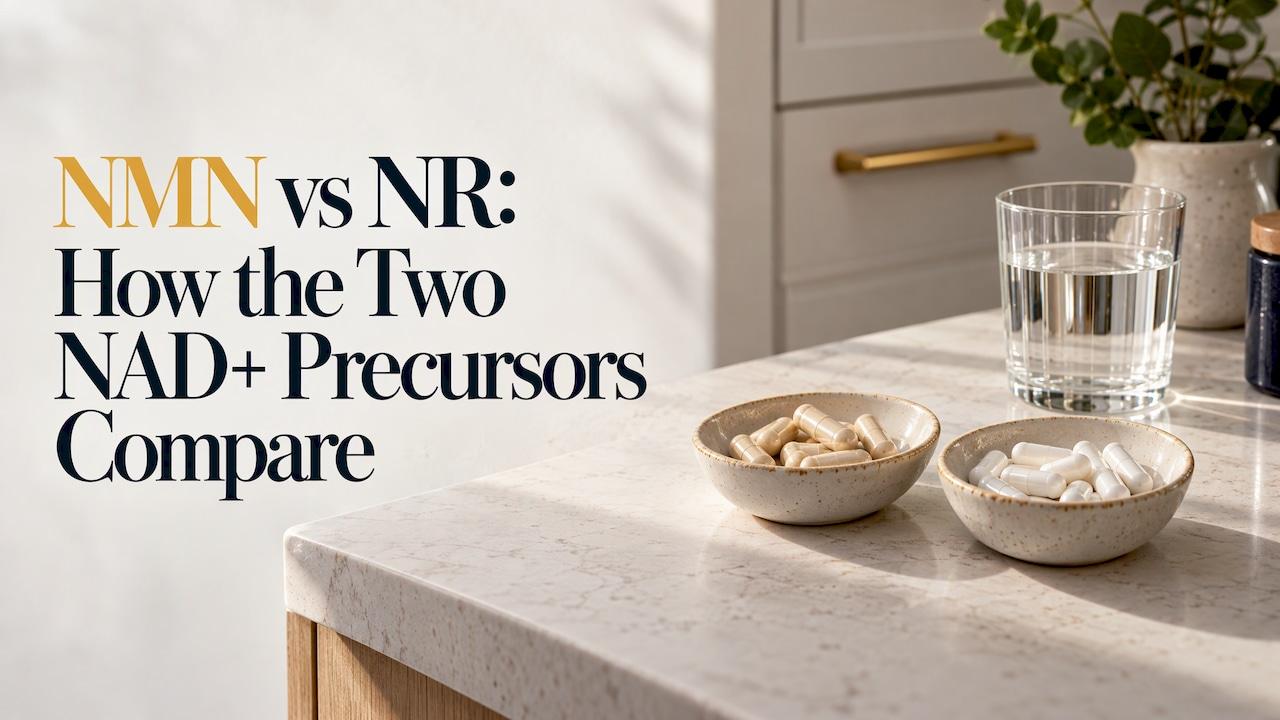
NMN (nicotinamide mononucleotide) and NR (nicotinamide riboside) are both oral building blocks the body uses to make NAD+. In the best head-to-head human trial so far, they raised blood NAD+ by about the same amount. Neither has shown a clear advantage for energy, recovery or healthy aging. So the better choice depends on practical things: the form you can get, how you tolerate it, and what you want it for.
This guide covers how each one works, what the human studies measured, safety, the FDA question behind the "NMN ban" headlines, and where our NAD+ treatments fit.
TL;DR
- NMN is one chemical step closer to NAD+ than NR, but that has not translated into a proven edge in people.
- A 2026 randomized trial of 65 adults found NR and NMN raised whole-blood NAD+ about twofold over 14 days, with no meaningful gap between them.
- Both were generally well tolerated in human trials. Trials measured NAD+ levels far more often than health outcomes.
- NMN's 2022 FDA problem was a classification dispute, and the agency reversed course in September 2025.
- NAD+ IV and IM are a different route from oral precursors. We offer both at our East Massapequa-area lounge.
Table of Contents
- What NR and NMN are
- What happens to NAD+ levels
- Do they improve how you feel or perform?
- Safety and tolerability
- Why NMN was "banned" and where it stands now
- How to choose between NMN and NR
- Where NAD+ IV and injections fit
- Perspective
- Our NAD+ options and pricing
- FAQ
- Sources
What NR and NMN are
Your cells need NAD+ to turn food into energy and to run repair processes. NR and NMN are "precursors": molecules the body converts into NAD+. They sit in the same chain. NR becomes NMN, and NMN becomes NAD+. NMN is NR with an extra phosphate group attached, which is why you will see them described as nearly identical in structure.
That extra step is the center of most marketing. One 2026 overview from WellFounded notes that NMN sits one step closer to NAD+, yet head-to-head comparisons have not shown an advantage for either compound.

How they enter cells is also debated. Some sources say NR gets in through nucleoside transporters, while NMN may need to be converted to NR first or use its own transporter. PrecisionOptimize notes that transporters vary by tissue. That could send each compound to somewhat different places, with NMN appearing to favor skeletal muscle and liver in the available data. Direct human comparisons are limited, so no one can say yet that this matters in practice.
What happens to NAD+ levels
The cleanest comparison is a 2026 randomized, open-label, placebo-controlled study in 65 healthy participants. After 14 days, NR and NMN both raised whole-blood NAD+ about twofold compared with placebo. Plain nicotinamide did not. The differences from placebo were 49.4 µM for NR and 43.1 µM for NMN. The study measured NAD+ in blood, not health outcomes.
Other trials point the same way, with different numbers:
| Trial or review | Compound and dose | NAD+ result | Other findings |
|---|---|---|---|
| Christen et al., 2026 (65 adults) | NR and NMN, 14 days | About 2-fold rise in whole blood | Nicotinamide did not raise it |
| Huang et al., 60 days (62 adults, 40 to 65) | NMN 300 mg/day | About 10% rise in serum NAD+ | Walk test, blood pressure, insulin sensitivity unchanged |
| Yi et al., 60 days (80 adults, 40 to 65) | NMN 300, 600, 900 mg | About 3-, 6- and 5-fold rise | Higher doses walked about 1.5 times farther in a 6-minute test; insulin sensitivity unaffected |
| NR-SAFE, 4 weeks (20 people with Parkinson's) | NR 3,000 mg/day | Up to 5-fold rise in blood NAD+ | Well tolerated, no moderate or severe adverse events |
The numbers differ because the studies used different doses, populations and blood tests. Do not line them up across rows and call a winner.

Do they improve how you feel or perform?
Here the honest answer is: the evidence is still being built. A 2026 systematic review covered 113 studies (33 human, 80 rodent). Oral NR and NMN consistently raised NAD+ in people and were generally well tolerated, but outcomes tied to healthspan were mixed, often null, or specific to one endpoint. The authors call for larger, longer randomized trials with clinically meaningful endpoints.
A 2025 review in Nature Metabolism reached a similar view. Animal studies are promising, but human trials have shown limited efficacy so far, and NAD+ decline with age has been seen consistently in only a limited number of human studies.
A few signals worth knowing about:
- NR and muscle. A review of human NR trials found that several trials did not see NR raise muscle NAD+. The most reproducible benefit it identified was lower inflammatory markers in blood or immune cells.
- NMN and exercise capacity. The Yi trial above showed longer walking distance at higher doses. The same trial did not move insulin sensitivity.
- NMN and muscle insulin sensitivity. A 2021 trial in Science gave 250 mg/day for 10 weeks to postmenopausal women with prediabetes. According to PrecisionOptimize, it improved skeletal muscle insulin sensitivity, with no change in fat tissue or liver.
- Hard outcomes. No robust randomized trial has yet tested mortality, major cardiac events or dementia with these compounds, per the WellFounded overview.
If you are choosing between the two for a goal like energy or recovery, treat both as reasonable, studied options with an unfinished evidence base. Anyone who tells you one is clearly superior is going beyond the trials.
Safety and tolerability
Short-term human data are reassuring for both. In the 65-person trial, only three adverse events were judged probably related to a product: abdominal pain in one placebo participant, low blood pressure in one NR participant, and a headache in one NMN participant. Another trial gave NMN at 1,250 mg/day for four weeks to 31 healthy adults with no serious adverse events. In 30 people with heart failure, NR at 1,000 mg twice daily for 12 weeks showed no significant difference in adverse events from placebo.
These trials run weeks to months. Long-term data are thinner. Practical rules for safe use:
- Start with a standard labeled dose rather than the highest dose studied.
- If you take prescription medicines, are pregnant or nursing, or have a heart, kidney, liver or blood pressure condition, check with your physician or pharmacist first. One trial participant on NR had a drop in blood pressure, so people on blood pressure medication should especially ask.
- Choose products from brands that show third-party testing and clear ingredient labels. Supplements are not reviewed by the FDA for effectiveness before sale.
For a broader look at nutrients tied to cellular energy, see this evidence on mitochondria vitamins.
Why NMN was "banned" and where it stands now
The ban was never a safety finding. At the end of 2022, the FDA said NMN could no longer be sold as a dietary supplement because it had been authorized as an investigational new drug, as reported in a 2023 review. Under US supplement law, an ingredient generally cannot be sold as a supplement once it is under public drug investigation, unless it was marketed as a supplement first. That was a classification dispute.
The position then shifted. According to omre.co, the FDA determined on September 29, 2025 that NMN is not excluded from the dietary supplement definition. NutraIngredients reported in December 2025 that the agency sent letters to ingredient suppliers confirming it had set aside its earlier determinations.
What that does and does not mean:
- NMN can be sold as a supplement again, but sellers still have to meet requirements such as New Dietary Ingredient rules.
- It is not an FDA-approved drug, and the decision does not mean every product has been reviewed.
- No supplement can legally claim to prevent, treat or cure a disease.
NR, by contrast, has been used in US food products with FDA acceptance, according to a 2024 review. Rules can change, so check the current FDA position before buying.
How to choose between NMN and NR
Since the data do not crown a winner, decide on these points:
- Track record. NR has more and longer independent human studies, including in people with narrowed leg arteries. NMN has many smaller studies, a number run by its makers, according to the evipedia.ai summary.
- Your goal. Muscle and liver interest might lean you toward NMN in theory. Inflammation markers have the most support in NR trials. Both are early.
- Tolerance. Start low. If one makes you feel off, stop and speak with a clinician rather than switching to a higher dose of the other.
- Availability and quality. Pick whichever you can source from a trustworthy brand with clear labeling.
- Your health history. Medications and conditions matter more than the precursor's brand name.
If you want a deeper comparison of NAD+ itself with NMN, we cover it in NAD+ vs NMN. For what trials and FDA warnings say beyond blood markers, read NAD beyond biomarkers.
Where NAD+ IV and injections fit
NR and NMN are precursors you swallow, and your body decides how much becomes NAD+. NAD+ IV and IM treatments deliver NAD+ itself, in a clinic, under nurse supervision. They are a different route, not a direct substitute, and the trials above do not compare them.
Some people want a supervised, dose-controlled session rather than a daily capsule, or want to pair it with hydration and other nutrients. If that sounds like you, our team can talk through what fits. Our guide to NAD injections covers what they are, costs and safe use.
Perspective
We hear the NMN vs NR question often, usually from people who want more energy, better recovery after training or long shifts, or a plan for healthy aging. The research is encouraging on one point: both precursors raise NAD+ in people. The harder part is knowing what that means for how you feel, and the honest answer is that it varies from person to person.
That is why we start with a conversation, not a menu. Our nurse-led approach looks at your goals, your medications and your routine, then matches a treatment to you. For some clients that is NAD+ IM at a lower dose to begin. For others it is a larger NAD+ IV session. Many pair it with hydration, red light therapy or a membership so the plan stays consistent.
If you already take an oral precursor, that is fine. Tell us what you take, and we will plan around it safely.
Debbie
Our NAD+ options and pricing
We publish our prices so you can plan. Current options on our services page:
| Treatment | Price |
|---|---|
| NAD+ IM 25mg | $65 |
| NAD+ IV 125mg | $199 |
| NAD+ IV 250mg | $334 |
| NAD+ IV 500mg | $624 |
| Red Light Therapy | $35 |
| B12 | $25 |
If you would like ongoing support, our membership plans are Essential at $205 per month and Elite at $415 per month. We also offer discounts for first responders and college students. We serve Massapequa, Wantagh, Amityville, Babylon, Lindenhurst, Merrick and nearby Long Island communities.
Ready to talk about which NAD+ option suits your goals? Book through our services page.
Prefer to stack sessions? See our packages.
FAQ
Is NMN or NR better?
Neither has been proven better. In a 2026 trial of 65 adults, both raised whole-blood NAD+ about twofold in 14 days. Larger, longer trials that measure real health outcomes are still needed.
Does NMN really work?
NMN reliably raises NAD+ in blood in human trials. Results on function are mixed: one trial saw longer 6-minute walk distances at higher doses, while another saw no change in walk test, blood pressure or insulin sensitivity. Reviews call the clinical effect inconclusive so far.
Why did NMN get banned?
The FDA said in 2022 that NMN could not be sold as a supplement because it was under investigation as a drug. That was a legal classification issue, not a safety finding. The FDA changed its position on September 29, 2025, though sellers still must meet New Dietary Ingredient requirements.
Are NR and NMN safe?
In trials lasting weeks to months, both were generally well tolerated, with few and mild adverse events. Long-term data are limited. Ask your physician first if you take medication, are pregnant, or have a heart, kidney, liver or blood pressure condition.
Sources
- NAD⁺ in humans: can you raise it and does it matter clinically (WellFounded)
- NAD+ Precursors: Does NMN or NR Actually Work? (PrecisionOptimize)
- The differential impact of three different NAD+ boosters (2026)
- Dietary Supplementation With NAD+-Boosting Compounds in Humans (Freeberg et al., 2023)
- NR-SAFE safety trial (2023)
- What is really known about the effects of nicotinamide riboside supplementation in humans (2023)
- NAD⁺ supplementation for anti-aging and wellness: systematic review (2026)
- NAD+ precursor supplementation in human ageing (Nature Metabolism, 2025)
- Safety and Tolerability of Nicotinamide Riboside in Heart Failure (2022)
- An Updated Review on NR mechanisms (Food Frontiers, 2024)
- Can I Buy NMN in the USA? Legal Status (omre.co)
- FDA reinstates NDI status of NMN (NutraIngredients, 2025)
- NMN vs. NR for Health & Longevity (evipedia.ai)
- Vitamins for Mitochondria: Disease vs. Wellness Evidence