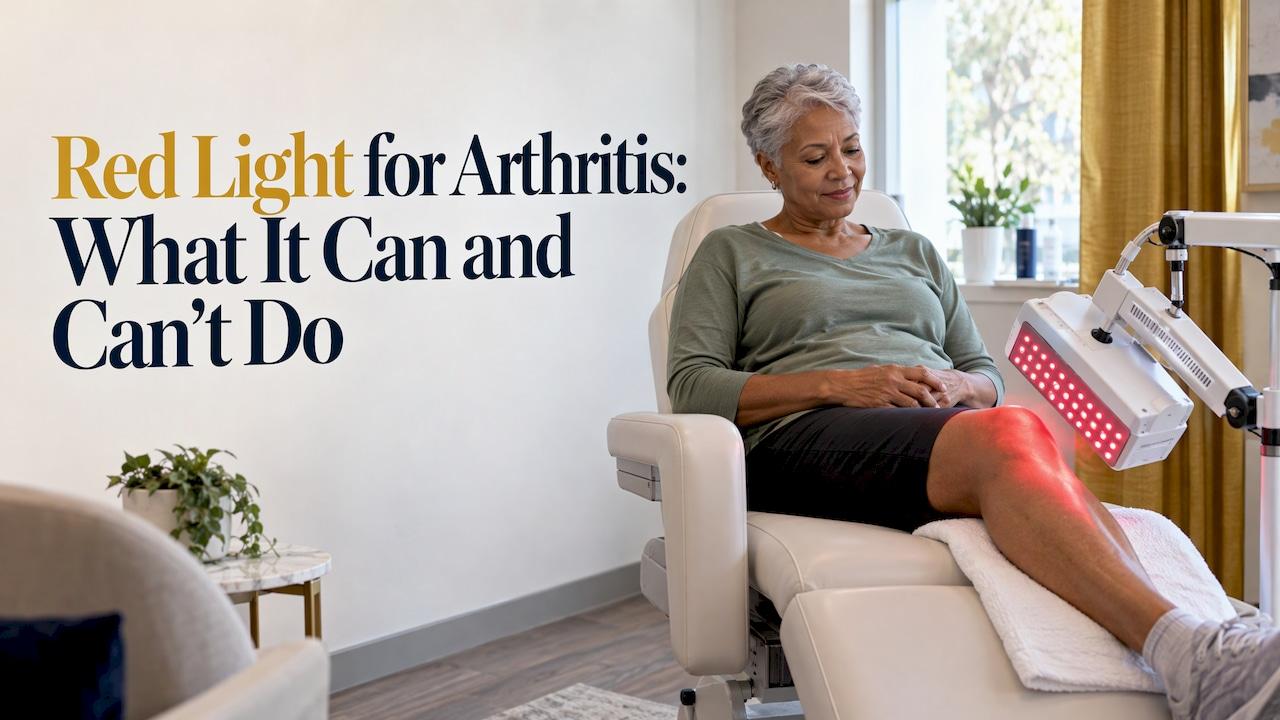
Red light therapy may ease joint pain for some people with arthritis, most clearly knee osteoarthritis pain, but the research is mixed and it works best as an add-on to your regular care. It is not a cure and it does not replace your doctor's plan. Below: what the studies found, which types of arthritis have the best support, what safety looks like, and how a session at our clinic fits in.
TL;DR
- A 2024 analysis of knee osteoarthritis trials found low-level light therapy beat sham for pain relief, but not for function or stiffness.
- Evidence for rheumatoid arthritis is weaker: a 2023 review of 18 trials found low-quality evidence of no difference from sham for infrared laser.
- Side effects are usually mild and temporary, such as warmth, redness or discomfort. Eye protection and a medication check matter.
- At Vitaluxe, a Red Light Therapy session is $35. Our nurse-led team can talk through whether it suits you.
Table of Contents
- How red light is supposed to help a joint
- What the research shows, by type of arthritis
- Why results vary so much between studies
- Safety and side effects
- Eczema, rosacea and thyroid: the quick answers
- Making red light work as part of a joint plan
- Our perspective
- Try red light at Vitaluxe
- FAQ
- Sources
How red light is supposed to help a joint
Red light therapy belongs to a field called photobiomodulation. A 2024 JAAD review defines it as light therapy using red light (620 to 700 nm) and near-infrared light (700 to 1440 nm), often delivered by low-level lasers or LEDs.
The proposed mechanism starts inside your cells. A 2023 review describes light activating an enzyme in the mitochondria called cytochrome C oxidase. That is linked to more ATP (cellular energy), less inflammation and changes in enzyme and gene activity. The same authors say this gives a theoretical basis for easing arthritis symptoms, while noting that real-world efficacy is still debated.
A 2026 review adds more detail. It reports that light can dampen inflammatory signaling, including NF-κB activity and cytokines such as TNF-α, IL-6 and IL-1β. It may also improve local blood flow and influence pain signaling. The authors frame it mainly as a potential adjunct to established osteoarthritis management, not a replacement.
In plain terms: the light is meant to calm irritated tissue and support the cells around the joint, so pain and stiffness may ease. That is the idea. Whether it happens for you depends on the type of arthritis, the joint and the dose.
What the research shows, by type of arthritis
Arthritis is not one condition, and the results differ.
| Condition | What the studies found | Source |
|---|---|---|
| Knee osteoarthritis | Light therapy was better than sham for pain, with a pooled effect of SMD 0.96. Function and stiffness did not improve significantly. | 2024 network meta-analysis, 13 studies, 673 people |
| Rheumatoid arthritis | Low-quality evidence of no difference between infrared laser and sham on pain, stiffness, grip strength or disease activity. | 2023 meta-analysis, 18 trials, 793 people |
| Arthritis in general | A review of studies suggested possible short-term help for pain and morning stiffness in rheumatoid arthritis. | WebMD |
These findings don't line up neatly, and that is the honest picture. Some reviews lean positive on pain, others find no edge over sham, and the trials used very different settings.
Knee pain and osteoarthritis
If you searched for red light for the knee, this is the strongest area. In the 2024 analysis of 13 studies, the wavelength with the best result for pain was 904 to 905 nm. That is near-infrared, which is worth knowing when you compare devices.
The 2026 review points out one caveat that helps you set expectations. The knee benefit showed up in pain at rest, a subjective measure, while a timed walking test did not improve significantly. The authors say interpretation should consider placebo response and whether the pain drop is large enough to matter in daily life.
So a realistic goal is less ache, not a new joint. If your knee feels calmer, that can make it easier to keep up the exercise and physical therapy that do the heavy lifting for osteoarthritis.

Rheumatoid arthritis and other inflammatory types
Rheumatoid arthritis is an autoimmune disease, and your rheumatologist's medications are the foundation of care. The 2023 meta-analysis authors concluded that infrared laser may not be superior to sham for RA, and that there was insufficient information to support or refute red laser. Another source notes a review that found possible short-term help with pain and morning stiffness in RA.
If you have RA and are curious, treat red light as something to discuss with your rheumatologist, not as a swap for anything you take now.
Hands and small joints
Hand joints are small and close to the surface, which is why people ask about them often. Our research did not turn up a strong body of hand-specific trials, so the knee and general findings above are the best guide. If you want to read more on this topic, there is a piece on red light therapy for hand arthritis worth a look.
Why results vary so much between studies
The studies don't use one standard dose. A 2024 meta-analysis in Physical Therapy found the median wavelength was 865 nm, but the range ran from 808 to 1064 nm. Power went from 18 to 1,100 mW, and total energy ranged from 7.5 to 3,000 J. The 2023 mechanisms review likewise notes that studies vary in wavelength, power density, light dose and treatment duration.

That spread explains a lot of the disagreement. A weak result with one device and schedule doesn't tell you what another would do. It also explains why where the light is aimed, how close the device sits and how many sessions you complete matter as much as the color of the bulb. We cover that depth question in our piece on red light versus laser therapy.
Safety and side effects
For most adults, red light is well tolerated. An evidence-based consensus on photobiomodulation states it is a safe modality for adults and that red light does not cause DNA damage. Side effects are generally mild and temporary: discomfort, burning, blistering, edema or redness, usually self-resolving. The American Academy of Dermatology says red light therapy appears safe in the short term, that research has not found it causes cancer the way UV light can, and that the most common effects are mild, temporary pain or irritated skin.
In the RA trials, three patients in one study reported a burning sensation in treated joints, all in the laser group. If a joint feels hot or sore during a session, tell your provider right away so the settings can be adjusted.
Who should check first
- Light-sensitive conditions or medications. The AAD advises seeing a board-certified dermatologist first, because a light-sensitive condition such as lupus can worsen with red light, and photosensitizing medication may rule it out. This matters for people with lupus-related arthritis in particular.
- Pregnancy. A 2026 review says controlled safety data are limited and direct irradiation over the fetus should be avoided.
- Tattoos and dense pigmentation. The same review says tattooed or heavily pigmented treatment sites may call for extra caution.
- Eyes. The light can be focused by the eye under hazardous exposure, so wavelength-appropriate protective eyewear is advised whenever your eyes could be exposed.
What FDA clearance means
Some devices are cleared by the FDA for temporary relief of minor muscle and joint pain, arthritis and stiffness. One example is a 510(k) clearance for a 640 nm red and 880 nm near-infrared device, classified as Class II. Clearance is not the same as approval. The AAD notes that it means a device poses low risk, not that effectiveness has been proven. ConsumerLab adds that evidence is still not enough to recommend devices for any specific condition. For a practical overview of those limits, see this guide to red light therapy safety.

Eczema, rosacea and thyroid: the quick answers
People who search for arthritis often search these too, so briefly.
Rosacea. A 2026 review found pulsed dye laser and intense pulsed light are the most studied light options for rosacea, with LED approaches still emerging. It also warns that in darker skin, melanin competes for the light energy and can raise the risk of pigment changes, so settings need careful selection. Ask a dermatologist before using red light on rosacea.
Eczema. We found no strong clinical source to cite for red light in eczema, so we won't promise anything. A dermatologist is the right first call.
Thyroid. We did not find an authoritative source on aiming red light at the neck. If you have a thyroid condition, ask your endocrinologist before any light treatment near that area.
Making red light work as part of a joint plan
If you try it, a few habits help you get a fair read on whether it works for you.
- Talk to your doctor first. Mention your arthritis type, your medications and any light sensitivity.
- Pick one joint and one goal. For example: morning knee stiffness, or pain going down stairs.
- Rate your pain before you start. A simple 0 to 10 score each week shows the trend and keeps placebo effects in perspective.
- Commit to a series, not a single visit. Our related pieces on red light for tendonitis describe pain often easing across several weeks of regular sessions, which is a more useful frame than one-session expectations.
- Keep up movement and your prescribed care. The 2026 review frames light as an adjunct to established management.
For a broader view of what clinics see compared with what studies show, read our overview of red light therapy benefits.
Our perspective
We see people come in with sore knees, stiff hands and the tired, achy feeling that follows a hard week. Many of them are already doing the right things, and they want one more tool.
That is how we position red light: as a supportive tool, delivered in a boutique, nurse-led setting where clinical safety comes first. We ask about your health history and medications before a session, because the people who benefit most are the ones treated with care, not on autopilot.
The research is honest about variation in dose and wavelength, and that is exactly why we favor guided sessions over guessing with a gadget at home. A consistent schedule, a clear goal and a nurse who knows your history give red light its best chance to help.
For many of our clients, red light sits alongside hydration and recovery support, since joints and muscles recover better when the whole body is looked after. We tailor that mix to you.
Debbie
Try red light at Vitaluxe
Our Red Light Therapy session is $35. It is offered at our Long Island clinic, which serves Massapequa, Wantagh, Merrick, Amityville, Babylon, Lindenhurst and nearby communities. If you want to pair it with other recovery support, see our services, packages and monthly memberships. Essential is $205 per month and Elite is $415 per month.

We offer special discounts for first responders and college students. Tell us about your joints and your goals, and our nurse-led team will help you decide where to start. You can begin at vitaluxedriplounge.com.
FAQ
Is red light good for arthritis?
It may help with pain for some people, especially in knee osteoarthritis, where a 2024 analysis found a pain benefit over sham. Results for rheumatoid arthritis are less consistent, and function and stiffness did not improve significantly in the knee analysis. Treat it as an add-on to your regular care.
How long until I notice a difference?
There is no single answer, because studies use very different doses and schedules. Plan on a series of sessions and track your pain weekly. If you see no change after a reasonable series, review it with your doctor.
Is red light therapy safe for arthritis patients?
For most adults, side effects are mild and short-lived, such as redness or discomfort. Tell your provider about light-sensitive conditions like lupus and any photosensitizing medication, and wear proper eye protection. If you are pregnant, avoid direct irradiation over the abdomen.
Can red light replace my arthritis medication?
No. The research frames it as a potential adjunct, and rheumatoid arthritis in particular needs ongoing care from your rheumatologist. Never change medication without your doctor's guidance.
Sources
- Photobiomodulation mechanisms and efficacy review, 2023
- Red and near-infrared photobiomodulation review, 2026
- JAAD photobiomodulation review, 2024
- Low-level laser therapy in rheumatoid arthritis meta-analysis, 2023
- Knee osteoarthritis network meta-analysis, 2024
- Photobiomodulation parameters meta-analysis, Physical Therapy, 2024
- WebMD: Red Light Therapy
- Evidence-based consensus on photobiomodulation, 2025
- American Academy of Dermatology: Is red light therapy right for your skin?
- FDA 510(k) K131113
- ConsumerLab: Red and near infrared light therapy
- Light Treatment for Rosacea review, 2026