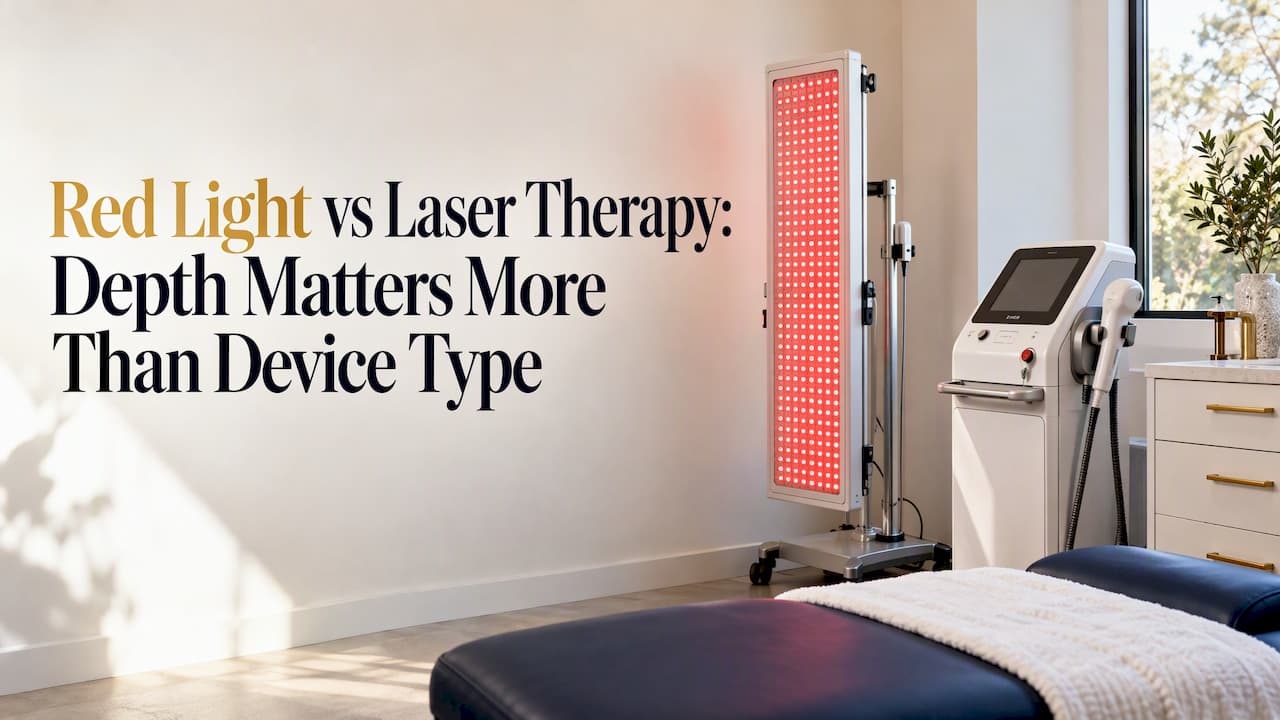
Red light and laser therapy are both photobiomodulation, so the practical choice comes down to how deep your target sits. If you want surface skin results or daily home maintenance, an LED red light panel fits. If you need to pinpoint treatment for a tendon, joint, or small lesion, a supervised clinic laser is usually the better starting point.
TL;DR:
- When comparing devices, check wavelength, irradiance at the working distance, and fluence; total wattage alone cannot show how much energy reaches tissue.
- PBM has a therapeutic window, and excess energy can reduce benefits; darker skin may react at lower doses, so start conservatively with clinical guidance.
- Lasers with high output require protective eyewear and supervised dosing; stop treatment and contact a clinician if redness lasts, blisters appear, or pain worsens.
- Published protocols vary in wavelength, dose, and schedule, so do not copy a study’s settings onto another device; ask a clinician to tailor treatment.
Table of Contents
- How does photobiomodulation work, and why do wavelength and dose matter?
- What actually differs between a laser and an LED?
- Which wavelengths and doses do clinicians use?
- How deep does the light actually go?
- What does the clinical evidence show?
- Is red light therapy safe, and what rules apply?
- How do you choose between a home panel, a clinic laser, or both?
- Can you combine clinic treatment with home use?
- Our view: why we lead with supervised red light therapy
- Book clinic-led red light therapy with our team
- FAQ
- Sources
How does photobiomodulation work, and why do wavelength and dose matter?
Both lasers and LED panels belong to one family of treatments called photobiomodulation, or PBM. The shared mechanism starts inside your cells. Light at red and near-infrared wavelengths is absorbed by a mitochondrial enzyme called cytochrome c oxidase. That absorption is thought to boost ATP production, the molecule cells use as fuel, and to set off anti-inflammatory and regenerative signaling. In plain terms, cells under stress get a nudge toward repair.
The important point is that the biology does not care what brand of device produced the light. Experts writing on this exact question emphasize that wavelength, power density, and total energy are the crucial parameters for success, rather than the "laser" or "LED" label. A high-power LED array can deliver the same total energy to a large area as a clinical laser delivers to a single point. When wavelength and delivered dose match, the cellular response may be similar.
Four terms carry most of the weight, so it helps to know them:
- Wavelength is the color of the light, measured in nanometers (nm). It determines which tissues absorb the light and how far it travels.
- Irradiance, also called power density, is how much power lands on each square centimeter of skin, measured in milliwatts per square centimeter (mW/cm²). Think of it as how intense the light is at the surface.
- Fluence, or dose, is the total energy delivered per square centimeter, measured in joules per square centimeter (J/cm²). It equals irradiance multiplied by treatment time.
- Emission mode describes whether the device emits continuously or in pulses, and whether the beam is focused or spread out.
These four interact. A weak light used for a long time can deliver the same fluence as a strong light used briefly. A strong light held too close, or for too long, can overshoot the dose you meant to deliver. That is why reading a device's advertised wattage alone tells you very little.
The biphasic dose response
PBM follows what researchers call a biphasic dose response. There is a therapeutic window where benefits appear. Below it, the dose may be too small to trigger a response. Above it, extra energy can be less effective or even counterproductive. Practitioners often say that once therapeutic thresholds are met, more light is not better light.
This is why "just do more" is poor advice. The right dose depends on the target tissue, the wavelength, and the person's skin type. It also explains why published trials vary so much: studies that use different doses can reach different conclusions about the same device type. Matching dose to goal, rather than chasing the highest number, is the habit that separates well-run protocols from guesswork.
What actually differs between a laser and an LED?
The physical difference is real, even if its clinical weight is often overstated. A laser produces a coherent beam: light waves that travel in step, in a narrow, tightly focused column at a very specific wavelength. An LED produces non-coherent light that spreads outward, with a broader band of wavelengths around its center. The FDA's overview of lasers notes that lasers produce concentrated beams at specific wavelengths, which is also why they demand eye-safety precautions.
Why coherence matters less than marketing suggests
Many ads treat coherence as a magic ingredient. The research points the other way. Photobiomodulation consensus work, including Karu's research, indicates that coherence is lost within the first 100–200 micrometers of tissue, roughly the thickness of a couple of hairs. After that, scattering in skin scrambles the light regardless of its source. What drives outcomes at depth is wavelength, dose, and delivery geometry.
So when a seller claims a laser is superior "because it is coherent," that claim does not hold up for the tissue beneath the surface. A well-specified LED and a well-specified laser can produce similar cellular responses when their wavelength and dose are equivalent.
Where geometry makes the real difference
Geometry is the practical divider. A clinical laser concentrates its output into a small spot, so irradiance at that spot is high. That focused power helps light reach small, deep targets such as a trigger point or a tendon sitting a few centimeters below the skin. An LED panel spreads its output across a large area, so irradiance at any one spot is lower, but total coverage is broad.

Historically, that made lasers the better choice for deep targets and LEDs the better choice for wide, shallow ones. Modern high-power LED arrays have narrowed the gap for many applications, which is part of why the old rule of thumb is less rigid than it used to be.
What you actually experience
The operational experience differs too:
- Clinic laser: a clinician scans a handheld probe over specific points. Treatment is targeted and hands-on, and total session time depends on how many points are treated.
- LED panel or wearable pad: you sit or stand near a panel, or strap a pad against the area, and let the light work for several minutes across a wide region. It is passive and easy to repeat.
The trade-off is time versus precision. A panel treats a whole knee, shoulder, or face in one pass. A laser lets a clinician place energy exactly where an injury sits. Neither approach is automatically better. The right choice follows the shape and depth of the problem.
Which wavelengths and doses do clinicians use?
PBM has been studied across a broad spectrum, from about 600 to 1064 nm. Within that range, a systematic review of oral mucositis research describes many studies using red light between 632.5 and 660 nm and near-infrared light between 780 and 970 nm. Spot size, fluence per point, and irradiance vary widely from study to study.
In practical terms, the common bands look like this:
- Red light: absorbed relatively close to the surface, which suits skin, wound healing, and hair follicles.
- Near-infrared: travels deeper, which may suit muscle, tendon, and joint targets.
Many devices combine both bands so a single session reaches multiple depths.
Reading irradiance and fluence on a spec sheet
Irradiance tells you how intense the light is. Fluence tells you how much energy the tissue actually received. A device that lists only total wattage hides the information you need, because the same wattage spread over a large panel is gentle and concentrated into a small probe is intense.
For safety context, randomized trials of LED red light tested fluences from 160 J/cm² up to 640 J/cm² and reported no serious adverse events in standardized regimens. That range comes from a dose-escalation safety study, not a recommended treatment dose, so it should not be read as a target for home use. Therapeutic fluences for individual conditions are usually set per treatment point or per area, and the right number depends on the tissue being treated.
Why the same dose does not suit every person
The biphasic response means the ideal fluence is a window, not a ceiling. Skin type matters inside that window. Higher doses that are comfortable in lighter skin can cause dose-limiting reactions earlier in darker skin, which is why conservative starting doses are the norm for skin of color. Depth of the target matters as well, since surface tissue receives far more energy than structures below it.
Protocol variability is the honest caveat
Published protocols differ in wavelength, spot size, power, session length, and schedule. That variability makes direct comparison between trials hard, and it is why researchers keep calling for standardized dosimetry. For you as a reader, the takeaway is practical: a dose that worked in one study does not automatically transfer to a different device. Protocol-specific dosing set by a trained clinician is safer than copying numbers from a paper.

How deep does the light actually go?
Depth is where "laser vs LED" stops being abstract. Visible red light is absorbed mostly in the skin and the layer just beneath it, which is ideal for surface goals. Near-infrared light penetrates farther, because tissue absorbs it less. But wavelength alone does not decide depth. The power arriving at the skin surface matters too, since light loses intensity as it scatters on the way down. A stronger surface dose leaves more energy at depth.
Beam area, distance, and contact
Three delivery details change how much dose reaches a given depth:
- Beam area: a small, focused spot concentrates energy and keeps irradiance high as it travels inward. A wide beam spreads the same energy thin.
- Distance from skin: light from a panel diverges, so moving farther away lowers irradiance at the surface. Panel manufacturers usually specify a working distance for exactly this reason.
- Contact vs non-contact: delivery geometry can affect how light reaches tissue. Follow the device instructions and clinician guidance when choosing how to apply the light.
Delivery geometry is the primary practical difference between the two device types. Focused lasers minimize scatter loss for deep targeting, while LED arrays cover large surface areas but lose intensity with depth.
Mapping tissue depth to the right tool
Here is a practical way to match the target to the tool:
| Target | Typical depth | Usually well-matched to |
|---|---|---|
| Skin rejuvenation, acne, wound surface | Epidermis and dermis | LED red light panel |
| Hair follicles | Shallow dermis | LED panel or cap |
| Broad muscle soreness | Superficial muscle | Near-infrared LED panel |
| Tendon a few centimeters deep | Deep soft tissue | Focused clinical laser |
| Specific trigger point | Deep, small area | Focused clinical laser |
This table is a guide, not a rule. A powerful near-infrared LED array can still reach moderately deep tissue, and a clinical laser can treat the skin too. The mapping simply shows where each tool's strengths line up with common goals.
A knee example
Picture a sore knee. An LED panel can bathe the entire front of the knee in near-infrared light in one session, which suits generalized stiffness, surface inflammation, and the muscles around the joint. It covers a lot of ground gently.
Now picture a specific tendon attachment or a tender point inside the joint. A laser probe lets a clinician aim concentrated energy at that exact structure, point by point, using irradiance high enough to push enough light through the tissue overhead. The panel treats the region. The laser treats the target. Which one you need depends on whether your pain is broad or pinpointed.
A note on clinic expertise
Medical-grade lasers are widely used for skin work as well. A Portland clinic discusses the role of medical-grade lasers in skin rejuvenation. The takeaway for choosing is the same: depth and precision needs point to clinical equipment, while broad surface goals fit panels.
What does the clinical evidence show?
Evidence is encouraging but uneven, and it differs by application. Here is how it looks across three major areas.
Skin and cosmetic uses
Randomized and clinical trials support LED red light for wound healing, skin rejuvenation, acne, and hair growth when doses are well-chosen, particularly under clinician-led regimens. These are surface and shallow-dermis targets, exactly where red light and panel-style delivery work best. If you want to know how long results typically take under supervised care, our clinic breakdowns on noticeable skin changes over 12–16 weeks and hair growth timelines lay out what we see in practice.
Musculoskeletal and sports medicine
For muscle, tendon, and joint problems, trials and meta-analyses report improvements in pain and function. Results depend on dose, wavelength, and study quality. A meta-analysis of randomized trials on photobiomodulation in temporomandibular disorders reports small-to-moderate gains and calls for standardized dosimetry. Both clinic-delivered lasers and well-dosed LED regimens appear in this literature.
Oral mucosal conditions
Oral tissue is a strong area for evidence because lesions are easy to reach and measure. A systematic review and meta-analysis on minor recurrent aphthous ulcers found that low-level laser therapy significantly reduced pain and shortened healing time, though methodological heterogeneity limits certainty and standardized protocols are still needed. For gingival lesions linked to autoimmune disease, a systematic review and meta-analysis found PBM reduced pain and clinical lesion scores, without clear superiority over topical corticosteroids on every outcome. For burning mouth syndrome, a meta-analysis reported lasers reduced pain versus placebo, but with low-to-very-low certainty.
One limit worth stating plainly: the oral evidence supports pain relief and faster healing of irritated tissue. It does not show that light therapy regrows lost gum tissue.
How strong is the overall picture?
The signal is positive, but trials differ in devices, protocols, and outcomes, which makes it hard to say which exact setting is best. Treat a published result as evidence that PBM may help, not as a guarantee of a specific outcome for you.
Is red light therapy safe, and what rules apply?
In controlled trials, LED red light is generally well tolerated. The usual effects are mild and temporary: a feeling of warmth, brief redness, and small localized swelling. Serious adverse events are rare. Two randomized controlled trials on the safety of LED red light on human skin found it safe, with high-fluence LED red light tolerated up to 480 J/cm² in non-Hispanic Caucasian subjects and up to 320 J/cm² in skin of color before dose-limiting adverse events appeared.
This is the key safety lesson. Darker skin contains more melanin, which absorbs more light energy at the surface, so reactions can arrive at lower cumulative doses. For skin of color, a cautious approach to dosing is sensible.
Eye safety comes first
Eye protection matters most with high-power devices. Lasers produce concentrated beams at specific wavelengths, and the FDA's guidance warns that beam brightness does not reliably indicate power, and direct eye exposure can be hazardous. High-power laser sessions should always use appropriate protective eyewear and a supervised protocol.
How these devices are regulated
FDA and international guidance set exposure limits and describe classification procedures for incoherent sources such as LEDs and for laser products. Many light-based therapeutic devices fall into Class II medical device categories, which come with specific safety controls. The FDA's list of recognized consensus standards for medical devices is where that framework is published.
Practical safety habits
- Wear the protective eyewear that comes with, or is recommended for, your device.
- Use a cautious approach to dosing, especially with darker skin or sensitive skin.
- Let a trained clinician set protocols for high-power lasers and for deep or complex problems.
- Stop and speak with a clinician if you notice lasting redness, blistering, or pain that gets worse.
How do you choose between a home panel, a clinic laser, or both?
Start with four questions: How deep is the problem? Is the goal cosmetic or tissue repair? How often can you realistically commit? And what do your skin type and budget allow? The answers usually point clearly in one direction.
A checklist for comparing devices or clinics
When you compare options, ask for these details instead of relying on marketing language:
- Wavelengths: which bands does it emit, and do they match your target depth?
- Advertised irradiance (mW/cm²): how intense is the light at the working distance?
- Recommended time and per-session fluence (J/cm²): does the maker state the dose, not just the watts?
- Beam area: is the output spread over a panel or focused in a probe?
- Contact vs non-contact design: how is the light delivered to the skin?
- Documentation: can the seller point to the clinical protocols behind the device?
A seller who cannot answer these questions is not giving you enough to judge the product.
When a clinic laser is the better pick
A clinic laser may fit when the problem is deep and localized, such as a tendon injury, or when precise dosimetry matters. A clinician can assess whether this approach is suitable.
When an LED panel is the better pick
An LED panel fits when you want daily maintenance, broad-area skin goals, convenience, and a gentler safety profile. Panels are easy to use consistently, which counts for a lot.
If the options feel hard to weigh, a clinician can also tell you whether a combined plan makes sense. For readers considering clinic pathways alongside PBM, one regenerative medicine practice offers a helpful overview of biologic treatments for joint pain and what to ask when evaluating a clinic.
Can you combine clinic treatment with home use?
Yes, and for many people the combination makes the most sense. The logic is simple. A clinic laser delivers targeted energy to a deep problem under precise dosing. A home LED panel then keeps the area supported between visits and covers broader tissue around it, with the added convenience of frequent sessions.
An illustrative rhythm
The following is an illustration for discussion, not a prescription. One possible pattern is targeted laser sessions in a clinic, followed by regular home LED sessions for maintenance. A clinician then adjusts the schedule based on how the area responds. Your own plan should come from someone who has examined you, because cadence depends on the condition, the device, and your skin.
Research on systemic and neurological PBM shows how much schedule matters. One randomized sham-controlled pilot trial on post-COVID cognitive dysfunction used daily sessions of about 20 minutes over several weeks, and compliance strongly shaped outcomes and expectations. The lesson carries over: PBM rewards steady repetition more than occasional heroic sessions.
Specs and protocol still decide the result
A home device with unclear output, or a clinic that cannot explain its dosing, undercuts the whole plan. Look for stated wavelengths, irradiance, and per-session dose. Avoid one-size-fits-all regimens, and treat any program that promises identical results for every condition with caution.
Why compliance is half the treatment
For many conditions, the chance of measurable results rises with consistent home use. If you know you will not keep up a daily routine, choose a schedule you can actually follow. A modest plan you complete beats an ambitious plan you abandon.
Our view: why we lead with supervised red light therapy
Most of the confusion in this topic comes from treating the device type as the answer. It is not. The answer is a dose delivered to the right depth for a person whose skin and goals are known. A laser in the wrong hands, or a panel with unlisted specs, can underperform a modest well-dosed protocol. That is why we put clinician judgment ahead of equipment.

At our clinic, red light therapy sits alongside our other wellness therapies, with protocols personalized to each client. In what we see, tendonitis pain and hair growth may improve under clinician-led care, These are our own clinic observations, not controlled trial results, and individual timelines vary. You can read more in our post on clinic-led red light therapy for tendonitis.
We recommend clinic delivery when an issue is deep, stubborn, or complex. We point people toward home devices for steady maintenance once the picture is clear. The best outcomes tend to come from matching the tool to the problem rather than defending one technology.
— Debbie
Book clinic-led red light therapy with our team
If you want supervised care instead of guessing at settings, our services page lists red light therapy at $35 per session, alongside complementary options such as IV vitamin therapy and peptide services. Prefer a bundle? Our packages combine sessions for better value, and our membership plans cover ongoing access: Essential at $205 per month and Elite at $415 per month.

Not sure what fits your goal? Book an assessment and ask our nurses to set clinician-determined dosing for your situation. Pick a time through our site at https://vitaluxedriplounge.com and we will take it from there.
This article is general information, not a substitute for advice from a qualified doctor. Consult a qualified healthcare professional about your own circumstances before acting on anything here.
FAQ
Which is better, red light therapy or laser?
Neither wins on every goal. When wavelength and total dose are matched, both can produce similar cellular responses, so the better choice depends on target depth. LED red light suits surface skin and broad areas, while a clinic laser suits small, deep targets.
What is the downside of red light therapy?
The most common downsides are mild and temporary: warmth, brief redness, and small localized swelling. Trials of LED red light report no serious adverse events in standardized regimens. Higher doses can cause problems sooner in darker skin, and high-power lasers require eye protection.
Can red light therapy regrow gums?
The evidence does not support regrowing lost gum tissue. Reviews show PBM can reduce pain and clinical scores in gingival lesions, and it may speed healing of irritated oral tissue. Receding gums are a different problem that needs a dentist's assessment.
Can you overdo red light therapy?
Yes, because PBM follows a biphasic dose response. Once the therapeutic threshold is met, extra energy can be less effective or counterproductive. Keep to the device's stated dose and a clinician's guidance rather than assuming more time is better.
Sources
- Photobiomodulation: Lasers vs Light Emitting Diodes? - PMC
- The effectiveness of lower-level laser therapy on the treatment of minor recurrent aphthous ulcers: a systematic review and meta-analysis
- Recognized Consensus Standards: Medical Devices
- Photobiomodulation: lasers vs. light emitting diodes? - Photochemical & Photobiological Sciences (RSC Publishing)