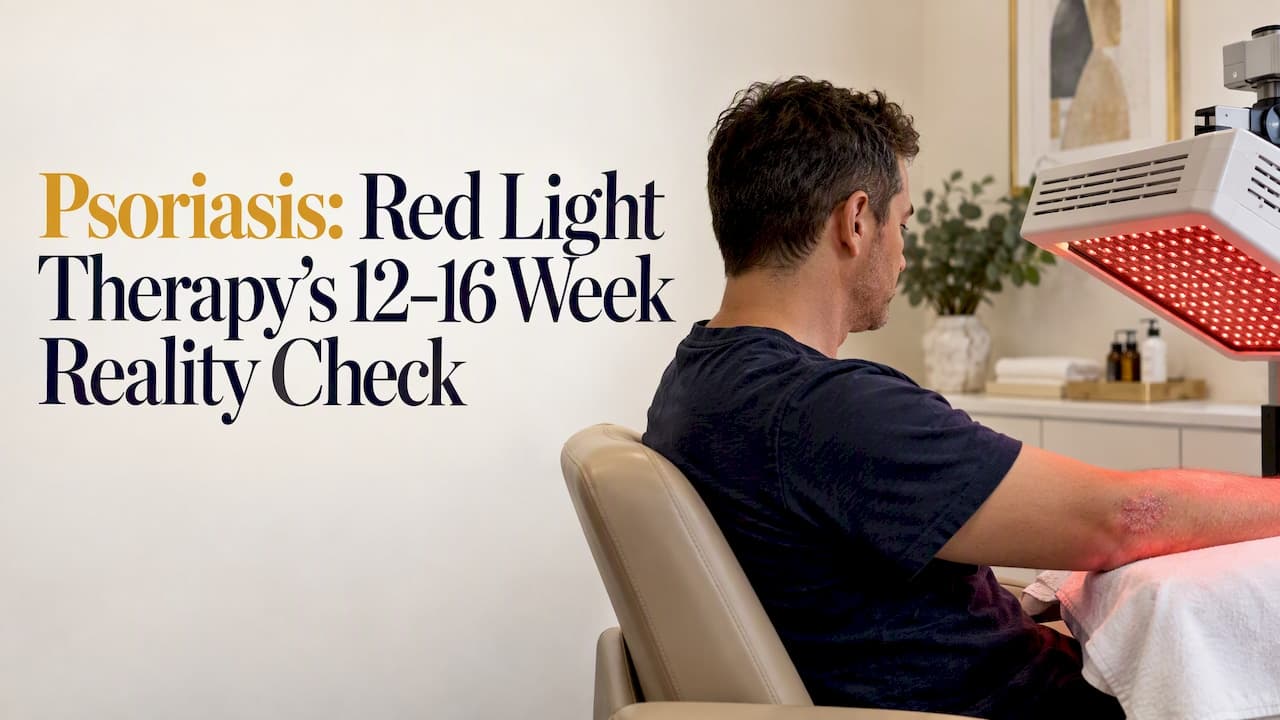
Red light therapy is a promising adjunct for mild to moderate psoriasis, backed by clinical reviews and systematic analyses, but it is not a proven replacement for standard UV phototherapy in severe disease. The evidence sits at a "Grade C" level, and clinic-observed results typically appear around 12 to 16 weeks. Compared with narrowband UVB or PUVA, red light carries no established DNA damage or cancer risk, though we still recommend working with a dermatologist to confirm it fits your case.
TL;DR:
- A pooled analysis found a negative SMD of 0.91 for local psoriasis severity, but small trials and varied protocols leave evidence at Grade C.
- Most trials used several sessions weekly for four to twelve weeks, while clinic observations suggest visible changes may take 12 to 16 weeks.
- For moderate to severe plaques, narrowband UVB remains the standard phototherapy choice; red light is an adjunct, not a replacement for prescribed care.
- People taking photosensitizing antibiotics, retinoids, or diuretics, and those with lupus, should get dermatologist clearance and use protective goggles during treatment.
- FDA clearance indicates a basic safety threshold, not psoriasis efficacy; compare wavelength and power density, and favor devices with third party testing.
Table of Contents
- What the research shows: clinical evidence and reviews
- How red and near-infrared light work on psoriatic skin
- Safety and precautions: side effects, photosensitivity, and eye protection
- At-home devices versus clinic treatments: what differs and how to choose
- How red light compares with other phototherapies
- How to start red light therapy for psoriasis
- Clinic perspective: Vitaluxe Drip Lounge experience and evidence
- Author perspective: how to think about RLT in your psoriasis care
- Vitaluxe Drip Lounge: clinic red light therapy as an option
- FAQ
- Sources
What the research shows: clinical evidence and reviews
The strongest data on red light for psoriasis come from a mix of systematic reviews, small randomized trials, and lab-based studies rather than large multicenter trials. A systematic review and meta-analysis of LED therapies covering 31 studies found that red and blue LED treatments reduced local psoriasis severity measures with a pooled analysis showing a meaningful decrease in psoriasis severity in small, heterogeneous studies.
A pooled analysis of LED trials found an SMD of -0.91 for local psoriasis severity measures, which suggests a real benefit, though the underlying studies were small and used varied protocols.
Separately, a clinical review of phototherapy options assigned red light a "Grade C" recommendation for psoriasis, meaning the evidence supports consideration as adjunctive care but doesn't yet meet the bar for first-line treatment. That grading reflects a few recurring issues:
- Most trials enroll small numbers of patients, limiting how confidently results generalize.
- Protocols vary widely in wavelength, dose, and session frequency, making head-to-head comparisons difficult.
- Some trials reported that improvements faded after patients stopped treatment, meaning red light likely needs to be maintained rather than used as a one-time fix.
None of this rules out red light as a useful tool. It means the research base is still building, and dermatology societies continue to favor narrowband UVB and PUVA as primary phototherapy options for patients who need more aggressive treatment.
How red and near-infrared light work on psoriatic skin
Photobiomodulation, the mechanism behind red and near-infrared light therapy, works by stimulating mitochondria in skin cells to produce more ATP, the energy currency cells use to repair and regulate themselves. In psoriatic skin, where keratinocytes multiply far faster than normal, this process appears to help calm the overactive signaling that drives plaque formation.

Research tied to animal models of psoriasis points to reduced STAT3 signaling and lower keratinocyte proliferation following red light exposure, both of which are central to how psoriasis plaques thicken and scale. Cytokine modulation, a reduction in the inflammatory signals that keep the immune response in overdrive, also shows up consistently across lab studies.
Wavelength and penetration depth matter a great deal here:
- Red light in the 620 to 770 nanometer range penetrates roughly 6 millimeters into tissue, enough to reach the upper dermis where much of the inflammatory activity occurs, according to the same clinical review.
- Near-infrared light, typically in the 810 to 830 nanometer range, reaches somewhat deeper and is sometimes paired with red light for thicker plaques.
- Thinner plaques tend to respond more readily since light can reach the active cell layers without being scattered or absorbed before it gets there.
Thicker, more established plaques may need longer exposure times or combination approaches, since scale and thickness both reduce how much light actually reaches the target tissue.
Safety and precautions: side effects, photosensitivity, and eye protection
Red light therapy has a favorable safety profile compared with ultraviolet-based treatments. Most people tolerate it well, and the side effects that do occur are usually mild and short-lived.
- Temporary redness or warmth at the treatment site, which typically resolves within a few hours.
- Mild, transient discomfort during longer sessions, especially on already-irritated plaques.
- Rare hyperpigmentation in people with darker skin tones, usually linked to higher cumulative doses.
Unlike narrowband UVB or PUVA, red light therapy has no established link to DNA damage or skin cancer risk, which makes it an appealing option for patients who need frequent, ongoing treatment. That said, a few precautions matter. Certain medications, including some antibiotics, retinoids, and diuretics, increase photosensitivity, and autoimmune conditions like lupus can flare with light exposure, according to Harvard Health's guidance on light-based skin treatments. Anyone on these medications or with a photosensitive condition should get dermatologist clearance before starting.
Eye protection is also worth taking seriously, even though red light is lower energy than UV. Most clinic protocols include protective goggles, and checking that any device you use, clinic or at-home, has clear dosing instructions and safety certification is a reasonable baseline.
Pro Tip: Keep a simple log of session dates, duration, and any skin changes so you and your dermatologist can track whether the therapy is actually helping.
At-home devices versus clinic treatments: what differs and how to choose
Not all red light devices are built the same, and the gap between consumer and clinical equipment is larger than marketing often suggests. Clinical devices deliver higher fluence (the total energy delivered per area) and more consistent power density, following structured protocols tested in the studies referenced above. Consumer devices, even FDA-cleared ones, are generally weaker and less standardized.
"FDA-cleared" for a consumer device signals that the product met a basic safety threshold, not that it's proven effective for psoriasis specifically, a distinction dermatology safety guidance makes explicitly.
When deciding between an at-home device and clinic treatment, a few factors help:
- Check whether the device lists its wavelength range and power density, not just "red light" as a vague claim.
- Favor devices with published third-party testing over ones that only cite internal marketing data.
- Consider clinic treatment first if you have moderate to severe plaques, since clinical equipment can deliver the higher, more consistent doses used in trials.
- Loop in a dermatologist before starting if you're on photosensitizing medication or have an autoimmune photosensitive condition.
For many people, a reasonable approach is starting under clinical supervision to establish what response looks like, then discussing whether an at-home device makes sense for maintenance.

How red light compares with other phototherapies
Narrowband UVB remains the standard first-line phototherapy for many patients with stable plaque psoriasis, typically delivered two to three times per week at a treatment center under dermatologist supervision, according to American Academy of Dermatology guidance. PUVA, which combines a light-sensitizing medication with UVA exposure, is generally reserved for more resistant or widespread cases.
- Narrowband UVB: first-line for moderate disease, requires a treatment center, strong efficacy track record.
- PUVA: used for more resistant cases, involves a photosensitizing medication plus UVA light.
- Blue LED: tends to address more superficial symptoms and surface bacteria-related skin issues.
- Red and near-infrared LED: penetrates deeper, targeting the hyperproliferation and inflammation processes beneath the surface.
Red light is best positioned as an adjunct, something layered onto existing care or used for milder presentations, rather than a stand-alone substitute for UV-based phototherapy. Dermatologists sometimes combine modalities, pairing red light with topical treatments or UVB, to address different aspects of the disease at once. The clearest safety tradeoff is long-term risk: UV therapies carry documented photoaging and skin cancer risk with cumulative exposure, while red light currently shows no comparable signal.
How to start red light therapy for psoriasis
Most published trials used red light sessions several times a week for four to twelve weeks, and clinic-based observation suggests noticeable skin changes typically appear around 12 to 16 weeks of consistent treatment. That timeline is longer than many people expect, so building in a realistic check-in point matters.
- Start with a dermatologist consultation to confirm red light is appropriate for your plaque thickness and overall treatment plan.
- Begin sessions on a consistent schedule, whether at a clinic or with a vetted at-home device, and avoid skipping weeks.
- Track progress with photos, a symptom diary, or a local severity scale your dermatologist recommends.
- Reassess at the 12 to 16 week mark to decide whether to continue, adjust frequency, or combine with a topical or systemic treatment.
Red light therapy doesn't need to replace what you're already using. Many patients fold it in alongside topicals or other prescribed treatments rather than switching entirely.
Clinic perspective: Vitaluxe Drip Lounge experience and evidence
Red Light Therapy is one of the wellness services we offer, administered through a nurse-led, personalized approach rather than a one-size-fits-all protocol. We've found that clinic-administered sessions tend to show noticeable skin changes around the 12 to 16 week mark, consistent with the broader research on LED therapies. Clinic dosing differs meaningfully from at-home devices: clinical equipment delivers higher, more consistent energy output, which is part of why clinic-based results tend to track closer to what's reported in clinical studies.
We treat red light as one piece of a broader wellness plan, often alongside hydration and recovery-focused IV treatments, and we offer discounts for first responders and college students as part of community-focused pricing.
Author perspective: how to think about RLT in your psoriasis care
I'd treat red light as a reasonable adjunct for many people with mild to moderate psoriasis, especially alongside a treatment plan your dermatologist already supports. For thicker, more stubborn plaques, starting in a clinical setting makes more sense than reaching for a consumer device first. Keep your expectations tied to the 12 to 16 week window, and check in with your dermatologist at that point rather than judging results too early.
— Debbie
Vitaluxe Drip Lounge: clinic red light therapy as an option
If you're weighing red light therapy as part of your psoriasis care, our nurse-led team at Vitaluxe Drip Lounge builds sessions around your skin, not a generic protocol. We offer Red Light Therapy as a standalone service, and it can also fit into a broader wellness routine through our membership plans.

- Single Red Light Therapy sessions are available through our services page; current prices are listed there.
- Regular sessions fit naturally into our Essential or Elite membership plans for ongoing care.
- Discounts are offered for first responders and college students as part of community pricing.
We always recommend confirming your plan with a dermatologist first, especially for moderate to severe plaques. If gentle topical support interests you alongside light therapy, barrier-repair skincare routines are worth a look too. Reach out to book a session and we'll help build a plan around your skin.
This article is general information, not a substitute for advice from a qualified doctor. Consult a qualified healthcare professional about your own circumstances before acting on anything here.
FAQ
Can red light therapy reduce psoriasis symptoms?
Small clinical trials and a meta-analysis of LED therapies suggest red light can reduce local psoriasis severity measures like erythema and scaling, with a pooled effect size of -0.91 in pooled study data. It's considered a reasonable adjunct for mild to moderate cases rather than a stand-alone cure.
How long should I leave red light on a psoriasis plaque?
Session lengths vary by device and protocol, but most studies used multiple sessions per week over four to twelve weeks before measuring results. Clinic-based observation points to visible changes typically appearing around 12 to 16 weeks of consistent use.
How does phototherapy for psoriasis work in general?
Phototherapy uses specific light wavelengths, including narrowband UVB, PUVA, and red or near-infrared LED, to calm the overactive skin cell turnover and inflammation behind psoriasis plaques. Narrowband UVB remains the first-line phototherapy option for many patients, while red light is typically used as an adjunct.
Is red light therapy safer than UVB or PUVA for psoriasis?
Red light has no established link to DNA damage or skin cancer, unlike narrowband UVB and PUVA, which carry known long-term photoaging and cancer risks with cumulative use. That said, red light still requires precautions around photosensitizing medications and eye protection, so dermatologist input remains worthwhile.
Sources
- A clinical review of phototherapy for psoriasis (PMC)
- Utilization of light‑emitting diodes for skin therapy: systematic review and meta‑analysis (PubMed)