Red light therapy is studied for mood in two main ways: as photobiomodulation, where low-level red and near-infrared light is applied to the body or head, and as a light exposure that interacts with your body clock without the melatonin disruption that bright blue-white light can cause. The research is active, the early results on depressive symptoms are encouraging, and the practical takeaway is simple: red light works best as a structured, repeated part of a wellness routine, delivered in a setting where someone checks that you are using it safely. At Vitaluxe Drip Lounge, a nurse-led clinic on Long Island, a Red Light Therapy session is $35.
TL;DR
- A 2024 meta-analysis of 11 randomized trials found that photobiomodulation (red and near-infrared light therapy) was associated with fewer depression symptoms.
- Red light at about 631 nm did not suppress melatonin in a controlled lab study, which is why it is of interest for evening use and body-clock research.
- The serotonin link is best documented for bright white light therapy, and researchers say the full mechanism is still being worked out.
- Persistent low mood, or a winter slump that disrupts your life, deserves a conversation with your doctor, and anyone with bipolar disorder should clear light therapy with their clinician first.
- Consistency matters: the studies that show benefit use repeated sessions over weeks, not a single visit.
Table of Contents
- What "mood" means in red light research
- What clinical studies found on depressive symptoms
- Why you might feel good after a session
- Red light and your body clock
- Red light therapy and serotonin
- Seasonal depression: what the standard approach is
- Who should use caution
- How to approach red light for mood and energy
- Red light at Vitaluxe Drip Lounge
- Our perspective
- FAQ
- Sources
What "mood" means in red light research
When researchers study red light and mood, they rarely mean a good feeling after one session. They measure standardized depression scores over weeks, usually in people who already have depressive symptoms, and they compare a light treatment against a control.
The technique most often studied is photobiomodulation, or PBM. Low-intensity red or near-infrared light is applied to tissue, and the working theory is that it influences how cells produce energy. Some trials aim the light at the head (transcranial PBM). That is a research approach with specific device settings, not the same thing as standing in front of a full-body panel, so it helps to keep the two apart when you read headlines.
It also helps to separate three things that often get blended together online:
- Red and near-infrared PBM, studied for depressive symptoms and cellular energy.
- Bright white light therapy, the long-established treatment for seasonal affective disorder (SAD), a pattern of depression that returns in darker months.
- Red light's effect on circadian rhythm, the roughly 24-hour internal clock that governs sleep, alertness and hormone timing.
Each has its own evidence, and each is covered below.
What clinical studies found on depressive symptoms
The strongest recent summary of PBM comes from a 2024 meta-analysis of 11 randomized controlled trials. It found that photobiomodulation reduced depression symptoms (a standardized mean difference of -0.55, with a 95% confidence interval of -0.75 to -0.35). The authors also reported the parameters that looked best for transcranial treatment: a wavelength around 823 nm, sessions of about 30 minutes, fewer than three times per week, and more than 15 treatments in total. They rated the evidence quality as moderate to very low, which is typical of a young field and a reason to read those numbers as a direction, not a prescription.
A 2023 meta-analysis of transcranial PBM pointed the same way overall. It found that transcranial treatment decreased depressive symptom severity across the studies pooled. The authors' own conclusion is that larger randomized trials with dose-finding are the next step, which is how a promising treatment area normally matures.
Two patterns stand out in this literature:
- Treatment is cumulative. The protocols that show effects use many sessions across weeks. That is why we talk about a course of red light, not a one-off.
- Parameters matter. Wavelength, dose and session length vary across trials, and results vary with them. A properly run clinic session uses a consistent, repeatable routine instead of an improvised one.
For a deeper look at how light reaches and may affect brain tissue, see our guide to red light therapy for the brain.
Why you might feel good after a session
People often describe feeling calm, warm and clear-headed after a red light session. Some of that is likely the simple effect of lying down for a protected block of time with no screen, which is itself restorative for a stressed nervous system. Some may be the biology under study: PBM is thought to act on the mitochondria, the structures that produce cellular energy, which fits the energy and recovery benefits that many of our clients, from college students in exam weeks to first responders coming off long shifts, are looking for.
We do not promise a mood outcome, and nobody honestly can. What we can say is that a short, comfortable, noninvasive session is an easy habit to repeat, and repetition is where the research points.
Red light and your body clock
Searches on red light and circadian rhythm are growing, and for good reason: red light behaves differently from the blue-white light of phones and overhead LEDs.
In a 2014 controlled laboratory study of 24 healthy volunteers, six hours of red light at 631 nm near the time melatonin normally begins to rise did not suppress melatonin. It shifted the body clock by almost an hour on average, a smaller shift than bright white light produced (2.64 hours). In 2 of the 16 red-light participants, the shift was similar in size to the bright white group, so individuals differ.
The likely reason is anatomical. A 2018 review explains that red light around 630 nm is picked up by cone cells in the retina, while the blue-sensitive cells that drive most melatonin suppression do not respond much to those longer wavelengths. A 2018 systematic review of light exposure added that two hours of evening blue light suppresses melatonin, with the strongest effect at the shortest wavelengths, while even the longest wavelengths tested could still nudge circadian timing.
In plain terms:
- Blue-white light in the evening tells your brain it is daytime.
- Red light is far less likely to do that, so a red-lit evening is more compatible with winding down.
- Red light is not inert for the clock either, so timing still matters.
That is why people exploring dim red light as part of an evening routine often read about dim red light for sleep alongside session-length guidance. We cover our own approach in red light therapy for sleep.
A scheduling tip from the science: if you are using red light to support sleep and mood, an afternoon or early-evening session tends to fit more naturally than a late-night one, because your clock's timing is what you are working with.
Red light therapy and serotonin
Serotonin is a chemical messenger involved in mood regulation, and it is the most common claim made about red light online. Here is what the evidence supports and what it does not yet.
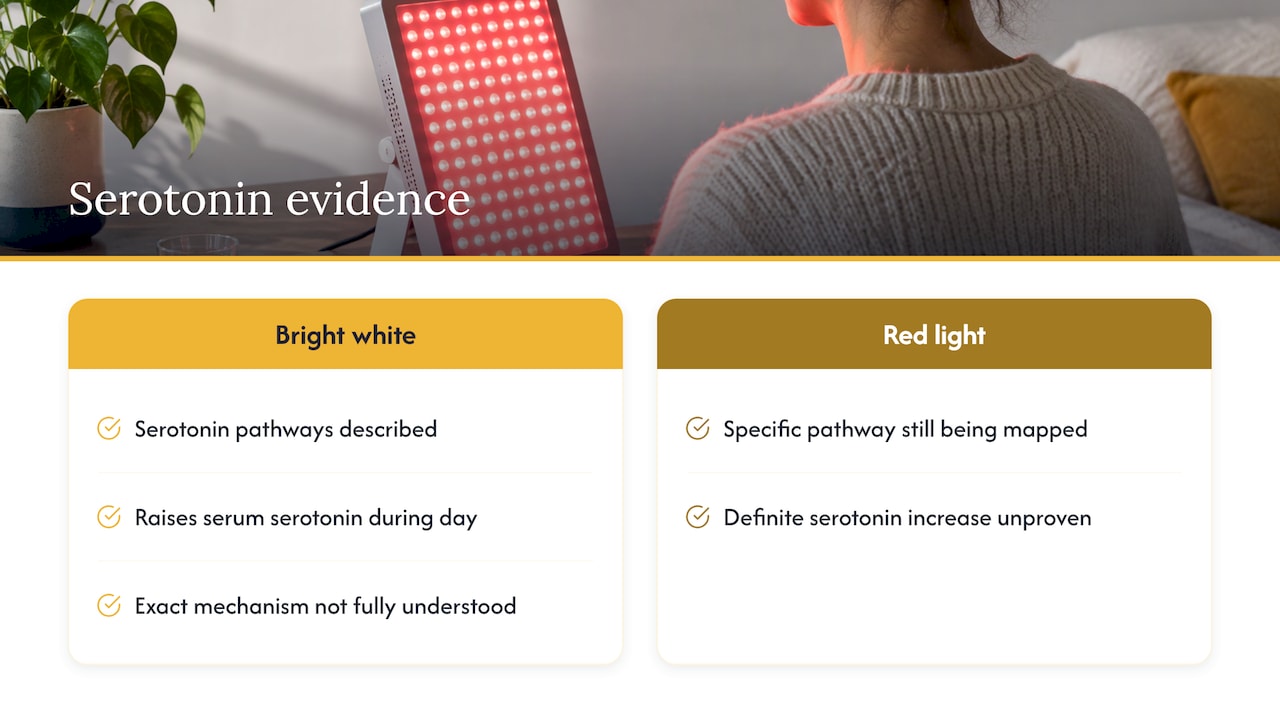
The documented serotonin findings concern bright white light therapy. A 2019 review describes bright light as acting on serotonin pathways, including by influencing serotonin-producing neurons, lowering levels of the serotonin reuptake transporter and increasing serotonin in mood-regulating brain areas. That review is about bright light, not red light specifically.
A 2014 review of bright light therapy notes that serotonergic activity is the presumed mechanism in the American Psychiatric Association's 2010 guidelines, and that light raised serum serotonin through the day in nonseasonal depression. It also says that the exact mechanism is not completely understood, and that serotonin effects sit alongside the light's effects on the body clock and the autonomic nervous system.
So the honest summary is this: serotonin is a credible part of the story for light-based approaches to mood, the specific pathway for red light is still being mapped, and anyone telling you red light definitely raises your serotonin is getting ahead of the science. We would rather you understand the research than repeat a slogan.
Seasonal depression: what the standard approach is
If you searched for red light and seasonal depression, the most useful thing to know is how seasonal affective disorder is treated in the United States.
The National Center for Complementary and Integrative Health (NCCIH) describes standard light therapy for SAD as daily exposure to a light box that filters out ultraviolet rays, for 20 to 60 minutes at 10,000 lux, which is about 20 times ordinary indoor lighting. A 2019 review notes that bright light therapy was introduced for SAD in 1984 and is established as a first-line treatment, with symptoms often easing within days.
The 2022 VA/DoD guideline went further. According to a published synopsis, it recommends bright light therapy for mild to moderate major depressive disorder with or without a seasonal pattern, where the previous version limited it to seasonal patterns.
What this means for you:
- If your low mood returns every fall and winter, or lasts more than a couple of weeks and affects work, school, sleep or relationships, talk to your doctor or a mental health professional. Depression is a medical condition and deserves a proper evaluation.
- A bright light box prescribed or recommended by your clinician is the established SAD approach.
- Red light sessions are a separate, wellness-focused tool. Many people fold them into a winter routine for energy and recovery, and they pair naturally with the basics that help in dark months: daylight in the morning, movement, regular sleep and good hydration.
We offer wellness therapies, not a replacement for care from your physician, and we would always encourage you to keep your doctor in the loop.

Who should use caution
Red light is generally gentle, but a few safety points matter, especially if you are using any light-based approach for mood.
- Bipolar disorder. NCCIH notes that light therapy may induce mania in people with unrecognized or undertreated bipolar disorder. If you have bipolar disorder, or a family history, speak with your prescriber before starting.
- Your eyes. The same source advises against staring directly into a light because of possible retinal injury. Use eye protection when a provider gives it, and follow the session instructions.
- Ultraviolet exposure. NCCIH advises avoiding UV lights because of skin cancer risk. Red light therapy is not a tanning bed or UV device.
- Mild side effects. Light therapy side effects are usually mild and can include blurry vision, light sensitivity or headache. If you notice any of these, tell the person running your session.
- Medications and skin sensitivity. If you take a medication that makes you sensitive to light, or have a skin or eye condition, check with your doctor first.
This is where a clinical setting earns its keep. At Vitaluxe, our approach is nurse-led, which means a medically trained person is part of your care instead of you reading a device manual alone.
How to approach red light for mood and energy
Here is a practical way to think about it, drawn from the research above.
- Start with the basics. Get morning daylight, move daily, and keep a steady sleep schedule. These support your body clock whether or not you add light therapy.
- Commit to a course. Research protocols use repeated sessions across weeks. Pick a frequency you can keep up.
- Be consistent about timing. Because light affects circadian timing, try to keep your sessions at similar times of day.
- Track what you notice. Keep short notes on energy, sleep and mood each week. You will see whether your routine is working for you.
- Pair it with recovery. Hydration, nutrients and rest all matter for energy. Our menu includes IV hydration, vitamin injections and NAD+ options for clients who want to combine them with light sessions.
- Involve your doctor if you have a diagnosis, take medication, or your mood is a daily struggle.
If you are curious about the broader picture of what the technology can and cannot do, our article on what clinics see versus what the evidence shows goes through it.
Red light at Vitaluxe Drip Lounge
A single Red Light Therapy session at Vitaluxe is $35, which makes a repeatable routine realistic. If you plan to come regularly, our membership plans run $205 per month (Essential) or $415 per month (Elite), and our packages page lists bundled options. You can see every treatment, from IV drips to peptide services, on our services page. We offer special discounts for first responders and college students, and we serve clients across Massapequa, Wantagh, Bellmore, Merrick, Rockville Centre, Babylon, Lindenhurst, Farmingdale and nearby Long Island communities.

Book a session through the Vitaluxe Drip Lounge site and tell us what you are after, whether that is steadier energy through a heavy semester, recovery after long shifts, or a calmer evening routine.
Our perspective
Most of the conversations we have about red light start with the same question: "Will it fix my mood?" We answer it the way a nurse-led team should, with respect for both the science and the person asking.
The research on light and mood is real and moving fast. Photobiomodulation has shown encouraging results on depressive symptoms in pooled trials, and red light's gentle relationship with the body clock is a genuine reason people like it in the evening. At the same time, bright white light remains the established tool for seasonal depression, and anyone dealing with persistent low mood should work with their doctor. Those two truths sit comfortably together.
What we focus on is the part we do well: a calm, boutique setting, a clinical standard of safety, and a plan built around you. Many of our clients pair red light with hydration, vitamin support or a membership so the habit sticks, because the studies that look best are the ones with repeated sessions over weeks. We would rather help you build a routine you enjoy than promise a miracle after one visit.
If you are a student in finals, a first responder after a rough stretch, or simply someone who wants to feel more like yourself in the darker months, we would be glad to build that routine with you.
Debbie
FAQ
Does red light therapy change your mood?
Pooled research on photobiomodulation has found reductions in depressive symptoms, and many people report feeling calm and clear after sessions. The evidence is still developing, and researchers are calling for larger trials. Think of red light as one supportive part of a wellness routine, not a stand-alone treatment for depression.
Does red light therapy affect circadian rhythm?
It can. In a controlled study, red light at 631 nm shifted the body clock modestly and did not suppress melatonin, unlike the stronger effects of bright white light. Because timing still matters, keep your sessions at consistent times of day.
Is red light therapy good for seasonal depression?
The established treatment for seasonal affective disorder is a bright light box at 10,000 lux, used under a clinician's guidance. If your low mood follows the seasons, see your doctor. Red light sessions can sit alongside that as a wellness habit for energy and recovery.
Does red light therapy increase serotonin?
The documented serotonin effects belong to bright white light therapy, and researchers say the full mechanism is still not completely understood. Red light's exact pathway is still being studied, so no one can yet say precisely how it affects serotonin.
Who should be careful with red light therapy?
People with bipolar disorder should talk to their prescriber first, since light therapy may induce mania in unrecognized or undertreated cases. Never stare directly into a light source, and tell your provider about light-sensitizing medications or eye and skin conditions before you begin.
Sources
- Photobiomodulation improves depression symptoms: a meta-analysis (2024)
- Efficacy of transcranial photobiomodulation on depressive symptoms (2023)
- Effects of intermittent versus continuous red light exposure (2014)
- Potential for the development of light therapies in mild traumatic brain injury (2018)
- Systematic review of light exposure impact on human circadian rhythm (2018)
- Bright light as a personalized precision treatment of mood disorders (2019)
- Bright light therapy for depression: a review (2014)
- NCCIH: Seasonal affective disorder and complementary health approaches
- Effects of light on human circadian rhythms, sleep and mood (2019)
- The Management of Major Depressive Disorder: Synopsis of the 2022 VA/DoD guideline