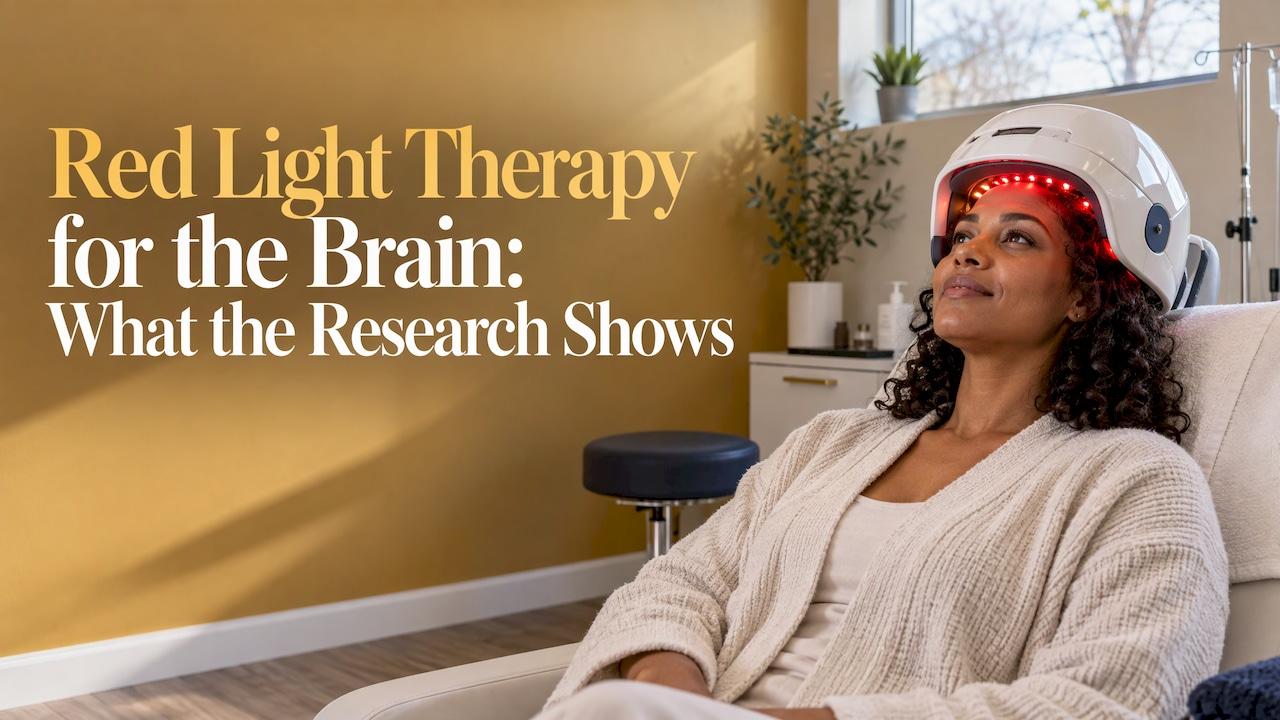
Red light therapy for the brain, known in research as transcranial photobiomodulation, sends low-intensity red or near-infrared light through the scalp and skull to nudge the energy-making machinery of brain cells. Human studies on memory, attention, mood and recovery after head injury are encouraging, and the protocols behind them are specific: particular wavelengths, doses and schedules. If you are curious about adding red light to your recovery routine, our nurse-led team at Vitaluxe Drip Lounge offers Red Light Therapy sessions for $35, and this guide explains what the science says so you know what to expect.
TL;DR
- Transcranial red light therapy applies red to near-infrared light (600 to 1300 nm) through the skull. The leading explanation is that it boosts mitochondrial energy (ATP) production in brain cells.
- A 2023 systematic review of 35 human studies found that 29 reported improved cognition, including all nine on memory complaints, mild cognitive impairment and dementia.
- Wavelength, dose, session length and schedule all matter. A common research protocol uses 810 nm light at 20 to 25 mW/cm².
- Reported side effects in the research are minor: headache, fatigue, eye strain and warmth at the treatment site.
- Our Red Light Therapy session is $35, and our Essential and Elite memberships cover ongoing wellness plans.
Table of Contents
- What red light therapy for the brain actually is
- How light is thought to affect brain cells
- Why dose, depth and delivery site matter
- What human studies show
- What a session feels like and how often people use it
- Safety: who, how much, and what to watch
- Who is most likely to care about this
- Red light at Vitaluxe Drip Lounge
- Our perspective
- FAQ
- Sources
What red light therapy for the brain actually is
The technical name is transcranial photobiomodulation, or tPBM. A 2024 review defines it as applying low-irradiance red to near-infrared light, between 600 and 1300 nanometers, through the skull to brain tissue, aiming at neuroprotection and better behavioral outcomes. The same review notes the idea is more than 50 years old and was first called low-level laser (or light) therapy.
A few terms help here:
- Wavelength is the color of the light, measured in nanometers (nm). Visible red sits around 620 to 700 nm. Near-infrared is just beyond what your eye sees.
- Irradiance is how intense the light is at the skin, in milliwatts per square centimeter (mW/cm²).
- Fluence is the total energy delivered, in joules per square centimeter (J/cm²). It equals intensity multiplied by time.
In a tPBM protocol, one or more light sources sit on the head over a target region. According to a 2016 review by Hennessy and Hamblin, wavelength, irradiance and other parameters define the protocol, and light in the 600 to 690 nm or 760 to 900 nm ranges has a greater effect than light around 700 to 750 nm.
This is not the same as the bright white light boxes used for seasonal mood, and it is not a laser procedure. If you are wondering how LED-style red light compares with laser devices, our guide on red light versus laser therapy explains why depth matters more than device type.
How light is thought to affect brain cells
The best-studied explanation starts inside the mitochondria, the part of each cell that produces energy. Hamblin's 2016 review describes an enzyme called cytochrome c oxidase, the fourth unit of the mitochondrial respiratory chain. Nitric oxide can sit on that enzyme and slow it down. Photons absorbed mainly in the red (600 to 700 nm) and near-infrared (760 to 940 nm) regions can knock that nitric oxide loose. The review links this to higher mitochondrial membrane potential, more oxygen consumption, more glucose metabolism and more ATP, the cell's energy currency.
A 2022 review of transcranial near-infrared stimulation lists the local responses researchers describe:
- Higher ATP production and mitochondrial function
- Management of local oxidative stress
- Widening of local blood and lymphatic vessels
- New synapses and restoration of damaged ones
- Stimulation of new neuron growth
- Neuroprotective, cell-protective effects
- New blood vessel growth
Hamblin has also suggested that tPBM could be used for cognitive enhancement in healthy people, not only in patients. That is the question most health-conscious readers bring: can this support energy and mental clarity, and not just treat injury?

Why dose, depth and delivery site matter
Light loses strength as it travels. A 2018 narrative review explains that light must pass through the scalp, periosteum, skull, meninges and dura, and that because of exponential attenuation only a small fraction reaches the outer layers of the cortex. The review lists absorption peaks of the key enzyme at 605, 620, 655 and 680 nm in the red range and 760 and 825 nm in the near-infrared.
The numbers from real trials show how this plays out:
- In a 2020 trial in moderate traumatic brain injury, the helmet delivered about 43 J/cm² to the scalp, and roughly 3% of it, about 1.3 J/cm², was estimated to reach the cortical surface, based on cadaver transmission data.
- In a 2021 forehead trial, an 810 nm LED at 250 mW/cm² and 60 J/cm² over the prefrontal cortex delivered about 2.1 J/cm² to the brain, with 3.7% penetration to the dura.
A 2026 history of direct transcranial photobiomodulation argues that dose, depth and delivery site are biological variables, not engineering footnotes. That is why the field has moved toward the forehead, where the target geometry is more reproducible, and why results depend on the protocol and not only on the color of the light.
The practical lesson for you: "red light" is not one thing. Wavelength, power, distance, session length and body area all change what a session does. Our red light therapy benefits guide covers how clinics think about these variables across the body.
What human studies show
Cognition overall
A 2023 systematic review of 35 human studies found that 29 (82.9%) reported positive cognitive improvement after tPBM. All nine studies on subjective memory complaints, mild cognitive impairment and dementia showed positive outcomes. The most common protocol used 810 nm light at 20 to 25 mW/cm² irradiance and 1 to 10 J/cm² fluence, though reviewed protocols ranged from visible red (630 to 635 nm) to near-infrared (1060 to 1068 nm).

Mild and moderate head injury
The same review found 7 of 8 traumatic brain injury (TBI) studies were positive. Two studies show what that looks like in practice:
- A 2014 open-protocol study (Naeser and colleagues) treated 11 people with chronic mild TBI using FDA-cleared red and near-infrared LED clusters. Each of 11 scalp placements got 10 minutes of light (13 J/cm² each), over 18 sessions on Monday, Wednesday and Friday for six weeks. Participants improved on executive function (Stroop test) and verbal learning measures, and reported better sleep and fewer PTSD symptoms.
- A 2020 randomized trial (Figueiro Longo and colleagues) assigned 68 patients with moderate TBI to a near-infrared helmet or sham treatment. The helmet used 18 clusters of 20 LEDs, three 20-minute sessions a day, starting within 72 hours of injury. Among the 28 who completed at least one light session, there were no adverse events referable to the light, and at three months the light group showed significant changes in white-matter diffusion measures on MRI. The authors concluded the trial established feasibility, safety and neuroreactivity, and called for larger trials.
This matters for first responders and anyone with a history of knocks to the head. These studies were run in clinical research settings with defined devices, and they are the reference point for what a real protocol looks like.
Stroke recovery and mood
A 2025 randomized trial of 90 people with cognitive impairment after stroke used a red-light LED helmet and belly band for 30 minutes, five times a week, for three months. At the six-month follow-up the light group had greater gains than sham on both the MMSE and MoCA cognitive tests (mean differences of 3.36 and 3.48 points) and a greater improvement in depression scores. A 2026 literature review of the same trial also reports a lower rate of stroke recurrence in the light group during follow-up.
A 2021 trial in opioid use disorder used just four minutes, twice weekly, on the forehead. Protocols can be short, but they are precise.
The honest summary
The research is promising and growing, and the protocols differ from study to study. A 2024 review of brain photobiomodulation devices screened 2,133 records, included 97 studies, and called for standardized reporting and sham-controlled comparison studies. Treat the studies above as evidence of what is being explored, not as a promise for any single person. If you have a diagnosed brain condition, work with your neurologist or primary care physician, and let them know about any wellness therapy you add.
What a session feels like and how often people use it
In the studies above, the schedule ranged widely: four minutes twice a week, 30 minutes five times a week, or three sessions over six weeks of Monday-Wednesday-Friday visits. What they share is repetition. Light therapy is a cumulative routine, not a one-off. If you are planning around a busy semester, a rotation of shifts or a training block, consistency is the part you control.
Sessions are painless. The sensation is gentle warmth. People often pair light work with hydration and recovery support, which is why many of our clients combine it with an IV session after hard training or a stressful exam period. We also publish a clinic-focused guide on red light for sleep, since better sleep is one of the most common reasons people come in.
For readers curious about the clinical side of photobiomodulation in neurological care, this overview of photobiomodulation benefits and dosage adds context on emerging applications.
Safety: who, how much, and what to watch
A 2025 systematic review of near-infrared stimulation in psychiatry describes the method as low-risk and non-invasive. Reported minor side effects are headaches, fatigue, eye strain and warmth at the stimulation site. The review also observes that because light bypasses liver cytochrome P450 metabolism, it carries no drug-interaction risk of the kind medications do.
Safe-use habits that follow from the research:
- Protect your eyes. Eye strain is among the reported effects, so keep light off the eyes unless a provider directs otherwise, and use the eye protection provided.
- Keep to the protocol. More is not automatically better. In the 2021 trial, the exposure was kept well below the ANSI RP-27 safety standard of 0.32 W/cm², and a rat safety study showed no neurological deficits or tissue damage even at ten times the optimal intensity.
- Tell your clinician. If you have a seizure disorder, a recent head injury, an implanted device, are pregnant, or take medicines that make you sensitive to light, speak with your physician before starting any light therapy.
- Stop and report persistent headache, dizziness or any symptom that worries you.
A nurse-led setting is a practical advantage here: someone who understands your health history can screen for these situations before your first session.
Who is most likely to care about this
Students juggling exams, late nights and screens often want clearer focus and faster recovery. First responders face physical strain and head-impact risk, so the TBI research is the part that gets their attention. Health-conscious adults and anyone interested in anti-aging are drawn by the mitochondrial energy angle: cells with more ATP are the idea behind much of the photobiomodulation literature.
If your interest is more about skin, hair or sore tissue than the brain, the same light has its own evidence trail. See our guides on skin changes, hair growth and tendonitis.
Red light at Vitaluxe Drip Lounge
Our Red Light Therapy session is $35, and it sits alongside the rest of our wellness menu: IV vitamin drips such as Energy Vital Spark, Reboot, Myers+ and Clarity Boost at $220 each, NAD+ IV options from $199 to $624 depending on dose, and a $25 B12 shot. Our team is nurse-led and we serve clients across Long Island's South Shore, including Massapequa, Merrick, Bellmore, Farmingdale and Lindenhurst. We offer discounts for first responders and college students.
If you want light therapy as part of a regular routine, our Essential ($205 per month) and Elite ($415 per month) memberships are built for ongoing wellness, and you can see every single-session option on our services page.
Our perspective
Light is one of the more elegant ideas in wellness: no needle, no pill, just photons asking your cells to make more energy. The studies on memory, injury recovery and mood are why people ask us about the brain.
What we have learned is that people do best when recovery is treated as a system. Hydration, nutrients, sleep and light work together, and the nurse who knows your history can help you build that routine around your life, whether that is finals week, a run of night shifts or a training block.
We care about a boutique, supportive setting with clinical safety behind it. That is why we pair every therapy with a conversation about your goals, and why red light, IV therapy and our other treatments are designed to complement each other, not compete for your attention.
Debbie
FAQ
Does red light therapy help the brain?
Research is encouraging. A 2023 systematic review found positive cognitive outcomes in 29 of 35 human studies, and trials in head injury and post-stroke cognition reported improvements in memory, attention, executive function and mood. Results depend on the protocol, and individual responses vary.
What is transcranial red light therapy?
It is the research term for shining red or near-infrared light through the scalp and skull to reach brain tissue. The light is low-intensity, painless and non-invasive. The aim is to support mitochondrial energy production in brain cells.
How long and how often are sessions in studies?
It varies. One forehead protocol used four minutes twice a week, one head injury study used 10 minutes at each of 11 placements three times a week for six weeks, and a stroke trial used 30 minutes five times a week for three months. A common protocol used 810 nm light at 20 to 25 mW/cm².
Is red light therapy safe for the head?
The research describes it as low-risk, with minor effects such as headache, fatigue, eye strain and warmth. Protect your eyes, follow a set protocol, and check with your physician first if you have seizures, a recent head injury, an implant or are pregnant.
How much does red light therapy cost at Vitaluxe?
A Red Light Therapy session at Vitaluxe Drip Lounge is $35. Our Essential membership is $205 per month and Elite is $415 per month. See our services page for current options.
Sources
- Transcranial photobiomodulation for brain diseases: review (2024)
- Photobiomodulation and the brain: a new paradigm
- Shining light on the head: Photobiomodulation for brain disorders
- Transcranial near-infrared light in treatment of neurodegenerative diseases (2022)
- Brain Photobiomodulation Therapy: A Narrative Review (2018)
- Can transcranial photobiomodulation improve cognitive function? (2023)
- Significant Improvements in Cognitive Performance Post-Transcranial, Red/Near-Infrared LED Treatments (2014)
- Effect of Transcranial Low-Level Light Therapy vs Sham in Moderate TBI (2020)
- Red-light photobiomodulation improves cognition after stroke (2025)
- Application of photobiomodulation in post-stroke cognitive impairment (2026)
- An Effective and Safe Novel Treatment of Opioid Use Disorder (2021)
- Devices used for photobiomodulation of the brain (2024)
- The evolution of direct transcranial photobiomodulation (2026)
- Near-Infrared Stimulation in Psychiatry Disorders: A Systematic Review (2025)
- Photobiomodulation benefits and dosage