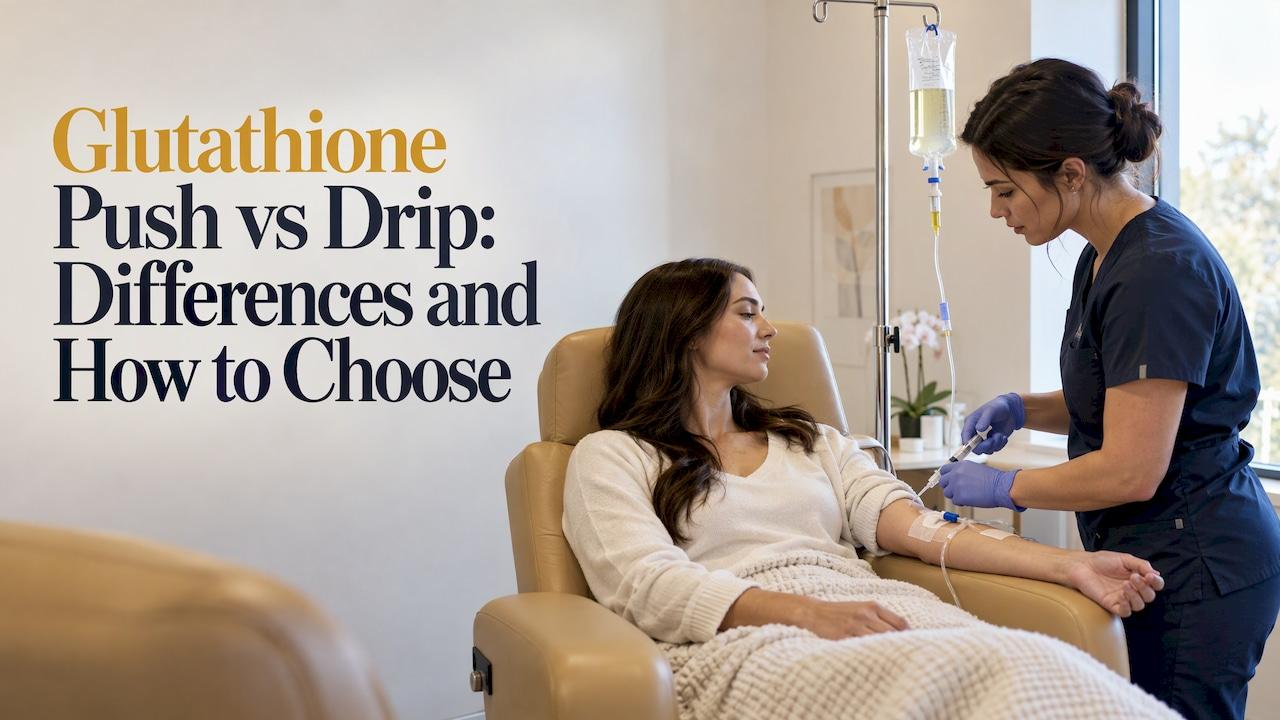
A glutathione push and a glutathione drip put the same molecule into your bloodstream. The difference is speed and setting. A push is a slow injection through the IV line over a few minutes, often added at the end of another IV session. A drip is glutathione diluted in a bag of fluid and run in over a longer stretch, commonly about an hour. If you are already getting an IV for hydration or recovery, a push fits neatly into that visit. If you want a dedicated session, a drip is the format built for it. At Vitaluxe Drip Lounge, our nurse-led team helps you pick between them during your visit, and glutathione is $220 per session.
TL;DR
- A push is a slow injection through the IV line over minutes. A drip is glutathione mixed into a bag and infused over a longer period, about an hour in one published US protocol.
- Both routes skip the digestive system, so glutathione reaches your blood directly. Research has not shown that one route outperforms the other.
- Glutathione clears from the blood quickly, with a measured half-life of about 14 minutes after infusion, so a slower drip is about duration of exposure, not a bigger dose.
- The FDA's August 27, 2026 alert is about the quality of the glutathione ingredient used in injectables, so sourcing matters more than push or drip.
- Which is better depends on your schedule, your other IV ingredients and your health history. A nurse should decide with you.
Table of Contents
- What a glutathione push and a glutathione drip actually are
- Side by side: push vs drip
- Which is better, push or drip?
- How often people schedule glutathione
- Safety: what the FDA says, and what it means for you
- How glutathione compares with alternatives
- Perspective
- What a glutathione session costs at Vitaluxe
- FAQ
- Sources
What a glutathione push and a glutathione drip actually are
Glutathione is an antioxidant your body makes on its own, built from three amino acids. When you swallow it, much of it is broken down in digestion. An IV route avoids that step, which is why people who want a larger dose in the blood look at injections and infusions. A 2026 systematic review notes that injectable glutathione has the highest bioavailability because it bypasses the gastrointestinal tract, meaning more of what you receive actually reaches your blood.
Both the push and the drip use a small catheter placed in a vein. What differs is how the glutathione travels from the syringe or bag into you.
The push
A nurse draws the dose into a syringe and delivers it by hand into your IV line, steadily and slowly. The nurse stays at your side the whole time, watching how you feel and adjusting the pace. A push is often given at the end of a vitamin drip, once the bag is nearly finished, which is why many clinics sell it as an add-on. Because it is short, it suits people with a tight lunch hour or a class break.
The drip
A drip means the glutathione is added to a bag of fluid, usually saline, and runs in by gravity or pump. One example from US clinical practice is a 2020 case report from New York City, where 2 g of IV glutathione was given with 1 L of 0.9% normal saline over one hour. That gives you a longer sit-down, more fluid, and a slower rate of delivery.
Side by side: push vs drip
| Glutathione push | Glutathione drip | |
|---|---|---|
| How it is given | Slow injection by hand through the IV line | Diluted in a fluid bag and infused |
| Typical chair time | Minutes | Longer, about an hour in the published protocol above |
| Fluid with it | Little | A full bag, which adds hydration |
| Often paired with | The end of another IV session | A standalone session or a blend |
| Pace control | Set by the nurse at the syringe | Set by the line or pump |
| Best fit | Short on time, adding to a drip | Wanting hydration and a longer, calmer session |
None of these differences changes what glutathione is. They change your experience in the chair and how the session fits into your day.
Which is better, push or drip?
The honest answer is that the better route is the one that fits your goal and your schedule, because published research has not established that either delivers better results than the other. The studies that exist test IV glutathione as a whole, not push against drip.
Here is what is measurable. A 1991 pharmacokinetic study of high-dose IV glutathione found that plasma total glutathione rose from 17.5 to 823 µmol/L, with a half-life of about 14 minutes. In plain terms, glutathione rises sharply in the blood and clears fast. That is useful context for both routes: whatever the format, the body handles the glutathione quickly, and the format mainly sets how quickly it enters.
When a push makes sense
- You are already getting an IV for hydration, energy or recovery and want glutathione added.
- You have limited time, for example between shifts, lectures or work.
- You prefer a short visit and do not need extra fluids.
When a drip makes sense
- You want a dedicated glutathione session rather than an add-on.
- You want the hydration that comes with a full bag of fluid, such as after a hard training week, a long shift or a stretch of poor sleep.
- You would rather a slower, steadier pace.
Matching it to your situation
College students heading into exam season often want hydration and recovery in one stop, which leans toward a drip. First responders coming off a shift may want the same, plus a quick add-on if the day is not done. Someone interested in anti-aging support may prefer a short push alongside a longer session. These are common patterns, not rules. Your nurse will go through your goals and history and recommend a format.

If you want to see how the glutathione fits with other ingredients, our guide to glutathione with vitamin C walks through the pairing, and what is actually in an IV drip bag explains the usual building blocks.
How often people schedule glutathione
There is no single schedule backed by trials. A 2018 review of glutathione in dermatology noted that manufacturers had been recommending 600 to 1,200 mg weekly or twice weekly without evidence behind those schedules. That is why we treat frequency as a conversation, not a formula. How often you come in depends on why you are coming, how you feel afterward and what your nurse sees on your history.
If you expect to come in regularly, a plan can make more sense than single visits. Our membership options start at $205 per month for Essential and $415 per month for Elite, and our packages page lists bundled sessions. For what to expect over time, read glutathione before and after.

Safety: what the FDA says, and what it means for you
The push-versus-drip question matters less than a more basic one: what went into the vial. In an alert dated August 27, 2026, the FDA reminded compounders not to use dietary-supplement-grade glutathione for injectables. It reported at least 30 patients with adverse events, including fever, chills, pain, dizziness and shock or sepsis-like symptoms, some hospitalized. The symptoms were consistent with excessive endotoxin exposure. Endotoxins are fragments of bacteria that can contaminate ingredients and cause a strong reaction when injected.
The FDA also states that compounders are responsible for making sure every component of an injectable is appropriate for its intended use, and that dietary-supplement-grade ingredients may carry impurities that are harmful when injected. This is not new. A 2019 FDA communication described seven patients at one clinic who reacted within minutes to IV glutathione made from supplement-labeled powder, with endotoxin levels up to five times the appropriate limit. In August 2026, one compounding pharmacy also voluntarily recalled a lot of compounded glutathione 200 mg/mL vials because of elevated endotoxin levels.
The point for you: these events trace back to ingredient quality, not to whether the dose was pushed or dripped. Our deeper write-ups, the FDA 2026 advisory on glutathione IV and why FDA alerts on IV hydration matter, cover the details.

Safe use and who should talk to a clinician first
Tell your nurse about every medication and supplement you take, any liver or kidney condition, any history of allergic reactions, and whether you are pregnant or nursing. If you have a medical condition or take prescription drugs, speak to your own physician before starting any IV therapy. Stop and tell the nurse right away if you feel chills, dizziness, itching, a rash, chest tightness or trouble breathing during an infusion or push.
If you take supplements that affect the liver, such as herbal products, it also helps to understand how they behave. This overview of milk thistle safety and interactions is a good place to start, and you can bring the list to your visit.
Glutathione injections are not an FDA-approved drug product by any route, and the FDA's guidance concerns how compounded injectables are made. That is another reason a medically supervised setting matters.
How glutathione compares with alternatives
People often ask whether glutathione is the right tool at all. Two common comparisons are with NAC, a precursor your body uses to make glutathione, and with milk thistle, a liver-support herb. We explain each in glutathione vs NAC and glutathione vs milk thistle. If your main goal is energy at the cellular level, our NAD+ options are another path, covered in NAD+ IM vs IV.
On oral glutathione, the 2026 review mentioned earlier describes it as generally safe but with low absorption unless it comes in liposomal or S-acetylated forms. That is the reason many people who want a bigger bump choose an IV route in a clinic.
Perspective
When people ask us push or drip, we turn the question around: what is your day like, and what do you want to feel afterward? A push is efficient. A drip gives you a longer, quieter session with fluids. Neither is a trick, and neither replaces a proper conversation with a nurse.
Our approach is nurse-led and personalized. We would rather match the format to you than hand everyone the same menu. A first responder off a long shift and a student in finals week may leave with different plans, and that is how it should be.
The FDA's 2026 alert reminds all of us that what goes into an injectable matters more than how fast it goes in. We want you to feel looked after in a calm, boutique setting where clinical care comes first.
Debbie
What a glutathione session costs at Vitaluxe
Glutathione is $220 per session. For comparison on the menu, Normal Saline is $120, Red Light Therapy is $35, and B12 or L-Carnitine shots are $25 each. High Dose Vit C runs $185 to $395, and NAD+ IV ranges from $199 for 125 mg to $624 for 500 mg.
We offer special discounts for first responders and college students. Browse everything on our services page, or book at Vitaluxe Drip Lounge and tell us whether you prefer something quick or a longer session.

We serve Massapequa, Wantagh, Amityville, Bellmore, Merrick, Rockville Centre, Babylon, Farmingdale, Lindenhurst and nearby Long Island towns.
FAQ
Is a glutathione push stronger than a drip?
Not by nature. Both put glutathione into the bloodstream, and research has not shown that one route is more effective than the other. The difference is pace and setting: a push is quick and a drip is slower and comes with fluids.
How long does each take?
A push takes minutes, while a drip takes longer. In one published US protocol, a glutathione drip with 1 L of saline ran for one hour. Your nurse will set the pace for your visit.
How often should I get glutathione?
There is no trial-proven schedule. Frequency depends on your goal, how you respond and your health history. Your nurse will talk it through with you, and a membership can make regular visits simpler.
Can I add a glutathione push to another IV?
Yes, that is a common way to take it, since the push goes through the same IV line at the end of a drip. Ask your nurse about the best pairing for your goals.
Sources
- Glutathione in Skin Aging and Tissue Regeneration, 2026 systematic review
- Efficacy of glutathione therapy in relieving dyspnea, 2020 case report
- High-dose intravenous glutathione in man: pharmacokinetics, 1991
- Glutathione for skin lightening: a regnant myth or evidence-based verity, 2018
- FDA reminds compounders not to use dietary supplement grade glutathione, August 27, 2026
- FDA highlights concerns with using dietary ingredient glutathione, 2019
- Optimal Balance Pharmacy voluntary recall, August 2026
- Milk thistle safety, side effects and interactions