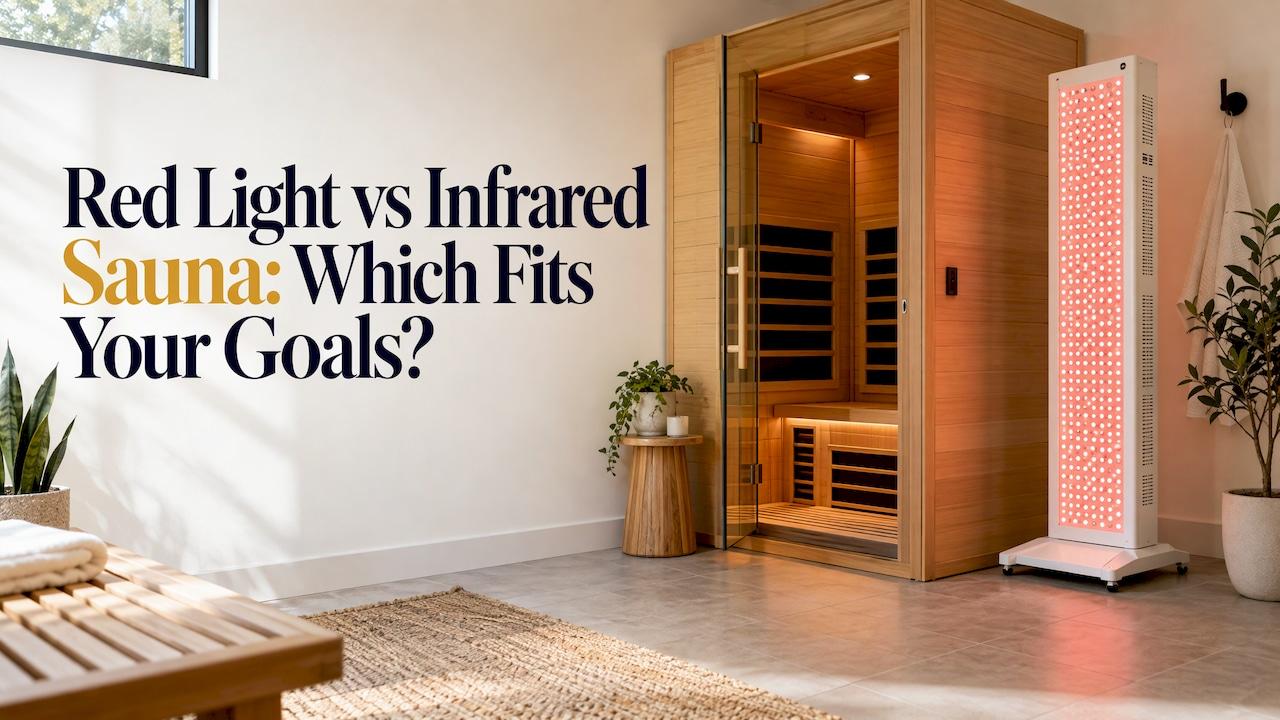
Red light therapy and an infrared sauna both use light, but they do different jobs. Red light therapy delivers specific wavelengths to skin and tissue to prompt a response in your cells. An infrared sauna uses light to make heat, and the heat is what works on your body. One is about light dose. The other is about heat stress. Once you see that, most of the confusion goes away.
Below we compare how each works, what a session feels like, what the research supports, who should check with a clinician first, and whether you can combine them.
TL;DR
- Red light therapy is light, not heat. It targets skin and cellular energy in a specific area, with no sweating.
- An infrared sauna warms your whole body directly, so you sweat and your heart rate rises, much like moderate exercise.
- Red light therapy is the better fit for skin, targeted recovery and cellular wellness goals. A sauna is a heat-and-relaxation habit.
- Both are generally well tolerated by healthy adults. Pregnancy, heart conditions, heat sensitivity, photosensitivity and certain medications are reasons to talk to your clinician first.
- At Vitaluxe, a red light session is $35.
Table of Contents
- The core difference: light versus heat
- Side-by-side comparison
- What a session involves
- What the evidence supports
- Which one fits your goal?
- Red light versus a tanning bed
- Safety: who should check first
- Can you do both?
- How we think about it at Vitaluxe
- Try red light therapy near you
- FAQ
- Sources
The core difference: light versus heat
A 2024 review in JAMA Dermatology describes photobiomodulation, the formal name for red light therapy, as using red light (620 to 700 nm) and near-infrared light (700 to 1440 nm). The light is absorbed by an enzyme in your mitochondria called cytochrome c oxidase. That changes mitochondrial ATP production, reactive oxygen species and calcium levels inside the cell. In plain terms, the light is a signal to the cell. The goal is not to warm you.
An infrared sauna works differently. According to Mayo Clinic, an infrared sauna uses light to create heat and warms your body directly instead of warming the air around you the way a regular sauna does. It brings on vigorous sweating and a higher heart rate, similar to moderate exercise, at lower temperatures than a regular sauna.
So both products carry the word "infrared," but the purpose is opposite. Red light therapy aims to deliver light into tissue without meaningful heat. An infrared sauna aims to raise your body temperature.

Why the labels get mixed up
Many saunas now include red light panels, and many red light studios use the word "infrared." Near-infrared light is part of red light therapy, and infrared heaters are part of a sauna. The wavelengths overlap, but the goal and the dose do not. If a provider sells the two as interchangeable, ask what the session is designed to do: stimulate a specific area, or heat your whole body.
Side-by-side comparison
| Red light therapy | Infrared sauna | |
|---|---|---|
| What does the work | Specific wavelengths of red and near-infrared light | Heat produced by infrared light |
| Main target | Skin, tissue and cellular energy in the treated area | Whole body, through raised body temperature |
| What you feel | Little to no heat | Heavy warmth, sweating, higher heart rate |
| Mechanism | Photon absorption in mitochondria | Thermal stress and dilated blood vessels |
| Aftercare | None specific | Drink water, rest |
| Our price | $35 per session | Not something we offer |
The research is also at different stages. Red light for skin rejuvenation and wound repair has a well-developed body of lab and clinical work behind it. A 2025 review in PMC says red and near-infrared light are well established for photobiomodulation, skin rejuvenation and wound repair, while noting that optimal dosing and long-term safety still need study. Infrared sauna research, according to Mayo Clinic, spans blood pressure, heart failure, dementia, headache, type 2 diabetes and arthritis, and larger, more exact studies are still needed.
What a session involves
Red light therapy
You expose the area you want treated to a panel, with eye protection when the light is bright or close to the face. There is no sweating and no recovery period. Skin goals build over weeks, not minutes. Stanford Medicine notes that for hair growth, red light used consistently over multiple months has been shown to regrow thinning hair, but the effect stops when you stop using it. Our own guides cover what to expect for skin changes over 12 to 16 weeks and for hair growth.
Infrared sauna
You sit in a heated cabin, usually in a towel, and sweat. Research protocols give a sense of the scale. In Waon therapy, a far-infrared dry sauna studied in cardiology, patients stay in a sauna kept at 60°C (140°F) for 15 minutes. Afterward they rest under blankets for 30 minutes and drink water to replace what they lost through sweat. Whatever the cabin, the pattern is the same: heat, sweat, rehydrate, rest.
What the evidence supports
Red light therapy
The strongest ground is skin and tissue repair. The PMC review above reports that red light increases type I collagen expression and reduces MMP-1 levels in skin cells, and that absorption of photons by mitochondria enhances ATP production to support growth, regeneration and repair.
As a Stanford dermatologist explains, red light is not bogus: with selective photothermolysis, specific wavelengths can target tissue and stimulate an effect in it. Longer wavelengths can help stimulate cell growth or collagen-building proteins. The American Council on Exercise also summarizes research in which photobiomodulation improved fine lines, wrinkles, skin texture and elasticity, with results from a mask lasting about a month after use stopped.
Scientific American reports that in 2025 more than 20 specialists joined a major consensus review that found red light therapy safe and effective for several types of conditions. For a fuller look at what we see in the clinic against what studies show, read our guide to red light therapy benefits.
Infrared sauna
The sauna evidence centers on cardiovascular response. Mayo Clinic notes that infrared saunas bring on reactions like moderate exercise, and that no harmful effects have been reported. In the Waon literature, the proposed mechanism involves increased endothelial nitric oxide synthase, and the cardiology paper reports that Waon therapy significantly lowered the rate of death or hospitalization in chronic heart failure patients over 60 months. That is a supervised clinical protocol, so it should not be read as a promise for a general-wellness cabin session.

Which one fits your goal?
- You want skin support, such as fine lines, texture or tone. Red light is the tool designed for this, and results build over weeks of consistent sessions.
- You want to support thinning hair. Red light, used consistently over months, is the one with a track record here.
- You want a targeted recovery option for a sore area. Light can be aimed at a specific spot. Our guide to red light therapy for tendonitis explains the typical timeline.
- You want cellular energy and a no-heat option. Red light works at the mitochondrial level without raising your body temperature.
- You want heat, sweat and a wind-down ritual. That is what a sauna is for. If you are weighing heat against cold for recovery, see our comparison of sauna and cryotherapy.
If your goal is a specific result in a specific area, light is the more precise instrument. If depth of treatment is your question, our piece on red light versus laser therapy covers it.
Red light versus a tanning bed
People also ask about tanning beds, and the answer is simple: they are different devices for different purposes. A tanning bed is built to produce ultraviolet light to darken skin. Red light therapy uses wavelengths in the red and near-infrared range, 620 to 1440 nm in the JAMA Dermatology review, which sit beyond the visible red end of the spectrum and not in the ultraviolet band. Red light therapy is not a tanning service and will not tan you. Skin goals come from cell signaling, not pigment.
Safety: who should check first
Both are generally well tolerated, but the cautions differ, and they belong at the point where you decide.
Red light therapy. The JAMA Dermatology review describes it as generally well tolerated and safe, with redness the most common and self-limiting skin effect. The American Council on Exercise advises caution for people with photosensitive conditions, those taking photosensitizing medications, or when light would fall directly over known areas of cancer. If that sounds like you, ask your prescribing clinician or dermatologist before starting. For a detailed rundown, see this list of red light therapy contraindications.
Protect your eyes with bright panels close to the face. And if you are shopping for a home device, the American Academy of Dermatology notes that FDA clearance means the device is considered low risk, but clearance says nothing about how effective it is.
Infrared sauna. Heat and fluid loss are the issues. Mayo Clinic reports no harmful effects in its review, but if you have a heart or blood pressure condition, are pregnant, or take diuretics or blood pressure medication, ask your own physician before using one. Drink water afterward, since you will sweat heavily.
The infrared lamps themselves matter too. A 2020 JAAD article warns that unrestricted infrared exposure, particularly with heat, can be detrimental, and that the doses needed to raise body temperature can reach levels associated with damage. That is why a controlled, low-heat light dose is a different thing from sitting under high-output infrared heat.
Can you do both?
Yes, for most healthy adults they sit well together, and many people do. They stack rather than overlap: light for the cellular and skin signal, heat for the sweat and relaxation. Be honest with yourself about the evidence, though. The combination itself has not been studied closely, so treat it as a routine you enjoy rather than a proven synergy. The same medical cautions apply to both, and you should check with your physician first if any of them fit you.
How we think about it at Vitaluxe
Clients often come in asking whether they need red light or a sauna, as if one replaces the other. We start with the goal. If it is skin, targeted recovery or cellular energy, light is the tool built for that job, and it asks nothing of your body in terms of heat or sweat.
Our approach is nurse-led and personal. We talk through your goals, your health history and any medications before we recommend anything, then build a plan around what you need. For many of our clients, red light is the simple, consistent habit that fits around a busy schedule, a demanding shift or a semester of exams.
Red light also pairs naturally with the rest of what we do, from hydration and vitamin therapy to ongoing memberships. Start with a single session, see how you feel, and build from there.
Debbie
Try red light therapy near you
We serve clients across Long Island, including Massapequa, Wantagh, Merrick, Bellmore, Rockville Centre, Babylon, Farmingdale and Lindenhurst. A Red Light Therapy session is $35, and nurse-led guidance comes with it. We also offer discounts for first responders and college students.

If you want to pair light with hydration, recovery or cellular support, browse our full list of services, compare our monthly memberships, or see our treatment packages. If you would rather talk it through first, start at Vitaluxe Drip Lounge.
FAQ
Is red light therapy the same as an infrared sauna?
No. Red light therapy delivers specific red and near-infrared wavelengths to tissue to stimulate cells, with little or no heat. An infrared sauna uses light to heat your body directly, so you sweat and your heart rate rises. The wavelengths overlap, but the goal and the experience are different.
Which is better for skin, red light or an infrared sauna?
Red light is the one with research on skin. Reviews report effects on collagen, texture and fine lines, and results build over weeks of consistent sessions. A sauna's research focus is cardiovascular and general wellness, not skin rejuvenation.
Does red light therapy make you sweat or need recovery time?
No. It is not a heat treatment, so there is no sweating and no cool-down. That is a practical difference from a sauna, where Mayo Clinic notes vigorous sweating and an increased heart rate, which is why rehydrating matters afterward.
Who should talk to a doctor before either one?
Anyone who is pregnant, has a heart, blood pressure or heat-sensitive condition, has a light-sensitive skin condition, or takes photosensitizing, diuretic or blood pressure medication should ask their physician first. The same goes for anyone with a known area of skin cancer.
Sources
- Do infrared saunas have any health benefits? Mayo Clinic
- Photobiomodulation CME part I: Overview and mechanism, JAMA Dermatology
- Red light therapy: What the science says, Stanford Medicine
- Waon Therapy for Cardiovascular Disease, Circulation Journal
- Biological and Therapeutic Responses of Human Skin to Light, PMC
- Red Light Therapy: Benefits, Risks and Evidence, American Council on Exercise
- Does red-light therapy work? Scientific American
- Is red light therapy right for your skin? American Academy of Dermatology
- Deja UV all over again: Theoretical risks of the infrared, JAAD
- Red light therapy contraindications