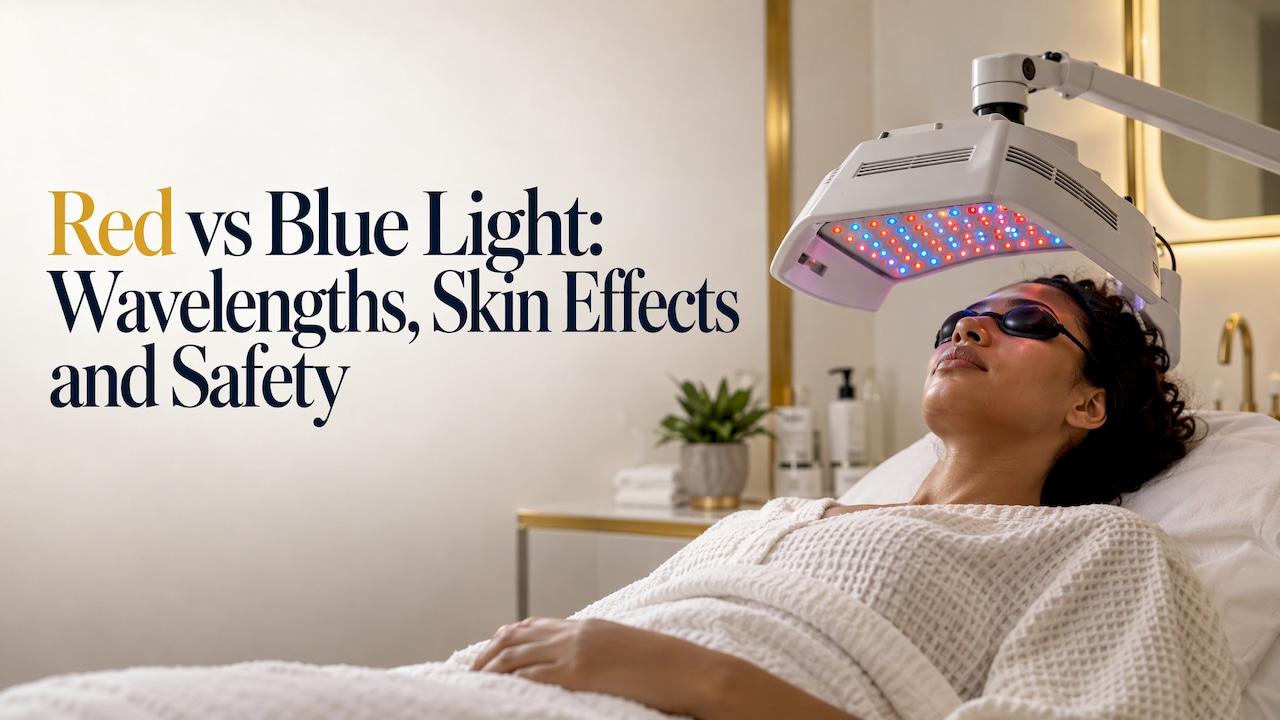
Red and blue light differ in wavelength, and wavelength sets how deep the light travels. Blue light stays near the surface of the skin and is mainly used for acne. Red light reaches deeper and is used for skin renewal, recovery and cellular support. If your goal is broader wellness, skin quality or recovery, red light is the wavelength that works at the depth where those processes happen. At Vitaluxe Drip Lounge, a red light therapy session is $35, delivered in a nurse-led setting.
TL;DR
- Blue light (about 415 nm) works at the skin's surface and targets acne-causing bacteria. Red light (about 600 to 650 nm) penetrates 1 to 2 mm deeper.
- Red light is studied for fine lines, redness, dark spots and loose skin. Blue light is studied mainly for acne.
- Used together, the two wavelengths have shown stronger acne results than blue alone.
- Short-term red light therapy is considered safe, with mild, temporary side effects. Darker skin tones and people with melasma need extra care with visible light.
- Blue light from screens at night is a sleep topic, not a therapy topic.
Table of Contents
- Red vs blue light at a glance
- Wavelength and penetration: why color matters
- What each wavelength is used for
- Can you use red and blue light together?
- Safety: what to know before you start
- Blue light at night is a different topic
- How to choose between red and blue light
- Our perspective
- Try red light at Vitaluxe
- FAQ
- Sources
Red vs blue light at a glance
| Blue light | Red light | |
|---|---|---|
| Typical wavelength | About 415 to 470 nm | About 600 to 700 nm |
| Depth in skin | Surface layers, roughly 0.3 mm | 1 to 2 mm deeper than blue, up to the full thickness of the skin in some reviews |
| Main skin use | Acne bacteria and inflammation | Fine lines, redness, dark spots, healing |
| Feel during treatment | Painless | Painless, mild warmth in some devices |
| Night-time effect on sleep | Strongly alerting | Far less disruptive |
The figures in this table come from the dermatology and academic sources linked in the sections below.
Wavelength and penetration: why color matters
Light is measured in nanometers (nm), the distance between wave peaks. Blue sits at the short end of the visible spectrum, roughly 450 to 495 nm. Red sits at the long end, around 620 to 750 nm. Shorter waves carry more energy per photon but scatter quickly in tissue. Longer waves carry less energy per photon but travel farther.
That difference is what separates the two in practice. A dermatology overview describes blue light therapy for acne at 415 to 545 nm, penetrating roughly 0.3 mm into the skin, with red light at 600 to 650 nm reaching 1 to 2 mm deeper. An academic review of light in medicine puts it in terms of effective depth: wavelengths around 400 to 450 nm reach roughly 50 to 100 micrometers, while red and near-infrared light can reach about 1 to 3 mm. A separate review of visible light and the skin notes that red light between 625 and 700 nm penetrates deeper than blue, reaching the full thickness of the skin in the reviewed discussion.

Why does depth matter? Skin is layered. Blue light acts on what sits in the upper layers, including the bacteria that live in oil glands. Red light reaches the dermis, where collagen-producing cells, small blood vessels and the cellular machinery that responds to light all sit. Red light therapy is also called photobiomodulation: light used to prompt a response in cells. Depth is the whole reason red light is used for renewal and recovery, and why we explain it to clients in terms of where the light lands, not what color it looks like.
We go deeper on the depth question in our piece on red light versus laser therapy.

What each wavelength is used for
Blue light: acne and surface inflammation
Blue light is best known for acne. The bacterium involved in breakouts, Cutibacterium acnes, contains molecules called porphyrins that absorb light strongly near 415 nm. When they do, they produce reactive oxygen species that damage the bacteria. The same dermatology review notes that blue light also has anti-inflammatory effects by modulating cellular inflammatory mediators.
Because blue light does not travel far, its use is mostly limited to surface-level concerns. That is a good fit for acne and a poor fit for anything that lives deeper in the tissue.
Red light: skin renewal, redness and recovery
The American Academy of Dermatology (AAD) describes red light therapy as an option for acne, signs of aging, hair loss and other conditions. It reports that studies suggest red-light LEDs can improve facial fine lines and wrinkles, dark spots, rough-feeling skin, redness and loose skin. It also notes that red light used after laser treatment may reduce discoloration and swelling.
The same AAD page cites a study in which 90 patients received 8 LED red-light treatments to the face over 4 weeks, and more than 90% reported improvement, including softer, smoother skin, less redness and lightening of dark spots.
The dermatology review also describes red light as activating porphyrins with less intensity than blue light, while possibly reducing the inflammatory response and accelerating wound healing. That healing role is why red light is popular for recovery after exertion, and why we see it as a natural companion to the rest of our wellness menu.
If you want to see how red light is applied to specific goals, these pages cover them one at a time:
- Red light therapy for skin and what changes in 12 to 16 weeks
- Red light hair growth over 12 to 26 weeks
- Red light for sleep
- Red light for cellulite
- Before and after photos across 15 to 30 sessions
Can you use red and blue light together?
Yes, and for acne the combination has a track record. A 2006 clinical trial of combined blue (415 nm) and red (633 nm) LED phototherapy gave participants 8 sessions, two per week, alternating blue and red exposures. It reported significant lesion-count reductions at 4 and 12 weeks, with minimal and temporary side effects.
The dermatology overview goes further. It says multiple studies show blue-red therapy is well tolerated and effective, with a reduction in inflammatory and non-inflammatory acne lesions that is superior to blue alone. The suggested reason is that the two wavelengths work at different depths: blue acts on bacteria near the surface, while red calms inflammation and supports healing underneath.
The lesson is that the two colors are not rivals. Blue is a surface tool for a specific problem. Red is the broader tool, and it is the wavelength that contributes at depth in the combination.
Red light is also often paired with other care for recovery. Guidance on non-invasive pain relief and recovery shows how light-based approaches fit alongside other routines. Used consistently, red light works well as one part of a wider plan.

Safety: what to know before you start
The AAD says short-term red light therapy appears safe, and the most common side effects are temporary mild pain or irritated skin. It adds that research has not found that red light causes cancer. A 2026 systematic review of LED photobiomodulation in dermatology reached a similar conclusion: adverse events were predominantly mild and transient, and safety depends on wavelength, dose, exposure and treatment site.
A few practical points keep a session comfortable:
- Eye protection. Use it when your provider instructs. Treatment goggles are standard practice for light therapy.
- Follow device directions. Time, distance and frequency are part of the dose.
- Darker skin tones. The AAD notes that people with darker skin may be more sensitive to visible light and can develop more intense, longer-lasting dark spots. Tell your provider your skin tone and history before treatment.
- Melasma. A 2026 dermatology discussion reports that higher doses of visible light can increase melanin and immediate pigment darkening, and it urges caution or avoidance of visible-light LED therapy in melasma, especially in darker skin phototypes. If you have melasma, see a dermatologist before any light treatment.
- Blue light and pigmentation. A 2025 review states that blue light at roughly 415 to 470 nm has been shown to worsen hyperpigmentation in darker skin phototypes (Fitzpatrick IV to VI). This is one more reason to have a clinician review your skin before you choose a wavelength.
If you take photosensitizing medication or have a skin condition you are treating, ask your doctor or dermatologist before starting light therapy. That conversation matters more than any device setting.
Blue light at night is a different topic
Part of the search interest in this keyword comes from a different question: why do people say to avoid blue light in the evening? That is about sleep, not skin.
Research on non-image-forming light pathways shows that light in the evening and at night can delay circadian phase and suppress melatonin, and that these effects are sensitive to blue wavelengths. A review of circadian interventions adds that blue-green light is especially impactful on the circadian system and that badly timed bright light can worsen difficulty falling asleep.
So the two uses of blue light do not conflict. A short, supervised blue-light treatment for the skin is one thing. Hours of phone and laptop glare before bed is another. The practical takeaway is to dim screens and bright overhead lights in the hour or two before sleep, and keep any light therapy to daytime or early-evening sessions unless your provider says otherwise.
How to choose between red and blue light
Start with the goal, then match the wavelength.
- Active breakouts that are mostly surface-level. Blue light is the wavelength studied for this, and blue-red combinations have shown stronger results than blue alone. Persistent or cystic acne belongs with a dermatologist.
- Fine lines, redness, uneven tone, dull or loose-feeling skin. Red light is the wavelength with the evidence here, because it reaches the layers where skin structure is maintained.
- Recovery after workouts or a demanding stretch. Red light, because the target is below the surface and the aim is cellular support.
- Hair, scalp and body concerns. Red light, again because depth is the point.
- Pigmentation concerns or darker skin. Get a clinician's guidance first, as described in the safety section.
For most people reading about wellness, aging and recovery, goals two to four describe what they want. That is why red light is the wavelength we offer.
Consistency matters more than the color of any single session. The studies above used repeated sessions over weeks: the 8-treatment facial study ran over 4 weeks, and the combination acne trial used two sessions a week. Plan for a series, not a one-off, and judge results over weeks.
Our perspective
We get asked this a lot, usually by someone who has seen a mask with a dozen glowing colors online. Here is how we think about it.
Color is a depth decision. Blue stays near the surface. Red travels deeper, into the layers where skin renews itself and where recovery happens. When clients come in tired, run down, training hard or heading into a stressful season, the goal is rarely a surface problem. It is cellular energy, repair and how they look and feel over time. That is red light territory.
It is also why we pair it with the rest of what we do. Red light therapy is $35 a session, and many clients add IV therapy, NAD+ or vitamin injections when they want hydration and nutrient support alongside it. Everything is nurse-led, in a boutique setting that is clinical where it needs to be and relaxed where it can be.
Our advice is simple: pick the light for the depth you need, treat it as a series, and tell your provider about your skin history up front. We would rather spend ten minutes on that conversation than skip it.
Debbie
Try red light at Vitaluxe
Red light therapy at Vitaluxe is $35 per session, and our team is nurse-led. If you want it as part of a regular routine, we also offer monthly memberships: Essential at $205 per month and Elite at $415 per month. You can see everything on our services page, compare membership options, or look at our packages. We also offer discounts for first responders and college students.

We serve clients across Long Island's South Shore, including Massapequa, Wantagh, Merrick, Rockville Centre, Babylon and Lindenhurst. Book from the services page and tell us your goals when you arrive.
FAQ
Is red or blue light better for you?
Neither is better across the board, because they do different jobs. Blue light is studied for surface-level acne, while red light reaches deeper and is studied for fine lines, redness, dark spots and healing. For general skin quality, recovery and wellness goals, red light is the one with the broader evidence.
What are the side effects of red light therapy?
The AAD says short-term red light therapy appears safe, with temporary mild pain or irritated skin the most common side effects. People with darker skin may be more sensitive to visible light and can develop longer-lasting dark spots. Use eye protection when instructed, and see a dermatologist first if you have melasma.
Why avoid blue light at night?
Blue wavelengths in the evening can delay your body clock and suppress melatonin, which can make it harder to fall asleep. This is about exposure from screens and bright lighting at night. It is separate from a short, daytime light treatment for the skin.
What color light is most healing?
Red light is the color associated with healing and skin repair, because it penetrates 1 to 2 mm deeper than blue and may reduce inflammation and speed wound healing. The dermatology literature describes these effects for red light, and the AAD notes red light after laser treatment may reduce discoloration and swelling.
Can you use red and blue light together?
Yes. A clinical trial that alternated blue (415 nm) and red (633 nm) sessions reported significant acne lesion reductions at 4 and 12 weeks. A dermatology overview describes the combination as superior to blue alone for acne, likely because the two wavelengths act at different depths.
Sources
- DermNet: Lasers, lights and acne
- Light in diagnosis, therapy and surgery
- Visible Light Part I: Properties and Cutaneous Effects
- American Academy of Dermatology: Is red light therapy right for your skin?
- Combination blue (415 nm) and red (633 nm) LED phototherapy for acne vulgaris
- LED photobiomodulation, Our Dermatology Online
- Light as a Modulator of Non-Image-Forming Brain Functions
- Circadian Interventions as Adjunctive Therapies
- Non-invasive therapy: safe pain relief and recovery guide